If you work as a mobile accountant or bookkeeper in Australia, your car is practically a second office. Driving between client sites, visiting business premises for audits, and heading to training events all rack up serious kilometres — and serious costs. The good news is that the ATO lets you claim a deduction for work-related car expenses, provided you follow the rules and keep proper records.
This guide covers everything accountants and bookkeepers need to know about claiming car expense deductions on their tax return.
What car travel qualifies as a deduction?
The ATO allows deductions for car expenses when you use your own vehicle for work-related purposes. For accountants and bookkeepers, qualifying travel typically includes:
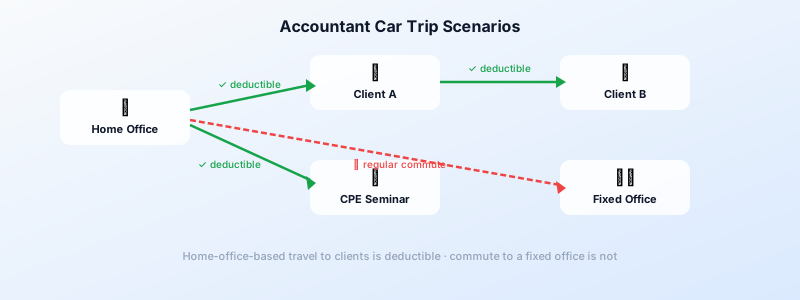
- Client visits — driving from your office (or home office) to a client’s premises
- Travelling between client sites — moving from one appointment to the next during the day
- Attending CPE and professional development — courses, seminars, and conferences required for your registration
- Visiting the ATO or other government offices on behalf of a client
- Collecting or delivering documents — picking up source documents, dropping off financial statements
- Travelling to your tax agent’s office — for your own professional obligations
What you cannot claim
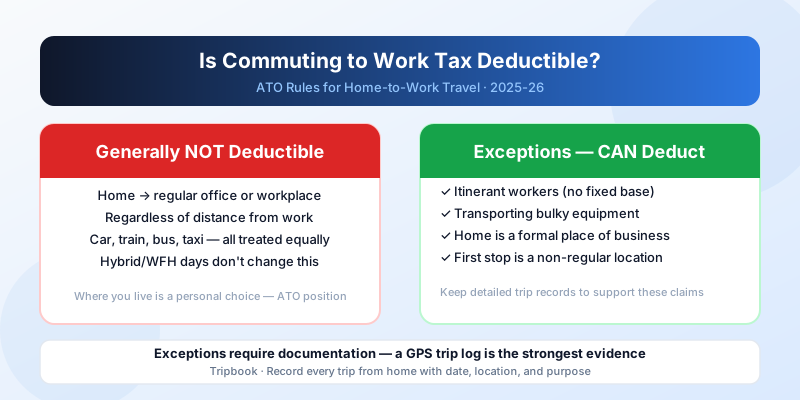
Your regular commute from home to a permanent office is not deductible. If you work from a fixed office every day, the drive there and back is considered private travel. However, if your home is your principal place of business (common for many mobile bookkeepers), then trips from home to client sites are generally deductible.
Choosing between claiming methods
You have two ATO-approved methods for calculating your car expense deduction.
Cents per kilometre method
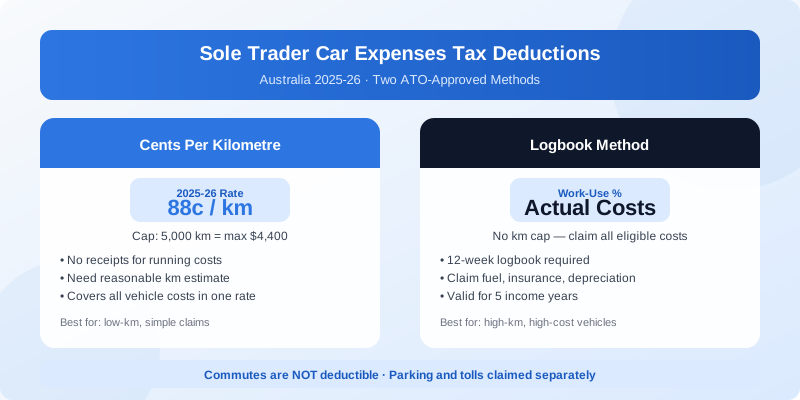
Under this method, you claim a flat rate of 88 cents per kilometre (2025–26 rate) for each business kilometre driven, up to a maximum of 5,000 km per car per year. That gives you a maximum deduction of $4,400.
This method works well if you have a modest amount of client travel — say, a few visits per week — and you want a simple calculation without keeping fuel receipts.
You still need to show how you calculated the total kilometres. A diary or digital log of your trips throughout the year is essential.
Logbook method
If you drive more than 5,000 business kilometres per year (which many mobile accountants and bookkeepers do), the logbook method will almost certainly produce a larger deduction. You keep a 12-week logbook to establish your business-use percentage, then apply that percentage to your total car running costs for the year.
Claimable running costs include:
- Fuel and oil
- Registration and insurance
- Servicing and repairs
- Tyre replacement
- Depreciation (decline in value)
- Interest on a car loan (for the business-use portion)
- RACV/NRMA membership (roadside assist)
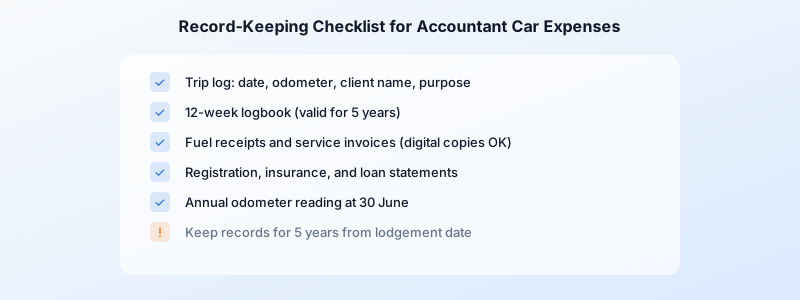
A valid logbook lasts for five years, so the initial effort pays off many times over. For details on keeping a compliant logbook, see our ATO logbook requirements guide.
Practical record-keeping tips for accountants
As financial professionals, you already understand the importance of documentation. Apply that same rigour to your own car expenses:
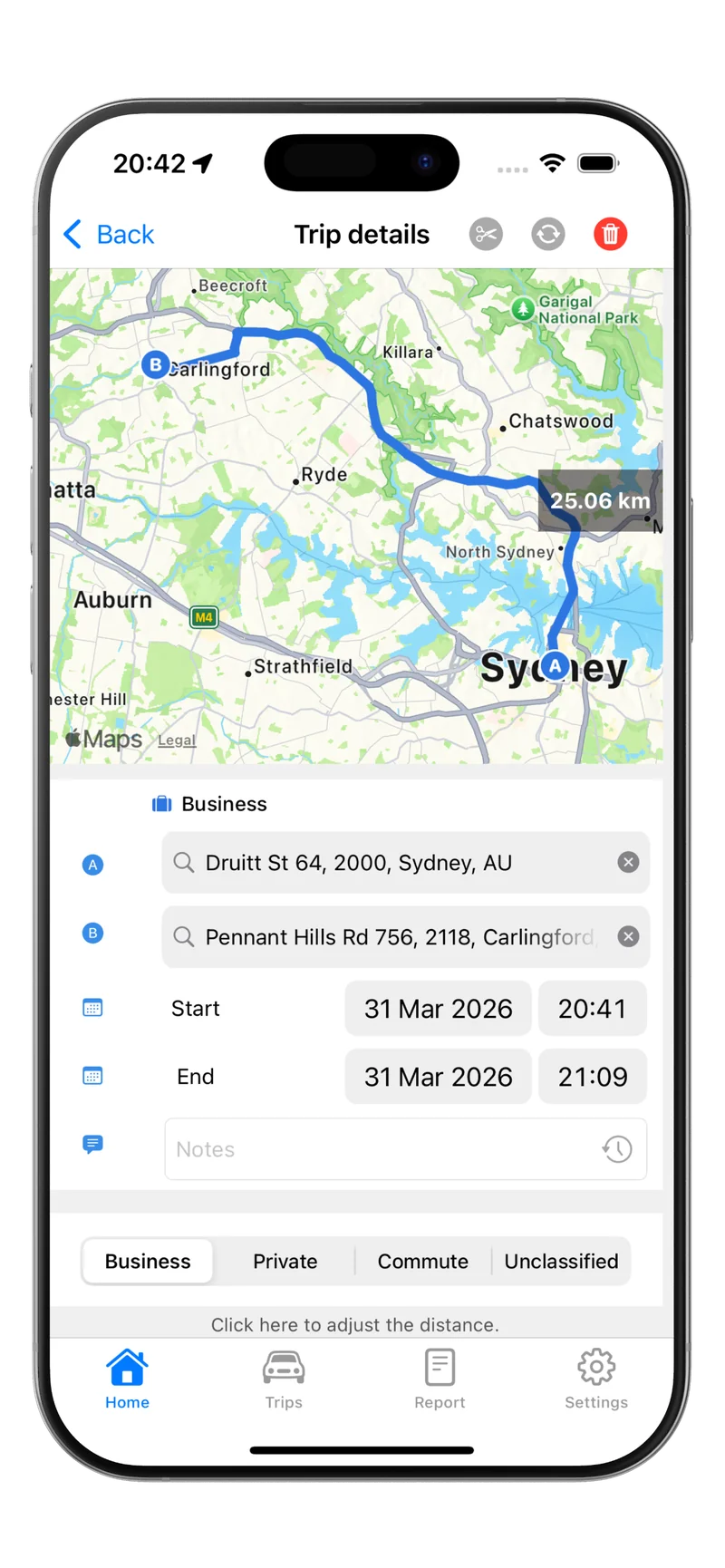
- Log every business trip — record the date, start and end odometer readings, destination, and purpose. A mileage-tracking app makes this effortless.
- Keep fuel and maintenance receipts — store digital copies so they do not fade or get lost.
- Separate business and private use clearly — if you use one car for both purposes, your logbook must accurately reflect the split.
- Review your logbook annually — if your driving pattern changes significantly (for example, you gain or lose a major client), start a new 12-week logbook to update your percentage.
Home office as your base of operations
Many bookkeepers operate from a dedicated home office. If your home qualifies as your principal place of business — meaning you have a room set aside exclusively for work, you regularly meet clients elsewhere, and your employer (or your own business structure) does not provide an alternative office — then trips between home and client sites are work-related.
This is a significant advantage. Instead of your first and last trips of the day being classified as a non-deductible commute, they become part of your business travel.
Make sure you can substantiate your home-office setup if the ATO asks. Keep evidence such as a floor plan, photos of your workspace, and records of your business operations from that address.
Sole traders vs employees
If you are a sole trader bookkeeper or accountant, you claim car expenses in your business tax return as a business deduction. You can choose either the cents per km or logbook method. For more information on sole trader deductions, check our guide on sole trader car expenses.
If you are an employee of an accounting firm, you claim work-related car expenses in your individual tax return at Item D1 (work-related car expenses). The same two methods apply, but you can only claim the portion that your employer does not reimburse.
If your employer pays you a car allowance, you must still declare it as income and then claim your actual deduction separately. An allowance does not automatically cover you — you need records to support whatever you claim. Learn more about how car allowances work in Australia.
Common mistakes to avoid
- Claiming your regular commute — driving from home to a fixed office is not deductible, even if you carry work materials.
- Double-dipping on reimbursed travel — if your employer reimburses you for a trip, you cannot also claim a deduction for it.
- Exceeding the 5,000 km cap on cents per km — the ATO will disallow anything above the limit.
- Using an outdated logbook — if your work pattern has changed materially since you last kept a logbook, the ATO may reject your percentage.
- Not keeping a record of trip purposes — vague entries like “client visit” without a name or address may not withstand an audit.
Track your kilometres with Tripbook
Manually logging every client visit gets tedious — especially when you are juggling multiple appointments in a day. Tripbook automatically tracks your business kilometres in the background, categorises trips, and generates ATO-compliant reports at tax time. It is the simplest way for accountants and bookkeepers to ensure every deductible kilometre is captured without the paperwork.