If you are self-employed, sole trader car expenses can be one of the most valuable deductions on your tax return. The ATO allows you to claim the business portion of running costs — but the method you choose and the records you keep determine how much you get back.
Here is a clear breakdown of how it all works for sole traders operating under an ABN.
How the ATO treats car expenses for sole traders
As a sole trader, you and your business are the same legal entity. Any car you use for both business and private purposes must have its costs split accordingly — only the business-use portion is deductible.
If you use a vehicle exclusively for business (and that is genuinely the case), you can claim 100% of running costs. In practice, most sole traders have some private use, which means you need a method to establish the business-use percentage.
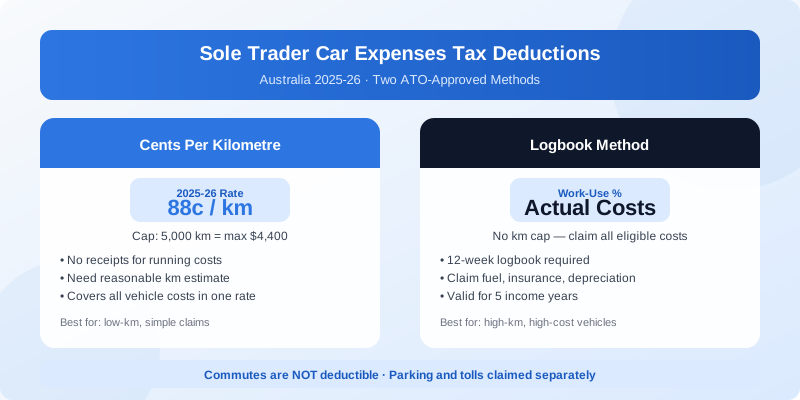
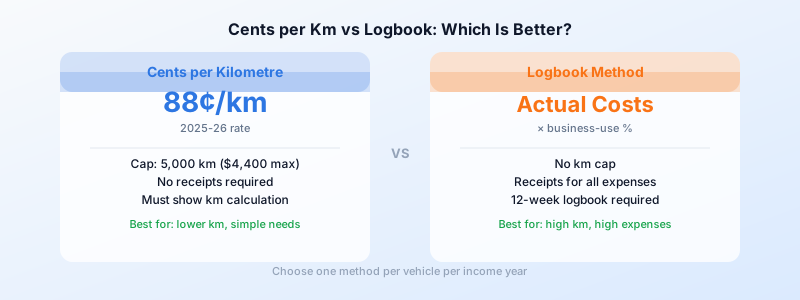
The ATO provides two approved methods: the cents per kilometre method and the logbook method. You choose one per vehicle per income year.
Cents per kilometre: the simple method
The cents per kilometre method is the easiest option for sole traders with moderate business travel.
You claim 88 cents per business kilometre driven during the income year (2025-26 rate). The maximum you can claim under this method is 5,000 kilometres, giving a maximum deduction of $4,400.
You do not need to keep receipts for fuel or servicing. However, you must be able to show how you calculated the kilometres — a contemporaneous record is far stronger than a year-end estimate.
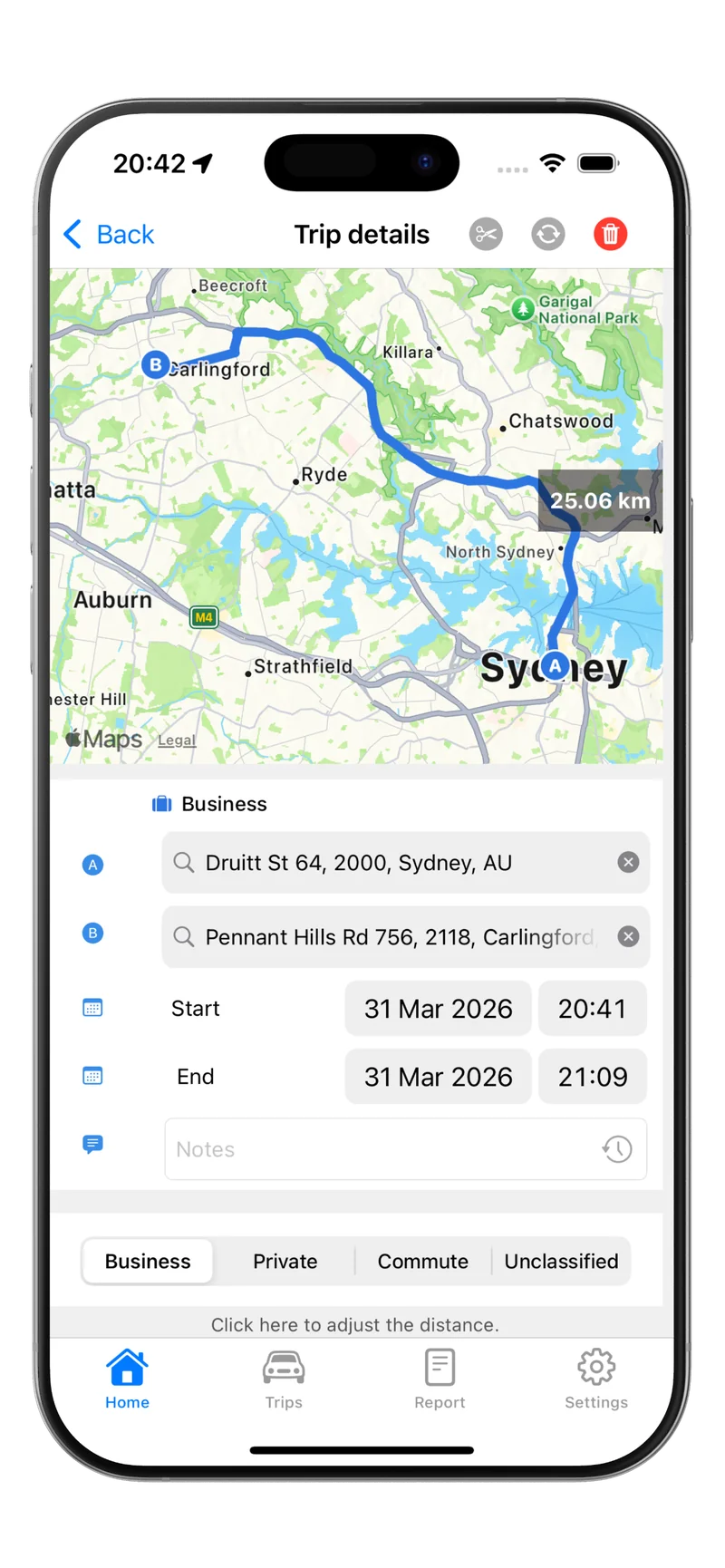
Tripbook automatically logs each trip so you always have a dated, GPS-verified record ready at tax time, rather than trying to reconstruct your driving from memory.
Logbook method: claiming actual expenses
If you drive more than 5,000 kilometres for business or have high running costs, the logbook method is likely to produce a significantly larger deduction.
You complete a 12-week continuous logbook (see our ATO logbook requirements guide) to establish your business-use percentage. That percentage is then applied to your actual expenses for the year: fuel, oil, registration, insurance, servicing, repairs, and depreciation.
Example: Your total car expenses for the year are $16,000. Your logbook shows 68% business use. Your deduction is $10,880.
A logbook is valid for five years if your business-use pattern does not change significantly. That means doing the 12-week period once and then updating your odometer readings each 1 July and 30 June.
GST on car expenses for sole traders
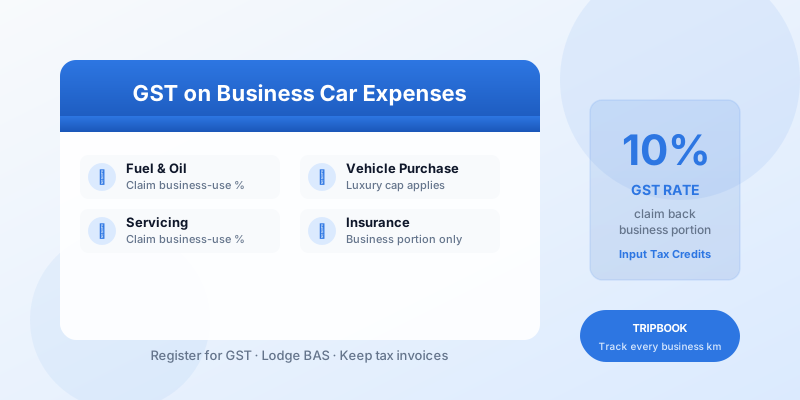
If you are registered for GST, you can claim input tax credits (GST credits) on car expenses used for your business.
The credit is 1/11th of the GST-inclusive cost of each eligible expense. So a $110 fuel receipt gives you a $10 GST credit on your BAS. This is in addition to the income tax deduction — a genuine double benefit.
There is one important limit: the GST credit on a car purchase is capped at 1/11th of the luxury car tax threshold ($80,567 in 2025-26). If you buy a vehicle above that value, the GST credit is limited even if you use the car 100% for business.
If you use the logbook method, your GST credits are also adjusted by the business-use percentage.
What records you must keep
Cents per kilometre: A trip log recording the date, distance, and purpose of each business journey. The ATO does not require receipts under this method.
Logbook method: A completed 12-week logbook, receipts for every car expense during the year, odometer readings at 1 July and 30 June, and evidence of the purchase cost (for depreciation calculations).
Keep all records for at least five years after you lodge the relevant tax return. If the ATO selects your return for review, you will need to produce the original documents.
For a full walkthrough of what your logbook needs to contain, see our kilometre tracking guide.
Tax return: where to claim
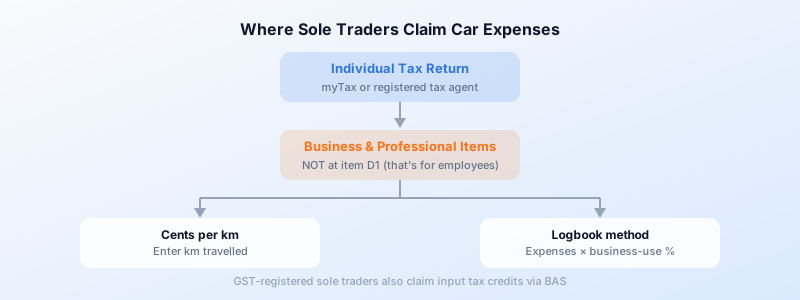
Sole trader car expenses are claimed in the business and professional items section of your individual tax return, not at item D1 (which is for employees).
Cents per kilometre: Enter the number of business kilometres and the ATO calculates the deduction automatically.
Logbook method: Enter the total car expenses for the year and the business-use percentage. Depreciation is entered separately.
If you operate through a partnership, the car expenses are claimed in the partnership return and flow through as your share.
Getting your sole trader car expenses right is worth the effort. The logbook method in particular can unlock a substantial deduction that the simpler cents per kilometre approach cannot match. Start a logbook now and use the full five-year validity to reduce your record-keeping workload in future years.