Logbook vs cents per km — this is the most important decision you make when claiming car expenses on your Australian tax return. The ATO offers two methods, and choosing the wrong one could cost you thousands in missed deductions. For the 2025–26 financial year, understanding how each method works and when it pays off is essential.
The short answer: if you drive fewer than 5,000 business kilometres per year, cents per km is simpler and often sufficient. If you drive more, or have high vehicle running costs, the logbook method almost always delivers a larger claim.
How the cents per kilometre method works
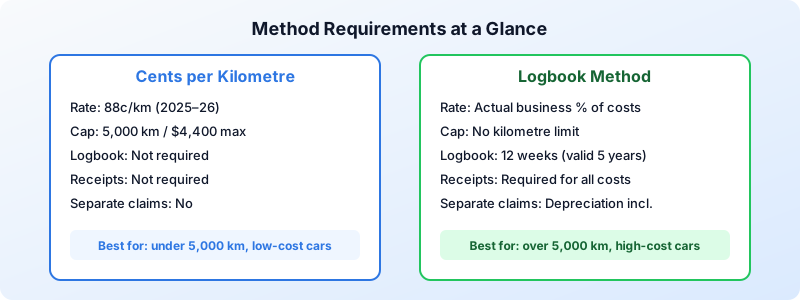
The cents per km method lets you claim a flat rate for every business kilometre you drive, without needing a logbook or receipts for running costs.
2025–26 rate: 88 cents per kilometre
Key rules:
- Maximum of 5,000 business kilometres per year
- Maximum deduction: $4,400 (5,000 × $0.88)
- The rate covers all car expenses — fuel, insurance, registration, depreciation, servicing
- You cannot claim any additional car expenses on top of this rate
- No written logbook is required, but you must be able to show the ATO how you calculated your business kilometres
This method suits employees and sole traders who do moderate business driving and prefer simplicity over maximum deductions.
How the logbook method works
The logbook method lets you claim the actual business-use percentage of your total car expenses. There is no kilometre cap — if you drive 30,000 business km, you claim for all of them.
Requirements:
- Keep a logbook for a continuous 12-week period
- Record every trip: date, odometer start and end, purpose, kilometres driven
- The logbook establishes your business-use percentage (e.g., 65% business, 35% personal)
- That percentage applies to all car expenses for the year
- The logbook is valid for five years, unless your travel patterns change significantly
Claimable expenses under the logbook method:
- Fuel and oil
- Registration
- Insurance
- Servicing and repairs
- Tyres
- Depreciation (up to the car cost limit of $69,674)
- Interest on a car loan
- Lease payments
Side-by-side comparison: real examples
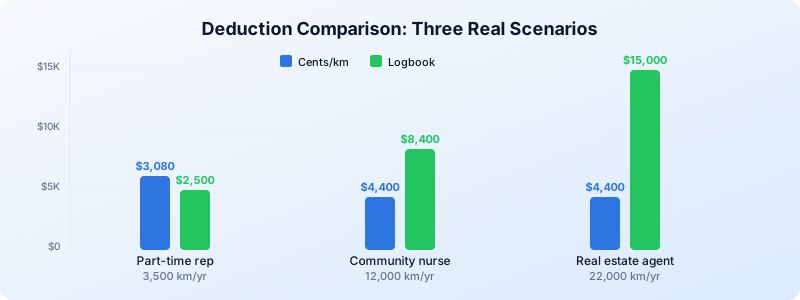
Example 1: Part-time sales rep — 3,500 business km/year
| Cents per KM | Logbook | |
|---|---|---|
| Business km | 3,500 | 3,500 |
| Total car costs | — | $10,000 |
| Business use % | — | 25% |
| Deduction | $3,080 | $2,500 |
Result: Cents per km wins. The flat rate of 88c/km is generous enough to beat the logbook method when business use is low and total kilometres are under 5,000.
Example 2: Community nurse — 12,000 business km/year
| Cents per KM | Logbook | |
|---|---|---|
| Business km | 12,000 (capped at 5,000) | 12,000 |
| Total car costs | — | $14,000 |
| Business use % | — | 60% |
| Deduction | $4,400 | $8,400 |
Result: Logbook wins by $4,000. The cents-per-km cap at 5,000 km leaves 7,000 business km unclaimed.
Example 3: Real estate agent — 22,000 business km/year
| Cents per KM | Logbook | |
|---|---|---|
| Business km | 22,000 (capped at 5,000) | 22,000 |
| Total car costs | — | $20,000 |
| Business use % | — | 75% |
| Deduction | $4,400 | $15,000 |
Result: Logbook wins by $10,600. For high-mileage professionals, the difference is substantial.
When cents per km makes more sense
Choose the cents per km method if:
- You drive fewer than 5,000 business km per year
- Your car is older with low running costs (the 88c rate may exceed your actual costs per km)
- You do not want to keep a logbook or collect receipts
- Your business use is under 30% and total expenses are modest
- You need simplicity and a quick claim at tax time
The method is popular with employees who occasionally use their car for work — visiting a second office, attending a meeting, or picking up supplies.
When the logbook method makes more sense
Choose the logbook method if:
- You drive more than 5,000 business km per year
- You have a newer or more expensive vehicle with higher running costs
- Your business-use percentage is above 50%
- You are a sole trader, tradie, or agent with heavy daily driving
- You want to maximise your deduction and are willing to keep records
For sole traders, the logbook method also allows you to claim GST credits on the business portion of your car expenses — a benefit not available under the cents-per-km method. For more on this, see GST Car Expenses Business.
How to keep a valid ATO logbook
Your logbook must cover a continuous 12-week period and include:
- Date of each trip
- Odometer reading at the start and end of the trip
- Kilometres driven
- Purpose of the trip (e.g., “Client meeting at 42 Smith St, Parramatta”)
- Whether the trip was business or personal
At the end of the 12-week period, calculate your business-use percentage:
Business km ÷ Total km × 100 = Business-use %
This percentage applies to your total car expenses for the entire financial year. You need odometer readings at the start (1 July) and end (30 June) of each year, plus receipts for all expenses.
For detailed instructions, see ATO Logbook Requirements.
Can you switch methods between years?
Yes. You can use the cents per km method one year and the logbook method the next. You are not locked in. However, you cannot use both methods for the same car in the same financial year.
If your travel patterns change — for example, you start a new role with more driving — switching to the logbook method mid-career can unlock significantly higher deductions.
Automate your logbook with Tripbook
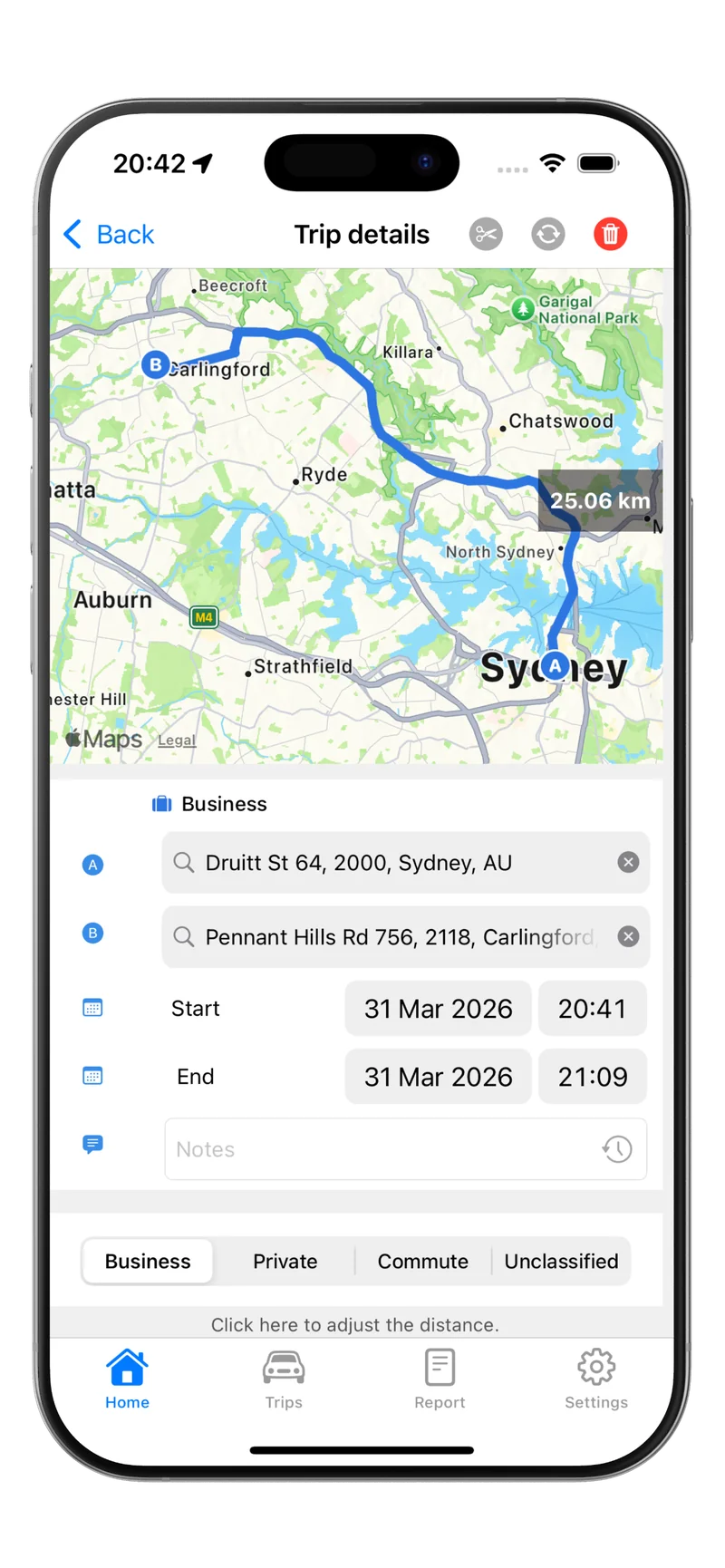
Keeping a manual logbook for 12 weeks is tedious. Missing a single trip can invalidate your records. Tripbook automates the entire process — GPS tracking captures every trip with the date, route, distance, and time. Classify trips as business or personal with a swipe, and your business-use percentage is calculated automatically.
At tax time, export an ATO-compliant report in PDF, CSV, or XLS format. No manual odometer readings, no paper logbooks, no missed trips.
Download Tripbook and start your 12-week logbook period today — your future deduction depends on it.