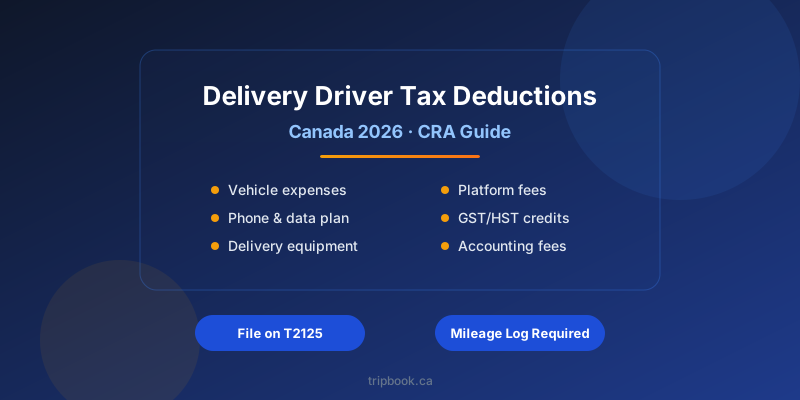
Delivery driver tax deductions Canada can turn a modest gig income into a much healthier bottom line. If you deliver for DoorDash, Uber Eats, Skip the Dishes, or Instacart, the CRA lets you deduct vehicle costs, phone expenses, equipment, and more from your taxable income on Form T2125. Knowing what qualifies — and keeping the records to prove it — can save you thousands every tax season.
Self-Employment Status and the T2125
Every major delivery platform in Canada classifies drivers as independent contractors. You will not receive a T4 from DoorDash, Uber Eats, Skip the Dishes, or Instacart. Instead, you report gross earnings on Form T2125 (Statement of Business or Professional Activities) attached to your T1 personal return.
Your net self-employment income is subject to both federal and provincial income tax plus both the employee and employer portions of CPP — roughly 11.9 percent combined on net income above $3,500 up to the annual maximum. That double CPP hit makes deductions even more valuable: every dollar you deduct reduces both your income tax and your CPP bill.
Under Bill C-47, gig platforms operating in Canada must now report driver income directly to the CRA for the 2026 tax year onward. The CRA will see exactly what each platform paid you, so accurate reporting is essential.
Vehicle Expenses — Your Largest Deduction
For most delivery drivers, vehicle costs dwarf every other deduction. You can choose between two CRA-approved methods each year.
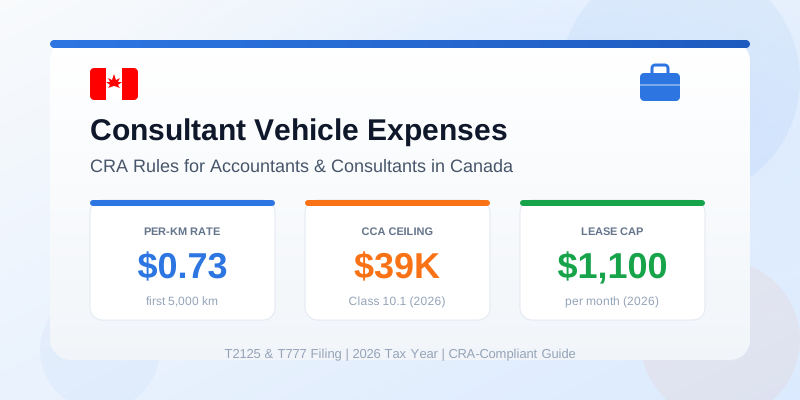
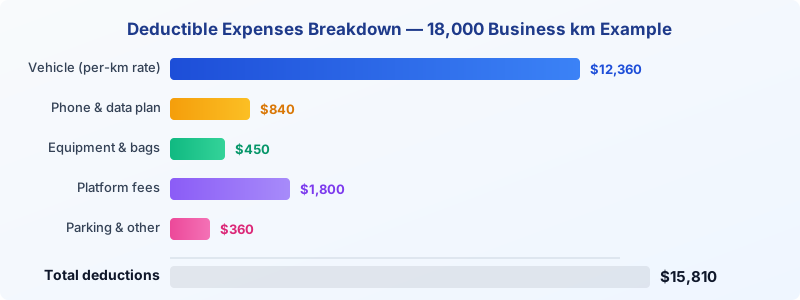
Simplified per-kilometre method. Multiply your business kilometres by the 2026 CRA mileage rate: $0.73/km for the first 5,000 km and $0.67/km for each additional kilometre. If you logged 18,000 business km, the calculation is (5,000 × $0.73) + (13,000 × $0.67) = $12,360.
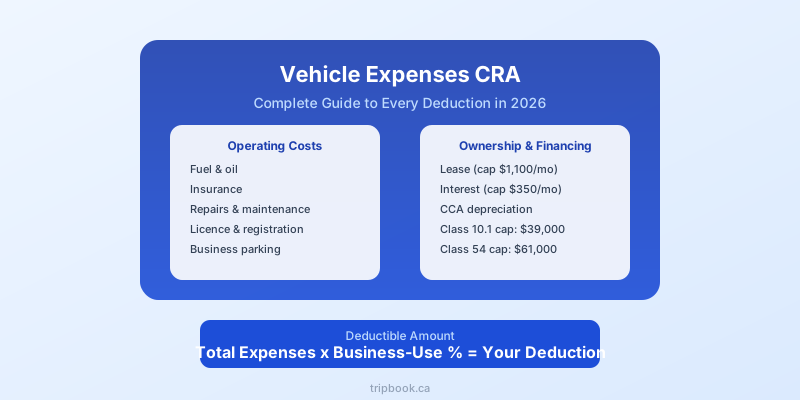
Actual-expense method. Total every vehicle cost for the year — fuel, insurance, maintenance, registration, lease payments (capped at $1,100/month), loan interest (capped at $350/month), and Capital Cost Allowance — then multiply by your business-use percentage. If total costs were $15,000 and you drove 75 percent for deliveries, the deduction is $11,250.
Compare both methods before filing and use whichever produces the higher deduction. Drivers who put heavy kilometres on their vehicles and have moderate total costs often benefit more from the per-km rate, while drivers with expensive leases or high repair bills tend to come out ahead with actual expenses.
Note the 2026 CCA ceiling for Class 10.1 passenger vehicles is $39,000 before tax. If you purchased a vehicle primarily for delivery work, this limit determines how much of the purchase price you can depreciate. For vehicles bought before 2026, the previous $38,000 ceiling applies.
For full details on the 2026 rates and limits, see CRA mileage rate 2026.
Phone, Equipment, and Other Deductions
Vehicle costs are the headline, but secondary deductions add up fast.
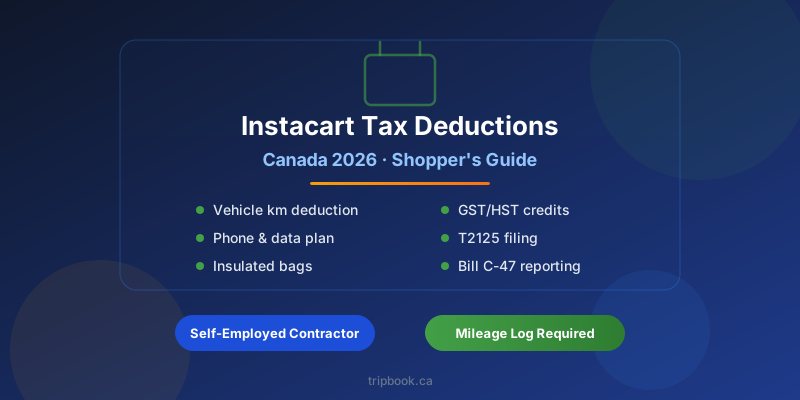
Phone and data plan. Your smartphone is required for accepting orders, navigating, and communicating with customers. Deduct the business-use portion of your monthly plan. If 70 percent of your usage is for deliveries, claim 70 percent of the bill. Keep monthly statements to support the split.
Delivery equipment. Insulated bags, phone mounts, car chargers, hot/cold carriers, and safety gear purchased for work are fully deductible. Items under $500 can be expensed in the year you buy them; items over $500 are claimed through CCA over several years.
Parking. Metered parking and lot fees paid during active deliveries are deductible. Commuting parking is not.
Platform fees. DoorDash, Uber Eats, and other platforms deduct service fees or commissions from your earnings. These are deductible on Line 8810 of your T2125 as management and administration fees.
Professional and bank fees. Tax preparation costs, accounting software, and monthly fees on a dedicated business bank account are all eligible deductions.
GST/HST Registration and Input Tax Credits
The CRA requires GST/HST registration once your gross business revenue exceeds $30,000 over four consecutive calendar quarters or in a single quarter. Full-time drivers working multiple platforms can cross this threshold quickly — the CRA counts your total self-employed revenue across all platforms, not each one separately.
Once you exceed $30,000, you have 29 days to register. After registration you charge GST/HST on your services and can claim Input Tax Credits (ITCs) on business expenses like fuel, phone, and equipment. Even below the threshold, voluntary registration lets you recover GST/HST paid on purchases through ITCs.
One important distinction: if you also do ride-sharing (transporting passengers), GST/HST registration is mandatory from day one regardless of income. Delivery-only work follows the $30,000 rule. However, if you combine delivery and ride-sharing and your total revenue exceeds $30,000, the CRA extends mandatory registration to cover all your self-employed activities — even if delivery income alone stayed below the threshold.
For a deeper look at ITCs on vehicle costs, read GST/HST input tax credit on vehicles.
Quarterly Installments and Filing Deadlines
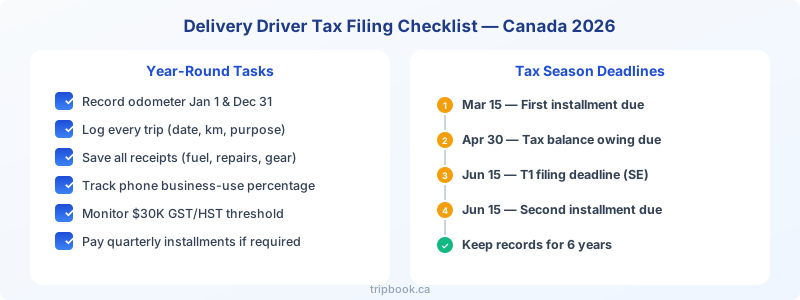
Self-employed delivery drivers file their T1 return by June 15, but any balance owing must be paid by April 30 to avoid interest charges. If you owed more than $3,000 in net tax last year (or in either of the two preceding years), the CRA expects quarterly installment payments on March 15, June 15, September 15, and December 15.
Missing installments triggers interest calculated daily at the CRA’s prescribed rate, and penalties can apply if the shortfall is large enough. The penalty is the greater of a flat $1,000 or 25 percent of the installment interest you would have owed had you made no payments at all. Setting aside 25 to 30 percent of each payout into a separate savings account is one of the simplest ways to stay ahead.
Mileage Log Requirements
None of these vehicle deductions matter without a proper mileage log. The CRA requires a logbook that records four things for every business trip:
- Date of the trip
- Destination — pickup and drop-off area
- Business purpose — for example, “delivery for DoorDash”
- Kilometres driven — odometer start and end
You also need your total annual odometer readings on January 1 and December 31 to calculate your business-use percentage. Without this logbook, the CRA can deny your entire vehicle deduction in an audit.
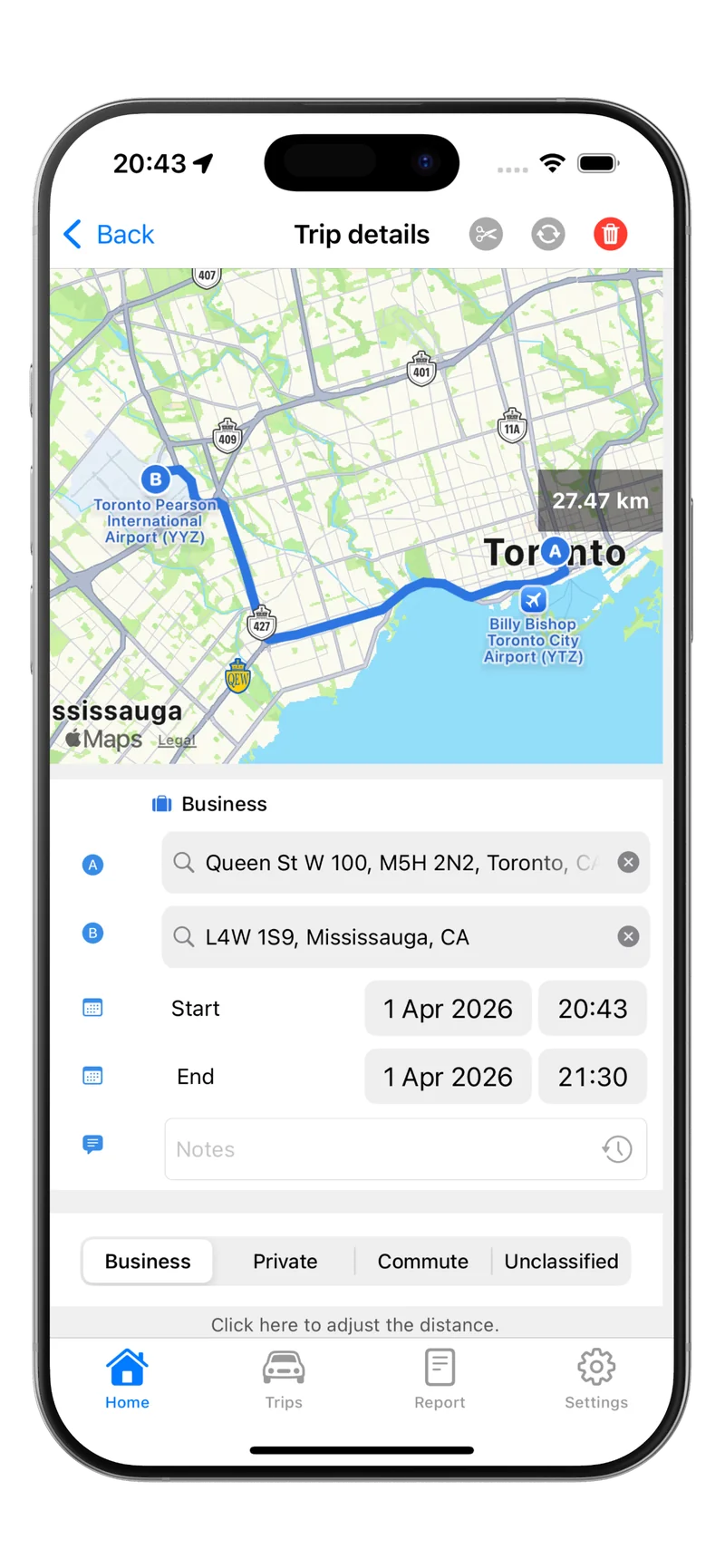
For delivery drivers completing dozens of trips per day, manual logging at every stop is impractical. Tripbook records every trip automatically using GPS, capturing the date, route, and distance without any manual entry. That automation is especially valuable when you are juggling orders across multiple platforms in a single shift.
For the full list of CRA logbook rules, see CRA mileage log requirements.
Maximize Your Delivery Driver Tax Deductions Canada
Delivery driver tax deductions Canada cover far more than fuel. Between vehicle costs, phone bills, equipment, platform fees, and GST/HST credits, a well-documented return can reduce your taxable income by thousands. The key is keeping organized records throughout the year — not scrambling at tax time.
Start with your mileage log, the foundation of your largest deduction. Download Tripbook to automate your tracking and keep a CRA-ready logbook without the manual effort. Your delivery driver tax deductions Canada are waiting — you just need the proof to claim them.