When your employees need to drive for work, you have two main options: provide a company car or reimburse them for using their personal vehicle. Both approaches get the job done, but the financial impact, administrative workload, tax implications, and liability exposure are very different.
This guide compares the two options head-to-head so you can make the right call for your business.
The Cost Breakdown
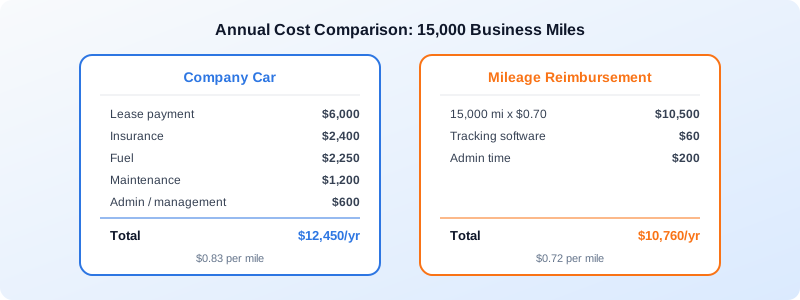
Cost is usually the deciding factor. Let’s look at what each option actually costs for a single employee driving 15,000 business miles per year.
Company Car Costs
When you provide a company vehicle, you’re taking on multiple ongoing expenses. A mid-range sedan lease runs around $500/month ($6,000/year). Commercial auto insurance typically costs $150-250/month. Fuel for 15,000 miles at current prices averages around $2,250/year. Maintenance, oil changes, tires, and repairs add roughly $1,200. On top of that, there’s the administrative time to manage the vehicle — scheduling service, handling registrations, and dealing with accidents.
All told, a single company car costs roughly $12,000-$14,000 per year to operate.
Mileage Reimbursement Costs
With mileage reimbursement at the 2026 IRS standard rate of 70 cents per mile, the same 15,000 miles cost $10,500 in reimbursement payments. Add a mileage tracking tool and minimal admin time, and the total comes to around $10,700-$11,000 per year.
That’s a savings of roughly $1,500-$3,000 per employee, per year. For a team of 10 drivers, the difference adds up to $15,000-$30,000 annually.
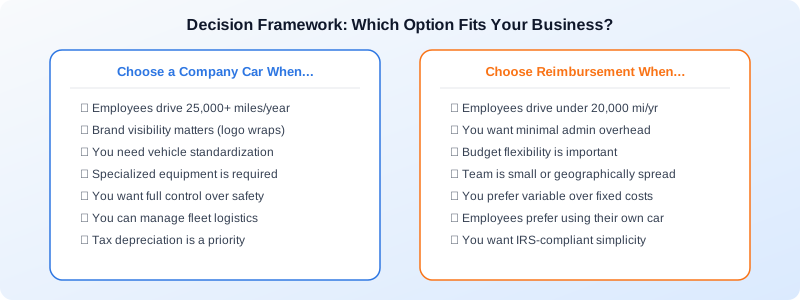
Company cars tend to become more cost-competitive when an employee drives over 25,000 business miles per year. Below that threshold, mileage reimbursement is almost always cheaper.
Tax Implications
Company Car Tax Treatment
Company vehicles are depreciable business assets. You can deduct lease payments, fuel, insurance, and maintenance as business expenses. If the employee uses the car for personal driving (which is common), the personal-use portion is taxable income to the employee. The IRS requires you to track personal vs. business use and report the personal-use value on the employee’s W-2.
This creates a compliance burden. You need to either prohibit personal use entirely (difficult to enforce) or calculate and report the taxable benefit each pay period.
Mileage Reimbursement Tax Treatment
Under an accountable plan, mileage reimbursements at or below the IRS rate are completely tax-free for the employee and fully deductible for the employer. There are no payroll taxes, no W-2 reporting, and no personal-use complications.
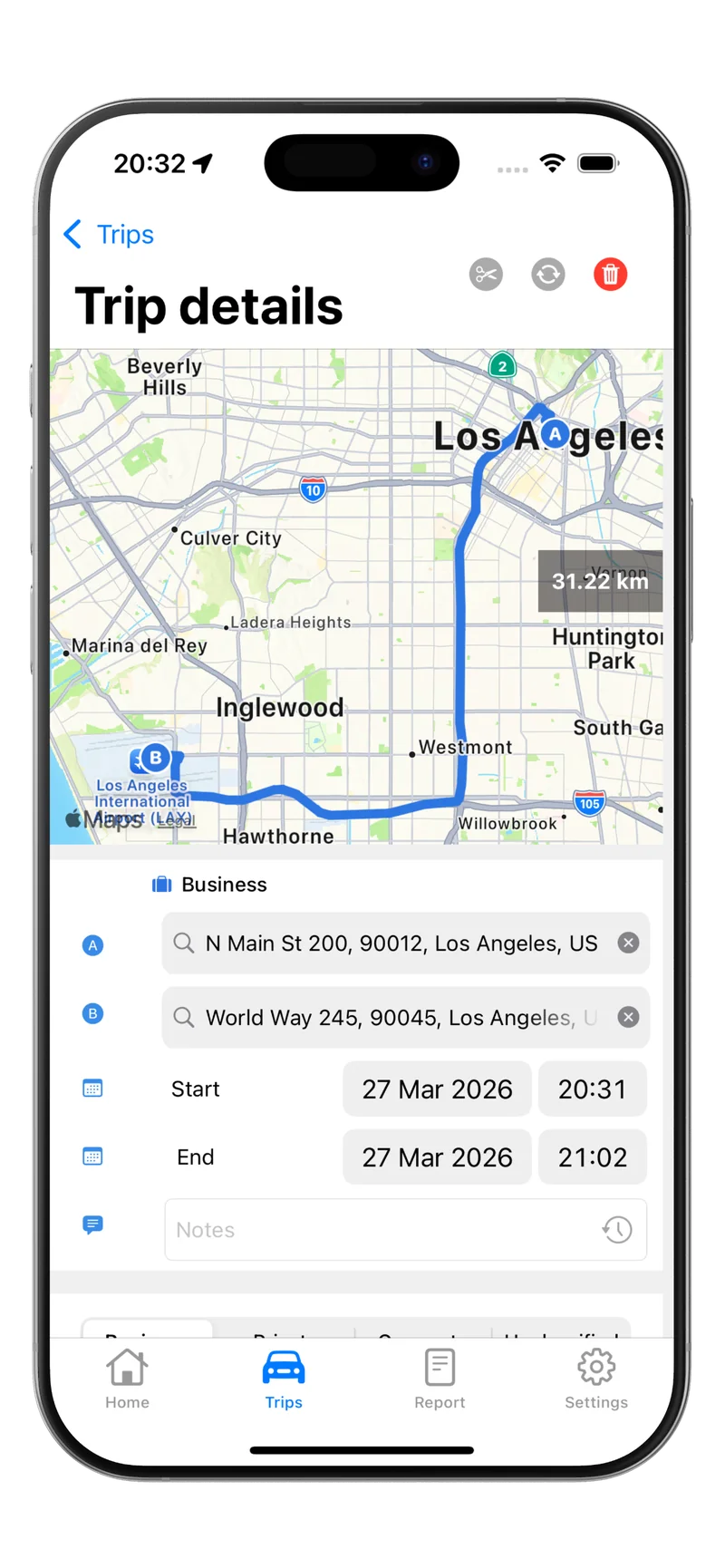
The only requirement is that employees substantiate their business mileage with proper documentation — date, destination, business purpose, and miles driven. For a complete breakdown of IRS mileage reimbursement rules, see our detailed guide.
Liability and Risk
Company Car Liability
When an employee drives a company-owned vehicle, your business carries direct liability for any accidents. Your commercial auto insurance policy covers this, but premiums rise with claims. If an employee causes an accident in a company car — even during personal use — the company can be named in a lawsuit.
You’re also responsible for vehicle maintenance and safety. If a brake failure or tire blowout causes an accident and the maintenance records are inadequate, the company faces negligence claims.
Reimbursement Liability
When employees use their own vehicles, their personal auto insurance is the primary coverage. Your company’s liability exposure is significantly reduced, though not eliminated — you can still be held liable under respondeat superior if an employee causes an accident while driving for work purposes.
The key difference is that you’re not managing vehicles, maintenance schedules, or recall notices. The employee handles all of that for their own car.
Administrative Burden
This is where the two options diverge sharply.
Company cars require: fleet management software or a dedicated fleet manager, maintenance scheduling and tracking, insurance policy management, fuel card programs, vehicle assignment and return processes, personal-use tracking and tax reporting, accident and claims handling, vehicle disposal or lease returns.
Mileage reimbursement requires: a written reimbursement policy, a mileage tracking system, and a monthly reimbursement process through payroll.
For small and mid-sized businesses without dedicated fleet staff, the administrative simplicity of mileage reimbursement is a major advantage. An app like Tripbook handles the tracking and documentation side, and your payroll team handles the reimbursement.
Employee Preference
This factor is often overlooked, but it matters for retention and satisfaction.
Many employees prefer driving their own car. They’re comfortable in it, they’ve chosen it, and they don’t have to coordinate vehicle pickups or deal with company-car restrictions. Mileage reimbursement lets them maintain that autonomy while being compensated fairly.
On the other hand, some employees — particularly those who drive extensively — prefer a company car because it eliminates wear and tear on their personal vehicle and removes the out-of-pocket cost of fuel and maintenance, even if it’s later reimbursed.
When a Company Car Makes Sense
Despite the higher cost and administrative complexity, company cars are the better choice in certain situations:
- High-mileage roles where employees drive 25,000+ miles per year. At that volume, the per-mile cost of a company car drops and can match or beat reimbursement rates.
- Brand visibility. If your vehicles are wrapped with company branding, they serve as mobile advertising. Service companies like plumbers, electricians, and delivery businesses get real marketing value from branded fleets.
- Specialized vehicles. If the job requires a specific type of vehicle (cargo van, pickup truck, refrigerated vehicle), it’s impractical to expect employees to own and maintain one. Industries like construction often face this situation — see our guide on mileage tracking for construction contractors.
- Safety and standardization. When you control the vehicle, you control the safety features, maintenance schedule, and equipment. This matters in industries with strict safety regulations.
When Mileage Reimbursement Makes Sense
For the majority of businesses with employees who drive moderate distances, mileage reimbursement is the smarter option:
- Lower total cost for employees driving under 20,000-25,000 miles per year.
- Minimal administrative overhead. No fleet management, no maintenance tracking, no vehicle disposal.
- Tax simplicity. No personal-use calculations, no W-2 adjustments — just a clean, tax-free reimbursement under an accountable plan.
- Scalability. Adding a new driver to a reimbursement program costs nothing upfront. Adding a new company car means a lease, insurance, and registration.
- Flexibility. If business needs change and driving requirements decrease, your costs drop immediately. With company cars, you’re locked into lease terms.
Some companies use a mixed model — company cars for high-mileage field workers and mileage reimbursement for office staff who drive occasionally. A third option is a flat car allowance, though it comes with different tax implications. This captures the advantages of both approaches where they make the most sense.
The Bottom Line
For most small and mid-sized businesses, mileage reimbursement under an accountable plan is the more cost-effective, simpler, and lower-risk option. It eliminates fleet management headaches, reduces liability, and costs less per mile for moderate driving volumes.
The key to making it work is accurate mileage tracking. Tripbook automates the entire process — GPS-based trip recording, one-swipe classification, and IRS-compliant report exports — so your reimbursement program runs smoothly without spreadsheets or paperwork.