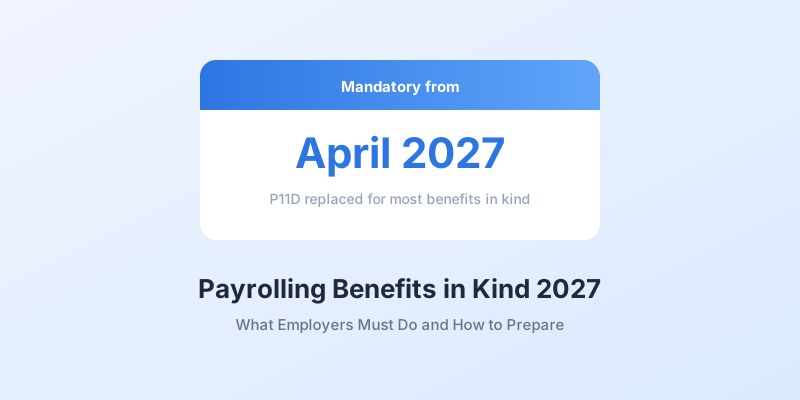
The way UK employers report taxable employee benefits is about to change fundamentally. From 6 April 2027, payrolling benefits in kind becomes mandatory for virtually all employers, replacing the annual P11D process that has been in place for decades. Originally planned for April 2026, the government pushed the start date back by twelve months to give businesses, payroll providers, and software developers more time to prepare.
This guide explains what payrolling benefits in kind means in practice, which benefits are affected, how Class 1A National Insurance moves to real-time collection, and what employers should do now.
What Is Payrolling Benefits in Kind?
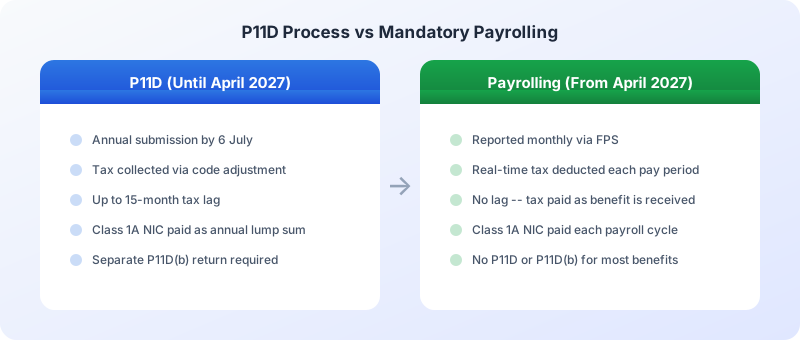
Under the current system, employers report taxable benefits such as company cars, private medical insurance, and gym memberships on a P11D form submitted to HMRC by 6 July after the tax year ends. HMRC then adjusts the employee’s tax code, and income tax is collected through PAYE over the following year. This creates a lag of up to fifteen months between the employee receiving a benefit and paying tax on it.
Payrolling eliminates that delay. Instead of filing an annual P11D, the employer calculates the cash equivalent of each benefit, divides it across pay periods, and adds it to the employee’s payroll. Income tax is deducted in real time through PAYE, just like salary. The employee sees the benefit value on their payslip each month, and HMRC receives the data through the Full Payment Submission (FPS) that employers already use for wages.
For employees, the total tax paid across the year is broadly the same. The difference is timing: tax is collected monthly rather than through a retrospective code adjustment.
The Timeline: Voluntary in 2026, Mandatory from April 2027
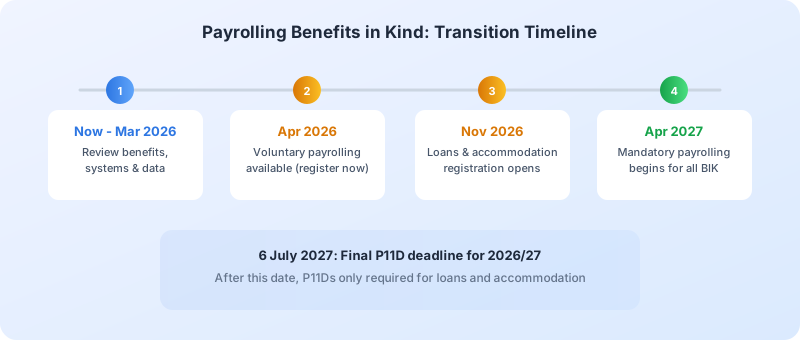
Understanding the transition timeline is critical for planning:
- Now through March 2026 — Review your current benefits, payroll systems, and data processes. Confirm your payroll software can handle real-time BIK reporting.
- 6 April 2026 — Voluntary payrolling available. Employers who register with HMRC before 5 April 2026 can payroll most benefits for 2026/27, testing processes while P11D remains as a fallback. This is the last year voluntary registration is available.
- November 2026 — HMRC opens a separate registration service for voluntary payrolling of employment-related loans and living accommodation from April 2027.
- 6 April 2027 — Mandatory payrolling begins. Employers do not need to register; HMRC will automatically remove benefit values from employees’ tax codes. All benefits in kind must be reported through the FPS, with limited exceptions.
- 6 July 2027 — Final P11D filing deadline for the 2026/27 tax year. After this, P11Ds are only required for non-payrolled loans and accommodation.
Note that the mandatory regime requires significantly more data fields on the FPS than the current voluntary process — HMRC estimates over one hundred new reporting fields.
What Replaces the P11D?
For most benefits, the P11D disappears entirely after the 2026/27 tax year. Reporting moves to the FPS, the same Real Time Information (RTI) submission employers use for salary data every pay period.
The key changes include:
- No more annual P11D filing for benefits that are payrolled (which will be almost all of them from April 2027).
- No more P11D(b) for Class 1A NIC declarations on payrolled benefits — the NIC is collected through payroll instead.
- Year-end corrections — Where the exact benefit value was not known during the year, employers must use a reasonable estimate and then submit corrections via an update process by 6 July following the end of the tax year. Any additional Class 1A NIC arising from corrections is due by 22 July.
- Expanded FPS fields — The FPS will include new data fields mirroring the detail currently captured on P11D forms, covering car details, fuel provision, medical insurance, and other benefit categories.
The P11D process is retained only for employment-related loans and living accommodation, which are excluded from mandatory payrolling because their values can be difficult to determine within the tax year. Employers can choose to voluntarily payroll these two categories from April 2027 if they register between November 2026 and 5 April 2027.
Class 1A NIC, Affected Benefits, and Exemptions
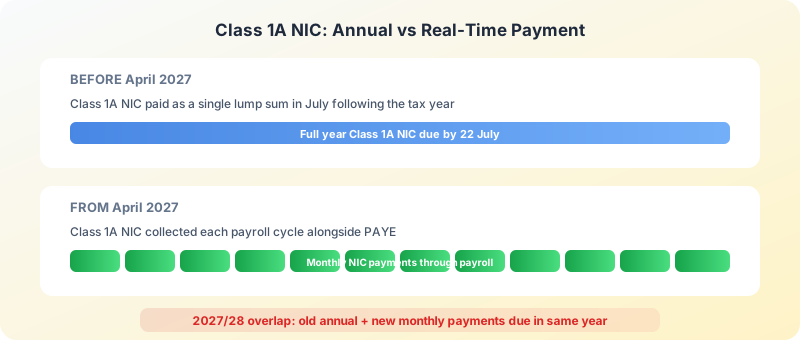
One of the most significant cash-flow changes for employers is the move from annual to real-time Class 1A National Insurance contributions. Currently, employers pay Class 1A NIC (at 13.8%) as a lump sum in July following the tax year, alongside the P11D(b) return. From April 2027, Class 1A NIC on payrolled benefits must be calculated and paid each pay period alongside the PAYE payment.
The overlap year matters. In July 2027, employers will need to pay the Class 1A NIC for the 2026/27 tax year under the old P11D system, while simultaneously paying real-time Class 1A NIC through payroll for benefits provided from April 2027 onwards. This creates a one-off year where two sets of Class 1A NIC are due, and employers should plan their cash flow accordingly.
Mandatory payrolling covers the vast majority of benefits in kind, including company cars and car fuel benefit, private medical and dental insurance, company vans and van fuel benefit, employer-provided childcare above exempt thresholds, professional subscriptions paid by the employer, and assets provided for private use.
The two categories excluded from mandatory payrolling are:
- Employment-related loans (for example, season ticket loans or beneficial loans above the threshold) — because the taxable amount depends on official interest rates and repayment patterns that may not be finalised within the year.
- Living accommodation — because the benefit calculation requires property valuations and other data that may not be available in real time.
These two benefits can still be reported on a P11D after April 2027, or voluntarily payrolled if the employer registers. HMRC is also considering retaining P11D reporting for certain internationally mobile employees on modified payroll arrangements.
How Employers Should Prepare Now
The transition to mandatory payrolling is a substantial operational change. Here is a practical preparation checklist:
1. Audit your current benefits — List every benefit in kind you provide, the number of employees affected, and how each is currently reported. Identify benefits where mid-year changes are common (such as company car swaps), as these will require timely payroll updates.
2. Check your payroll software — Confirm your provider supports the expanded FPS fields and real-time BIK calculations from April 2027. HMRC’s Basic PAYE Tools will be updated, but verify timelines and test early.
3. Consider voluntary payrolling from April 2026 — Registering before 5 April 2026 gives you a full year to refine processes while P11D remains as a fallback.
4. Model the cash-flow impact — Budget for the 2027/28 overlap year when both the final P11D-based Class 1A NIC and the new real-time NIC payments are due.
5. Communicate with employees — Benefit values will appear as a separate payslip line item, and tax codes may change as HMRC removes benefit deductions. Clear communication prevents confusion.
6. Maintain robust mileage and fleet records — For company cars, the underlying rules for business mileage record keeping and HMRC mileage rates do not change, but calculating accurate BIK values depends on reliable data about vehicle allocation dates, CO2 emissions, P11D values, and fuel arrangements.
Tripbook automates this process by logging every journey via GPS, capturing the data your payroll team needs to calculate accurate company car BIK values throughout the year.
Penalties, Record Keeping, and Next Steps
HMRC has confirmed a penalty soft landing for the first year of mandatory payrolling (2027/28). Employers who make genuine errors in their RTI returns will not face inaccuracy penalties, provided there is no evidence of deliberate non-compliance. However, existing late filing and late payment penalties for RTI submissions still apply from day one, as does statutory late payment interest. From 2028/29 onwards the full penalty regime is in force, so the soft landing is limited to a single year. This makes voluntary payrolling in 2026/27 even more valuable — working out operational issues a year early means fewer errors when penalties are on the line.
Regardless of how benefits are reported, employers and employees should maintain thorough records. For company car benefits, this means tracking vehicle allocation dates, P11D values, CO2 emissions, fuel type, and any mid-year changes. For employees who also use personal vehicles for business travel, maintaining a compliant mileage log is equally important. These records support expense claims, provide evidence for HMRC enquiries, and satisfy Making Tax Digital digital record-keeping requirements.
Tripbook keeps your mileage records current and HMRC-compliant by automatically logging business journeys with GPS tracking, so you always have the evidence you need.
Download Tripbook from the App Store to keep accurate mileage records through the transition to mandatory payrolling of benefits in kind.
For more detail on the current P11D process that remains in place until April 2027, see our P11D company car reporting guide.