Having an ABN changes how you interact with the tax system — and one of the most useful changes is the ability to claim car deductions with ABN work. Whether you’re a sole trader, a contractor working part-time, or a freelancer with a handful of clients, using your car for work trips creates a legitimate tax deduction. But the rules have specific requirements, and the way you claim differs from how an employee claims.
This guide explains what having an ABN means for car expenses, the two ATO methods available, how GST credits work, and practical tips for keeping the records that support your claim.
What having an ABN means for car expenses
An ABN is a registration for business or enterprise activity. Sole traders, partnerships, companies, and trusts all have ABNs — and if you operate as a sole trader (the most common structure for contractors and freelancers), your car expenses are claimed through your individual income tax return.
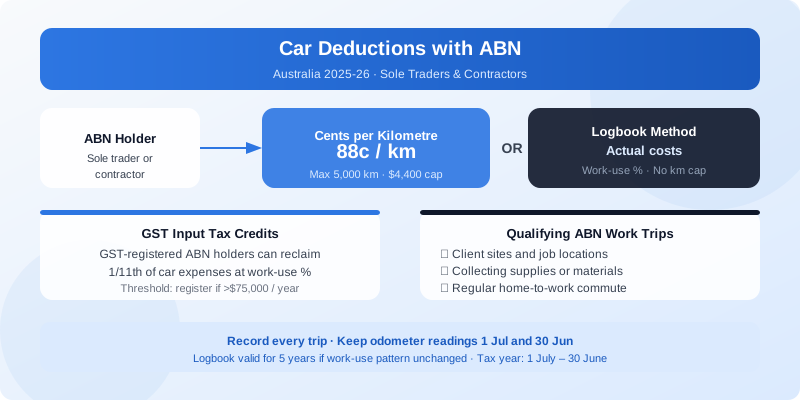
The key principle is that you can only claim car expenses for trips that are directly connected to earning your ABN income. Common qualifying trips include:
- Travelling between client sites or job locations
- Driving to pick up materials, equipment, or supplies for your work
- Attending a supplier, trade event, or work-related professional appointment
- Going to a temporary worksite that is not your regular place of business
Your commute from home to a fixed workplace does not qualify, even if you hold an ABN. If your home is your genuine principal place of business, travel from home to other work locations typically does qualify — but this must be genuine, not just nominally working from a home laptop.
The distinction between employees and ABN holders matters here. Employees are limited to claiming what the ATO allows as work-related deductions. ABN holders operating as sole traders can claim against their business income directly, which can produce a higher overall benefit — particularly through the logbook method.
Sole traders vs employees: a key difference
An employee who uses their personal car for work claims a deduction in their tax return under work-related car expenses. The deduction reduces their taxable income.
A sole trader using their car for business claims car expenses as a business expense. The deduction reduces their assessable business income. The end result on taxable income is similar, but the mechanism is different and the record-keeping rules are the same.
The practical difference is that sole traders can also claim input tax credits on car expenses through the GST system (if registered for GST), whereas employees generally cannot.
If you hold an ABN but are engaged as an employee by a specific client (for example, through a labour hire arrangement), the ATO may treat your income as wages rather than business income. In this case, your car claims work on the employee model, not the business model. Checking your actual engagement arrangement matters.
The two ATO methods for ABN holders
Sole traders and ABN holders use the same two methods as all individual taxpayers for car expense claims:
Cents per kilometre
For 2025-26, the rate is 88 cents per kilometre, with a cap of 5,000 kilometres per car per year. The maximum deduction under this method is $4,400.
This rate covers all vehicle running costs — fuel, oil, registration, insurance, tyres, servicing, and depreciation. You do not claim these separately on top of the per-km rate.
You don’t need fuel receipts, but you do need a reasonable basis for the number of kilometres you claim. A diary, GPS records, work calendar, or job records all work as supporting evidence.
Logbook method
The logbook method lets you claim your actual vehicle costs at your work-use percentage. Establish the percentage with a valid ATO logbook covering at least 12 continuous weeks of representative travel. The logbook is valid for five years.
Actual costs you can claim include:
- Fuel and oil
- Registration and compulsory insurance
- Comprehensive insurance
- Servicing, repairs, and tyres
- Loan interest or lease payments (not capital repayments)
- Depreciation
There is no kilometre cap. If you drive 20,000 km per year and 75% is work-related, you claim 75% of your actual costs — which could significantly exceed the $4,400 cents-per-km maximum.
See ATO Car Expenses Sole Trader for a step-by-step comparison of both methods with worked examples.
GST credits on car expenses
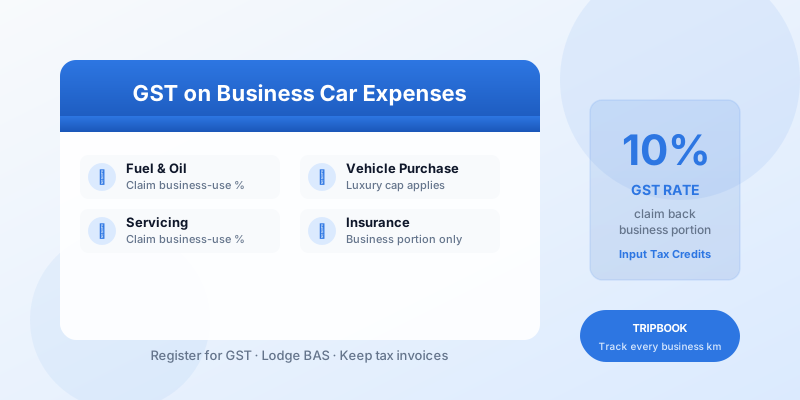
If your ABN income is above the GST registration threshold ($75,000 per year for most businesses), you must register for GST. If you’re registered, you can claim input tax credits on the GST included in your car expenses.
How it works:
- Every time you pay for fuel, a service, or insurance, 1/11th of the price includes GST
- You claim that GST back through your BAS (business activity statement) at your work-use percentage
Example:
- Fuel cost: $110 including $10 GST
- Work-use percentage: 70%
- Input tax credit claimable: $10 × 70% = $7
For a car purchase, the GST input tax credit is limited by the luxury car tax threshold. For 2025-26, the GST threshold for cars is $69,674 — you cannot claim an input tax credit on the portion of the purchase price above this amount.
For day-to-day running expenses, there’s no special cap. Claim the work-use proportion of the GST on every qualifying expense.
If you’re not registered for GST (because your ABN income is below $75,000), you cannot claim input tax credits. Your car deductions are based on the GST-inclusive cost.
Contractors and part-time ABN work
Many people hold an ABN for contracting or freelance work alongside employment. If you use your car for both, you need to keep clear records of which trips relate to your ABN work and which relate to your employment.
Under the logbook method, you record the purpose of each trip. Trips for your ABN work go in the business column. Trips for your employer’s work are separate and subject to the employee car expense rules.
Under cents per kilometre, you simply count the work-related kilometres separately for each role.
Part-time ABN holders often underestimate their eligible kilometres. If you visit clients, attend meetings, travel to job sites, or collect materials — even a few times a week — those kilometres add up quickly.
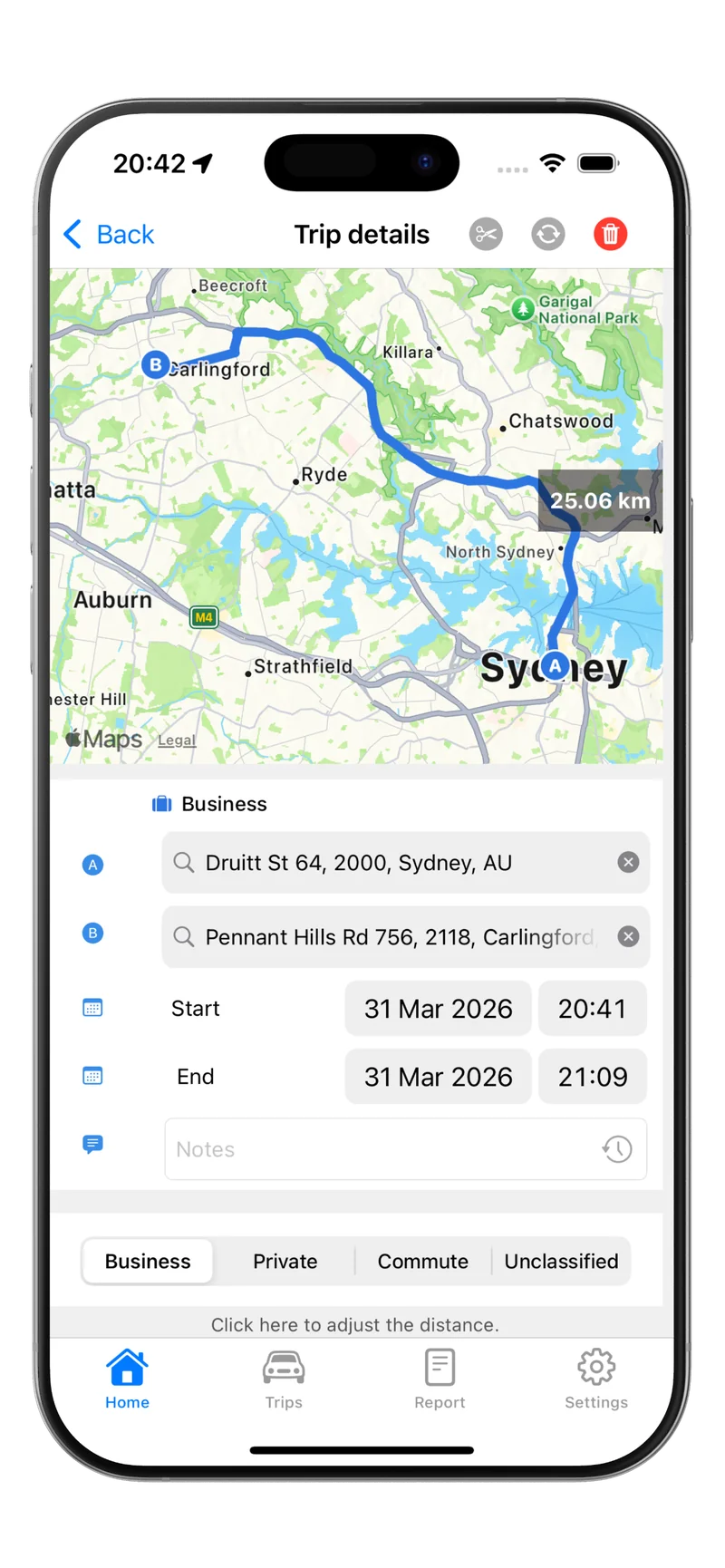
Tripbook makes it easy to categorise every trip and separate your ABN work trips from other travel. At year-end, you can export a clear record of kilometres by purpose.
Practical record-keeping tips
Good records are what protect your deduction if the ATO ever asks questions. Here’s what works:
Log trips as you go. Reconstructing a year of travel from memory is inaccurate and risky. Use a GPS app to capture trips automatically and categorise them daily or weekly while they’re fresh.
Record odometer readings at 1 July and 30 June. You need annual odometer readings to confirm total kilometres driven. Many people forget this until it’s too late.
Keep all expense receipts. Under the logbook method, every cost needs to be substantiated. Fuel receipts, service invoices, insurance renewal notices — all are needed.
Note the work purpose of trips. For the logbook, each work trip needs a note of the destination or the nature of the work. “Client site — Parramatta” or “Picked up materials for Project X” is sufficient.
Separate personal and business bank accounts. This makes it far easier to identify business car expenses at tax time rather than sifting through personal transactions.
Car deductions with ABN work are one of the more accessible and valuable tax benefits for self-employed Australians. The cents per kilometre method is a solid starting point for lower-km workers; the logbook method pays dividends for anyone putting significant business kilometres on their car.
For more detail on kilometre rates and logbook rules, see ATO Kilometre Rate and Kilometre Tracking.
Download Tripbook to log every ABN work trip automatically and have ATO-ready records waiting at tax time.