The electric vehicle FBT exemption has been one of Australia’s most generous tax concessions since its introduction in 2022. But significant EV FBT exemption changes in 2026 — particularly the exclusion of plug-in hybrid electric vehicles (PHEVs) — mean employers and employees need to understand what still qualifies and what does not.
This guide explains the current state of the exemption, the PHEV changes, grandfathering rules, and what it all means for salary packaging decisions.
What is the EV FBT exemption?
Fringe benefits tax (FBT) normally applies when an employer provides a car to an employee for private use. The FBT rate is 47%, making car fringe benefits expensive for employers.
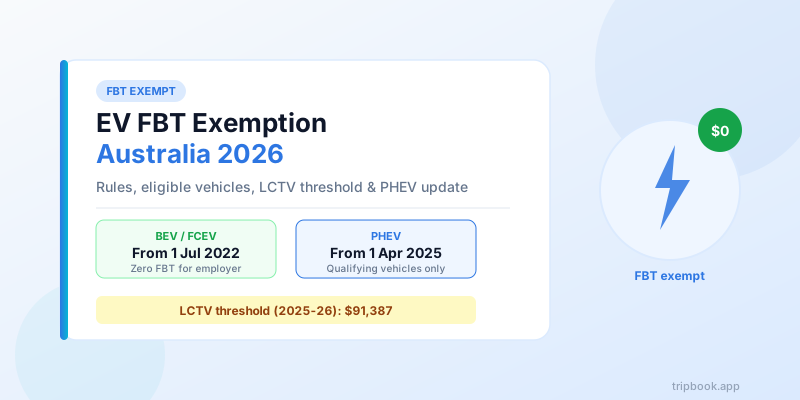
The EV FBT exemption removes this cost entirely for eligible zero and low-emission vehicles. When a qualifying EV is provided through a salary packaging or novated lease arrangement, neither the employer nor the employee pays FBT on the car benefit.
This can save employees thousands of dollars per year compared to packaging a conventional vehicle of the same value.
Which vehicles still qualify?
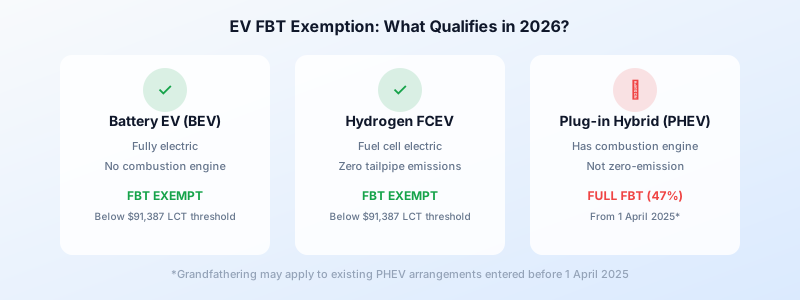
As of 2026, the following vehicles remain eligible for the FBT exemption:
- Battery electric vehicles (BEVs) — fully electric, no internal combustion engine
- Hydrogen fuel cell electric vehicles (FCEVs)
To qualify, the vehicle must also meet these conditions:
- First held and used on or after 1 July 2022
- The car’s value must be below the luxury car tax threshold for fuel-efficient vehicles ($91,387 for 2025–26) — meaning LCT has never been payable on the car
- The car is provided under a salary packaging or employer-provided arrangement
The PHEV exclusion — what changed
From 1 April 2025, plug-in hybrid electric vehicles (PHEVs) are no longer classified as zero or low-emission vehicles for FBT purposes. This means:
- New PHEV salary packaging arrangements entered into after 31 March 2025 attract full FBT at 47%
- PHEVs are now treated the same as conventional petrol or diesel vehicles for FBT calculations
- The exemption no longer applies to any new PHEV commitments, regardless of the vehicle’s electric range or efficiency
Why the change?
The government’s position is that PHEVs, while more efficient than conventional vehicles, still rely on internal combustion engines and do not represent the zero-emission future the exemption was designed to encourage. The policy shift aims to direct the tax incentive squarely at fully electric transport.
Grandfathering rules for existing PHEVs
If you entered into a PHEV salary packaging arrangement before 1 April 2025, the exemption may still apply under transitional rules. To qualify for grandfathering:
- The PHEV must have been used or available for private use before 1 April 2025
- That use must have been exempt from FBT at the time
- A financially binding commitment to continue providing the vehicle must have existed on or before 31 March 2025
Important caveats:
- Delivery delays do not extend the deadline — the vehicle must have been in use before 1 April 2025
- Refinancing, extending, or materially changing the lease arrangement will void the grandfathering
- Optional extension clauses in the original agreement are not considered binding
Employers and employees with grandfathered PHEVs should document the original arrangement carefully in case the ATO requests evidence.
Impact on salary packaging decisions
The PHEV exclusion significantly changes the financial equation for anyone considering a novated lease:
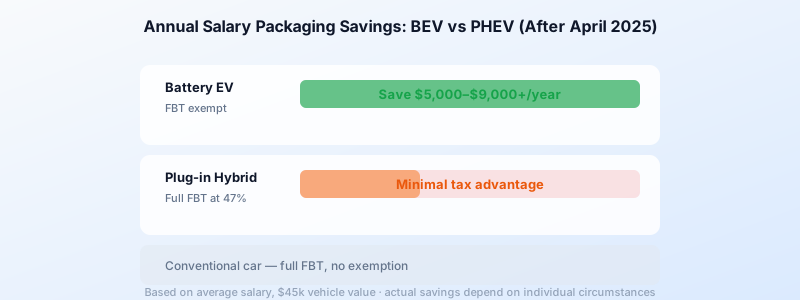
Full BEVs remain the clear winner. The FBT exemption means employees can package a BEV and avoid FBT entirely, generating savings of $3,000 to $9,000+ per year depending on salary and vehicle value.
PHEVs now carry full FBT. Without the exemption, the cost of salary packaging a PHEV is comparable to packaging a conventional car. The financial advantage of a PHEV now rests solely on lower fuel costs, not tax savings.
Conventional vehicles are unchanged. FBT applies as it always has, calculated using either the statutory formula or operating cost method.
For a broader comparison of packaging options, see our novated lease FBT guide.
Government review — what comes next
The government has commenced a review of the EV FBT exemption, running from February 2026 with a report expected by mid-2027. The review will consider:
- Whether the exemption should continue, be modified, or be phased out
- The impact on EV adoption rates
- Revenue implications
- Whether the LCT threshold cap remains appropriate
A decision could come at any time during the 18-month review window. Employers and employees should monitor developments, but for now the full BEV exemption remains firmly in place.
Record-keeping for EV FBT
Employers providing exempt EVs still need to maintain records, including:
- Evidence the vehicle meets eligibility criteria (BEV or FCEV, first used after 1 July 2022, below LCT threshold)
- Salary packaging agreement documentation
- Odometer readings if using the operating cost method for any non-exempt vehicles in the fleet
Employees using an exempt EV for work travel should still track their business kilometres — this data supports income tax deductions for work-related travel that may be available on top of the FBT exemption.
Tripbook records every trip with GPS accuracy, making it easy to separate business and private use for both FBT and income tax purposes.
Key takeaways
The EV FBT exemption changes in 2026 centre on the PHEV exclusion from 1 April 2025. Full battery electric vehicles and hydrogen fuel cell vehicles remain exempt, making them the most tax-efficient choice for salary packaging. If you have a grandfathered PHEV arrangement, document it carefully and avoid changes that could void the transitional provisions.
For accurate kilometre tracking across your EV fleet, download Tripbook.