Salary packaging a car is one of the most popular fringe benefits in Australia. By sacrificing part of your pre-tax salary to cover a vehicle lease and running costs, you reduce your taxable income — potentially saving thousands each year. But fringe benefits tax (FBT) applies to most packaged vehicles, and the rules are more complex than many employees realise.
This guide explains how salary packaging a car works, what FBT means for your arrangement, and how the electric vehicle exemption changes the equation for the 2025–26 FBT year (1 April 2025 to 31 March 2026).
How salary packaging a car works
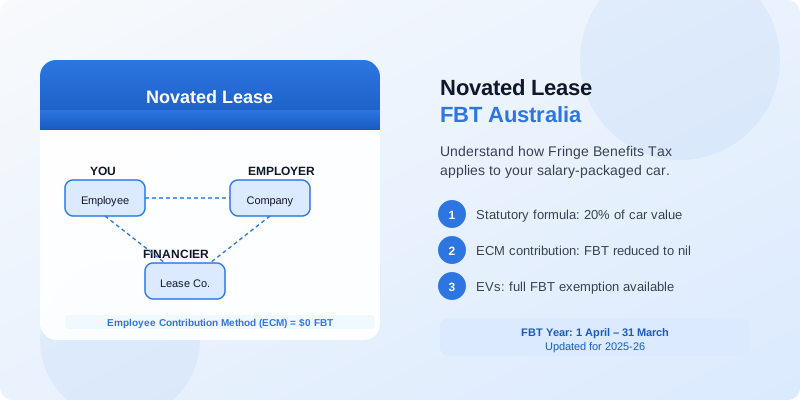
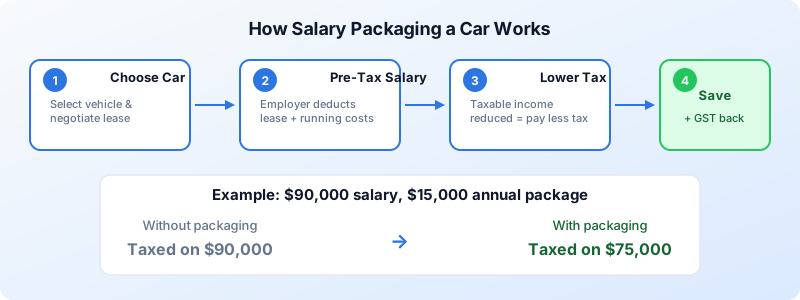
A salary-packaged car typically involves a novated lease — a three-way agreement between you (the employee), your employer, and a finance company.
Here is how it works:
- You choose a vehicle and negotiate the lease terms
- Your employer agrees to make lease payments from your pre-tax salary
- Running costs (fuel, insurance, servicing, registration, tyres) are also deducted pre-tax
- You use the car for both work and personal purposes
- At the end of the lease, you can buy the car (residual payment), refinance, or return it
Because payments come from pre-tax income, your taxable salary drops. On a $90,000 salary with $15,000 in annual lease and running costs, your taxable income effectively drops to $75,000 — saving you tax at your marginal rate.
Fringe benefits tax: the catch
The ATO treats a salary-packaged car as a fringe benefit. Your employer must pay FBT on the taxable value of the benefit — and most employers pass this cost on to you through your packaging arrangement.
FBT rate for 2025–26: 47%
The FBT year runs from 1 April to 31 March (not the standard financial year). For the year ending 31 March 2026, the rate remains at 47%.
How FBT is calculated on a car:
The statutory formula method is the most common approach. The taxable value is calculated as:
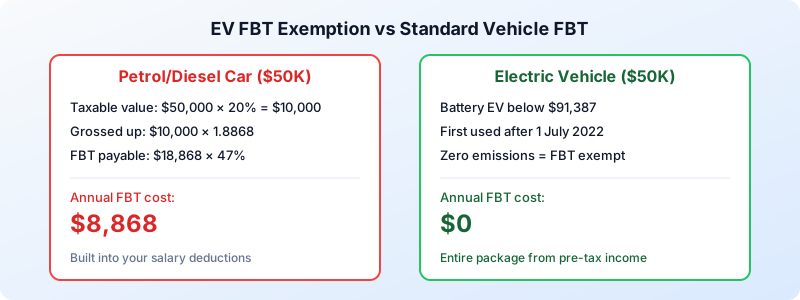
Car cost price × 20% statutory rate = taxable value
For example, a $50,000 car has a taxable value of $10,000 per year. After grossing up (Type 2 rate of 1.8868), the FBT payable is:
$10,000 × 1.8868 × 47% = $8,868 FBT
This FBT cost is built into your salary packaging deductions. Your net saving depends on your marginal tax rate and total car costs.
Employee contributions reduce the FBT liability. If you make post-tax contributions towards the car (such as paying for fuel from your own pocket), these reduce the taxable value dollar-for-dollar.
The electric vehicle FBT exemption
This is where salary packaging becomes significantly more attractive. Since 1 July 2022, eligible battery electric vehicles (BEVs) and hydrogen fuel cell vehicles are exempt from FBT.
Eligibility requirements:
- The vehicle must be a zero-emissions vehicle (battery electric or hydrogen fuel cell)
- The car’s value must be below the luxury car tax threshold for fuel-efficient vehicles: $91,387 for 2025–26
- The vehicle must have been first held and used on or after 1 July 2022
Important change from 1 April 2025: Plug-in hybrid electric vehicles (PHEVs) no longer qualify for the FBT exemption. Only pure battery electric and hydrogen vehicles are eligible. Transitional rules apply for PHEVs committed to before 1 April 2025.
What this means in practice:
On a $60,000 EV salary packaged with no FBT, the entire lease payment and running costs come from pre-tax income. Compared to the same car without the exemption, you could save $5,000–$8,000 per year depending on your marginal tax rate.
For more on EV tax benefits, see EV FBT Exemption Australia.
GST savings on salary-packaged cars
When you acquire a car through a novated lease, the finance company purchases the vehicle and claims back the GST. This saving is passed on to you, effectively reducing the purchase price by up to 10%.
On a $55,000 car (GST inclusive), the GST component is $5,000. This amount is claimed back by the leasing company, meaning your lease is calculated on $50,000 — an immediate saving before you even consider the income tax benefits.
Who benefits most from salary packaging?
Salary packaging a car delivers the strongest savings for:
- Higher-income earners — the tax saving scales with your marginal rate. At 37% or 45%, the pre-tax deductions are worth more
- EV buyers — the FBT exemption eliminates the biggest cost of packaging a traditional vehicle
- Healthcare and not-for-profit employees — these sectors often have additional salary packaging caps that make car packaging even more attractive
- Employees driving newer vehicles — packaging bundles maintenance, insurance, and fuel into one predictable pre-tax payment
For employees on lower marginal rates (19% or below), the FBT cost on a traditional vehicle may offset most of the income tax saving. Run the numbers carefully.
Tracking your business kilometres
Even with a salary-packaged car, tracking your business kilometres matters. Employee contributions based on business use can reduce FBT, and if you also claim work-related car expenses separately (where applicable), accurate records are essential.
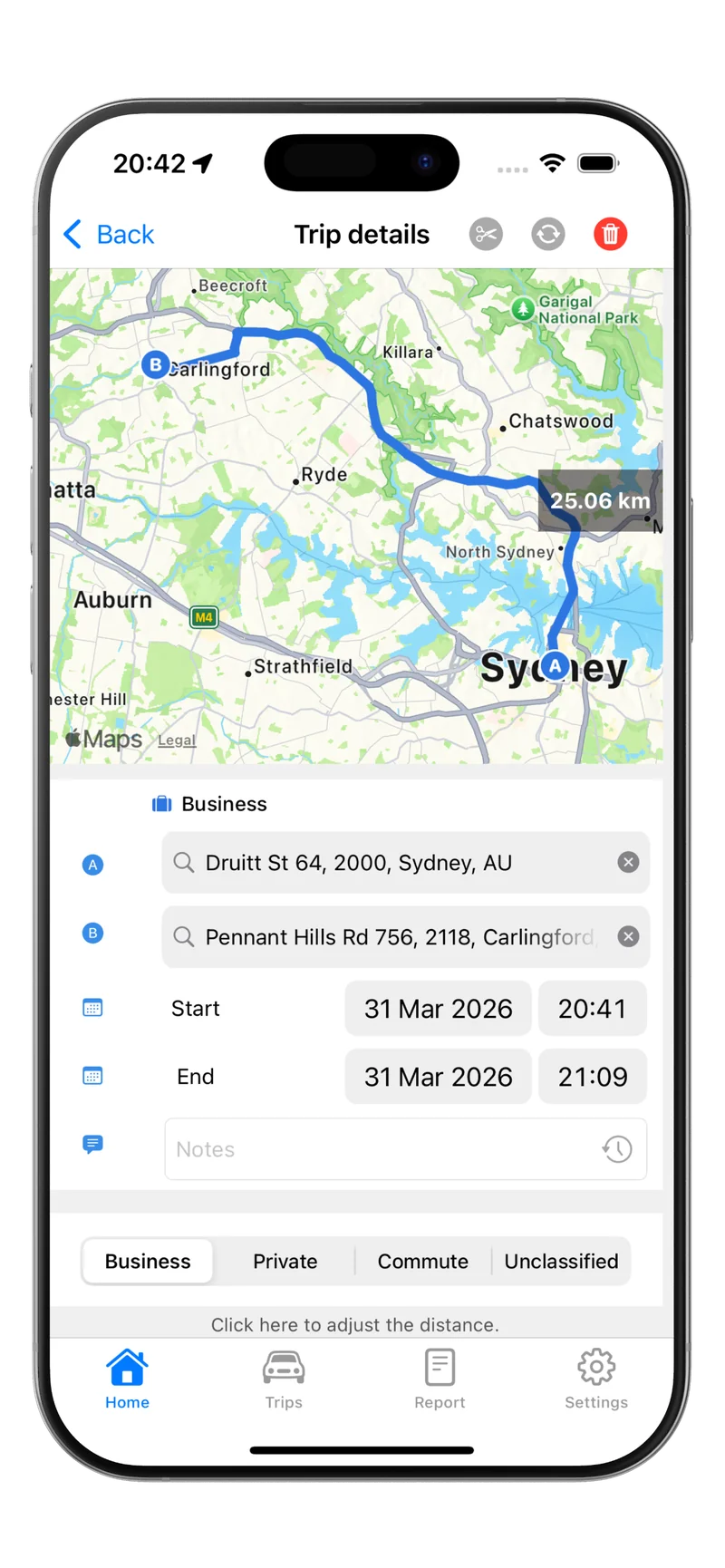
Tripbook automatically logs every trip with GPS tracking. Classify each journey as business or personal, and export a report showing your exact business-use percentage — useful for FBT calculations, employee contribution records, and ATO compliance.
Key figures for 2025–26
| Item | Value |
|---|---|
| FBT rate | 47% |
| FBT year | 1 April 2025 – 31 March 2026 |
| Statutory fraction (car) | 20% |
| Type 1 gross-up rate | 2.0802 |
| Type 2 gross-up rate | 1.8868 |
| EV LCT threshold | $91,387 |
| Car depreciation limit | $69,674 |
| FBT return due date | 21 May (25 June via tax agent) |
Is salary packaging a car worth it?
For most employees earning above $80,000, salary packaging a car through a novated lease delivers genuine savings — especially for electric vehicles where FBT is zero. For traditional vehicles, the FBT cost reduces the benefit, but pre-tax payments and GST savings still make it worthwhile in many cases. For a detailed breakdown of FBT on company-provided vehicles, see Company Car FBT Australia.
Always seek independent financial advice before entering a salary packaging arrangement. Your employer’s packaging provider can model the exact savings based on your income, vehicle choice, and expected running costs.
Download Tripbook to track your business and personal kilometres accurately — whether your car is salary packaged, leased, or owned outright.