Truck driving is one of Australia’s most physically demanding and travel-intensive occupations. Whether you are an owner-driver hauling freight interstate or an employee running local deliveries, the ATO allows a range of tax deductions that can significantly reduce your tax bill. This guide covers every major deduction available to Aussie truckies, plus the records you need to back them up.
Vehicle expenses for owner-drivers
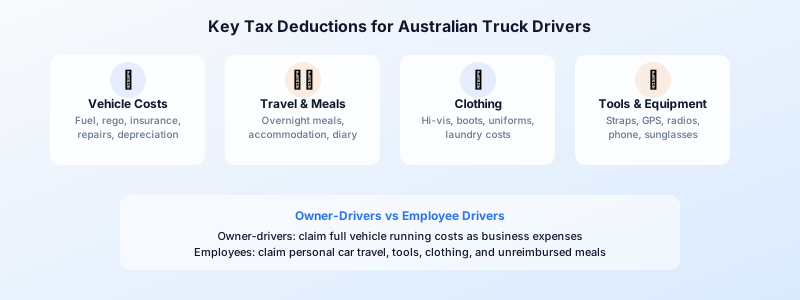
If you own and operate your own truck, vehicle costs are typically your largest deduction. You can claim the business-use portion of:
- Fuel and oil — keep fuel receipts or use fuel cards that generate statements
- Registration and compulsory third-party (CTP) insurance
- Comprehensive insurance
- Servicing, repairs, and tyres
- Depreciation (decline in value) on the truck
- Loan interest — the business-use portion of finance costs
- Tolls — E-tag statements are ideal for record keeping
- Roadside assistance
If you use the truck 100% for business (common for owner-drivers), the full cost is deductible. If there is any private use, you need to apportion accordingly.
For those who also use a separate car for work-related travel (for example, driving to the depot or attending meetings), the standard ATO car expense rules apply — either cents per km or the logbook method.
Vehicle expenses for employee drivers
If you drive a truck owned by your employer, you generally cannot claim vehicle running costs because the employer bears those expenses. However, you may be able to claim:
- Travel between workplaces — if you drive your own car between depots or to pick up a truck from a different location
- Tools and equipment stored in the truck that you purchased yourself
If your employer pays you a vehicle allowance for using your own car to get to different depots, you must declare it as income and then claim the actual expense separately.
Travel and meal deductions
Long-haul truck drivers who sleep away from home overnight can claim:
Overtime meal allowance
If your employer pays you an overtime meal allowance (shown on your payment summary), you can claim reasonable meal expenses without receipts up to the ATO’s reasonable amount. For 2025–26, the reasonable daily amounts for meals and incidentals depend on the location — capital cities attract a higher rate than regional areas.
Accommodation
If you sleep in your truck, there is no accommodation cost to claim. However, if you pay for a motel or caravan park out of your own pocket (and your employer does not reimburse you), those costs are deductible.
Travel diary
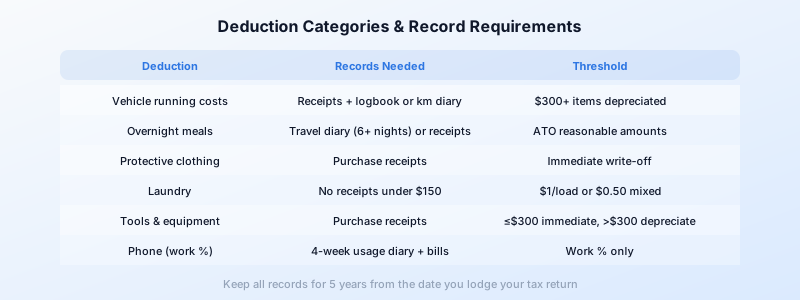
If you are away for six or more consecutive nights, the ATO requires you to keep a travel diary. This diary should record the date, location, and nature of each activity — essentially, where you were and what you were doing for work. Without it, overnight travel deductions can be denied.
Clothing and laundry
Protective clothing
Items such as hi-vis shirts, steel-cap boots, sun-protection gear, and wet-weather clothing are deductible if you buy them yourself. These are considered protective clothing because they protect you from injury or illness at work.
Uniforms
If your employer requires you to wear a uniform with a company logo, and the uniform is registered with AusIndustry or is distinctive enough to identify you as an employee of a specific company, you can claim the cost of purchasing and laundering it.
Laundry
You can claim $1 per load if the load includes only work clothing, or $0.50 per load if mixed with personal items. No receipts are needed for laundry claims up to $150 for the year.
Tools and equipment
Truck drivers often purchase their own tools and equipment. Deductible items include:
- Tie-down straps, ratchets, and load binders
- Torches and safety equipment
- GPS units (if not provided by the employer)
- Two-way radios or CB radios
- Sunglasses (if required for driving safety — prescription or safety-rated)
- Mobile phone — the work-related portion of your phone bill and the phone itself
Items costing $300 or less can be claimed immediately. Items over $300 are depreciated over their effective life.
Licences and training
- Heavy vehicle licence renewal — deductible if you already hold the licence and need it for your current job
- Licence upgrades — generally not deductible if the upgrade leads to a new type of employment (e.g. getting an HC licence to move from rigid trucks to B-doubles). However, if your current employer requires the upgrade for your existing role, it may be deductible.
- First aid courses, dangerous goods training, and fatigue management courses — deductible if required for your current work
Phone and technology
If you use your personal phone for work — calling dispatch, using GPS, receiving job updates — you can claim the work-related percentage. Keep records for a representative four-week period to establish the split, then apply it for the full year.
Common mistakes to avoid
- Claiming home-to-depot travel — your regular commute to a fixed depot is not deductible, even if the trip is long or at unusual hours.
- Over-claiming meals without an allowance — if your employer does not pay a specific meal allowance, you need actual receipts for every meal you claim.
- Forgetting the travel diary — without one, claims for trips of six or more nights can be disallowed.
- Claiming employer-reimbursed expenses — if your employer pays for something, you cannot claim it as well.
- Not keeping fuel receipts — owner-drivers need receipts to substantiate fuel claims. Fuel card statements are a good alternative.
For more detail on what the ATO looks for in car and vehicle claims, see our guide on ATO car expense audit red flags.
Track your work kilometres with Tripbook
Whether you drive your own car to the depot or use a personal vehicle for ancillary work trips, Tripbook automatically logs every kilometre. It categorises trips, stores records securely, and generates tax-ready reports — so your deduction claims are always backed by solid evidence.