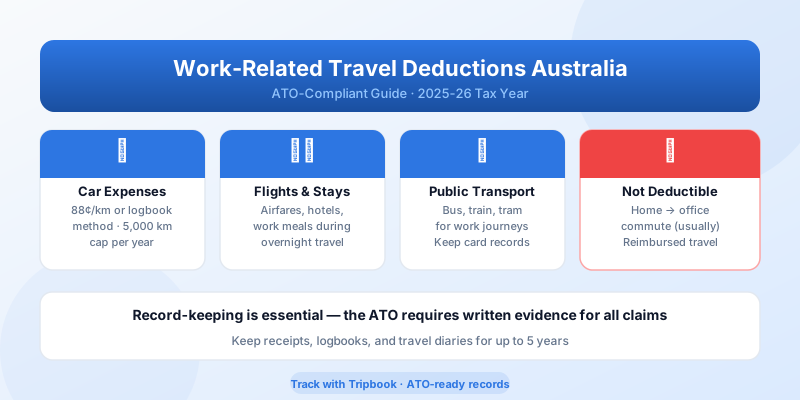
If you travel for work in Australia, you may be able to claim a deduction on your tax return — but only for the right kinds of travel, with the right records. Work-related travel deductions Australia rules cover everything from driving to a client site to overnighting for a conference interstate. This guide explains what qualifies, what doesn’t, and exactly what the ATO needs you to document.
What counts as work-related travel in Australia?
The ATO draws a clear line: travel is work-related when it is incurred in the course of performing your employment or business duties, not simply in getting to and from work.
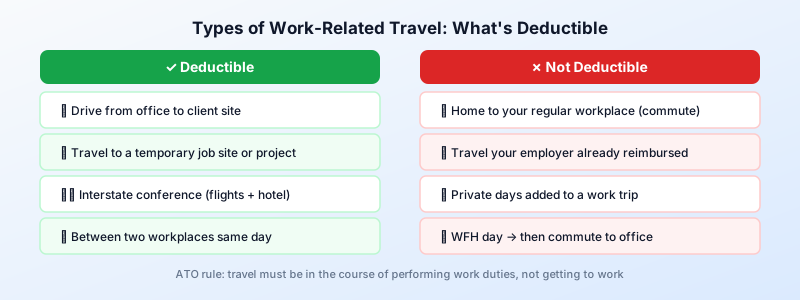
Deductible travel typically includes:
- Driving or travelling between two separate workplaces on the same day (for example, a nurse who works at two hospitals)
- Travel from your regular workplace to a client’s premises, job site, or another location required by your duties
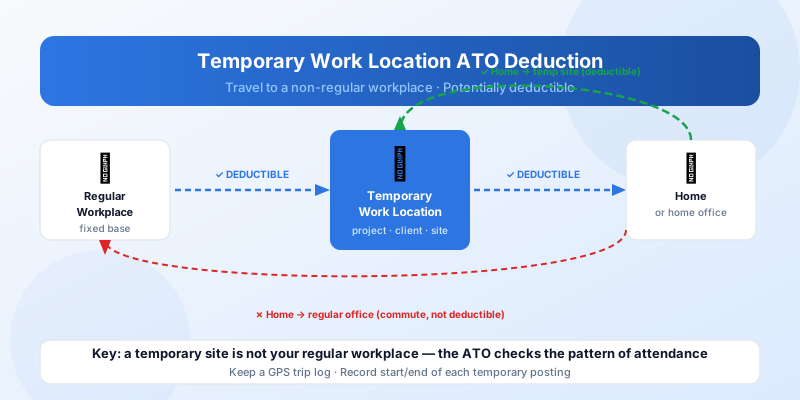
- Travel to a temporary work location that is not your usual place of work
- Overnight travel undertaken for a work purpose (conferences, training, client meetings)
- Travel to collect or deliver goods or equipment as part of your role
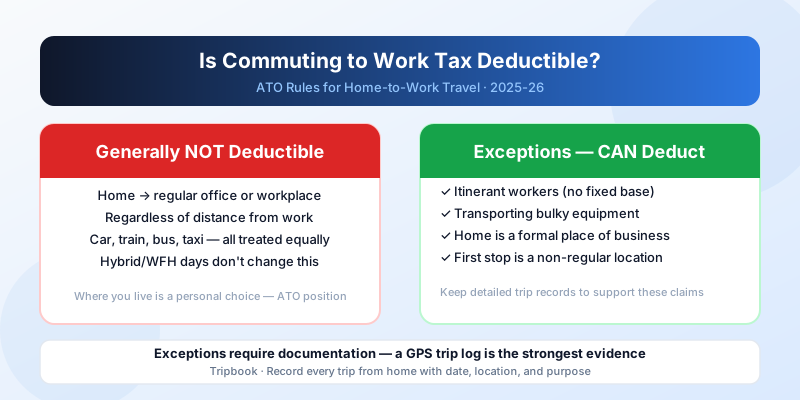
Travel that is not deductible includes your regular commute between home and your usual place of work. The reasoning is that the expense of getting to work is a private choice — the ATO does not consider it to arise from your employment duties. There are narrow exceptions, which are covered in the commuting section below.
Car expenses vs other travel deductions
Work-related travel breaks into two broad categories: car expenses and other travel expenses. The rules and methods differ for each.
Car expenses — if you use your own car (or a car you lease in your name), you claim using one of the ATO’s two methods:
- Cents per kilometre — 88 cents per km for 2025-26, capped at 5,000 km per year. No receipts needed, but you must be able to explain how you calculated your kilometres.
- Logbook method — claim the actual business-use percentage of all running costs. Requires a valid 12-week logbook and receipts.
See the ATO car expense guide for a detailed comparison of both methods and worked examples.
Other travel expenses include:
- Airfares and train/bus tickets
- Taxi and rideshare fares for work journeys
- Accommodation costs when away overnight for work
- Meals during overnight work travel (to the extent not covered by a tax-free travel allowance)
- Incidentals such as laundry on extended trips
For these, you simply claim the actual cost with supporting receipts — there is no special ATO calculation method.
Overnight trips and travel allowances
When your employer pays you a travel allowance to cover meals and incidentals during overnight work travel, the tax treatment depends on whether you are claiming within the ATO’s reasonable amounts.
The ATO publishes reasonable travel allowances each year (in a Taxation Determination). If your allowance is at or below the reasonable amount and you spent the money, you do not need every receipt — you are still required to keep some evidence that you incurred a cost, but the ATO’s scrutiny is lower.
If your allowance exceeds the reasonable amount, you must keep full receipts for the excess, and any unspent portion may be assessable income.
If you receive no allowance but travel overnight for work, you can still claim actual meal and accommodation expenses with receipts. The deduction is for costs genuinely incurred — you cannot claim a flat amount just because you were away.
Key rules for overnight travel:
- Accommodation must be for work purposes, not personal convenience
- Meals are deductible for the nights away, not for every meal that day
- Private extensions to a work trip are not deductible (personal holiday days tacked onto a conference)
- The travel must not start and end at your home — regular commuting does not become deductible because you drove a long way
Fly-in fly-out and remote area workers
Fly-in fly-out (FIFO) workers occupy a particular position in the ATO’s rules. If your employer requires you to live away from home and travel to a remote job site, the travel costs may be deductible — or your employer may provide tax-free benefits under the fringe benefits tax rules.
The key question is who bears the cost. If your employer pays for your flights and accommodation, you are not out of pocket and have nothing to deduct. If you pay your own costs and your employer does not reimburse them, you can claim:
- Flights between your home city and the work site
- Accommodation at the work site (if not employer-provided)
- Meals during the remote posting (to the extent not covered by allowances)
The ATO does not allow FIFO workers to claim travel costs as if the job site were a temporary location when it is in fact their regular place of work — once you have been travelling to the same site for some time, it becomes your regular work location. At that point, the travel from home to site takes on the character of a commute.
Living away from home allowances (LAFHAs) from employers are a separate, complex area involving fringe benefits tax. If you receive a LAFHA, speak with a registered tax agent.
Public transport and parking deductions
If you travel by public transport — bus, train, tram, or ferry — for work journeys (not commuting), the fares are deductible. Keep Opal, Myki, or equivalent card transaction records as evidence.
Parking costs at a work-related destination (a client’s building, a court, a hospital) are deductible. Airport parking for a work trip is deductible. Parking at your regular workplace is generally not deductible — it is part of your commute costs.
Tolls on work journeys are deductible using the same rules as car expenses. If you use the cents-per-kilometre method, tolls are a separate deduction on top of the per-kilometre amount.
What the ATO won’t allow
Beyond the commuting rule, there are several common claims the ATO will disallow:
Mixed-purpose trips. If you combine a work conference with a holiday, only the work-related portion is deductible. You need to apportion reasonably and keep a diary.
Travel that was reimbursed. If your employer pays you back for travel costs, you cannot also claim a deduction — you have not been out of pocket.
Travel for the purpose of self-education. Travel to a course or study is only deductible if the course is directly connected to your current employment and is not a prerequisite for your role. The rules here are nuanced.
Home-office workers travelling to the office. Working from home does not make your office commute deductible. Even if you work partly from home, the days you travel to the office remain a non-deductible commute.
International travel with a private component. The ATO applies strict apportionment rules. If the private component is more than incidental, you must split costs.
Records you need to substantiate your claim
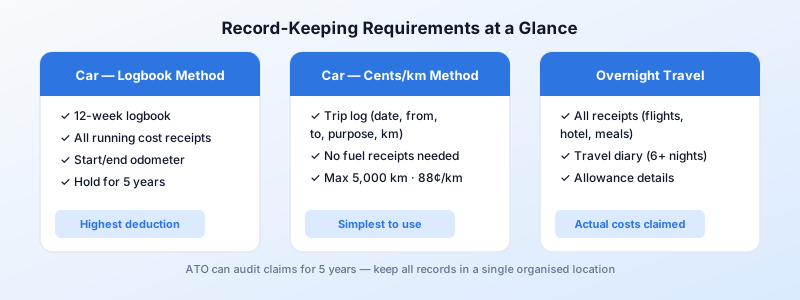
The ATO’s substantiation rules require you to hold written evidence for most travel expenses. The type of evidence depends on the claim:
Car travel (logbook method): A valid 12-week logbook, all car-expense receipts, and odometer readings at the start and end of each year and each logbook period. See ATO logbook requirements for full detail on what must appear in your logbook.
Car travel (cents per kilometre): A record of the journeys — where you started, where you went, why, and the distance. This can be a simple spreadsheet, a note in a diary, or a dedicated kilometre-tracking app. You do not need petrol receipts.
Airfares and accommodation: Tax invoices or receipts showing the amount, date, supplier, and purpose.
Overnight trips with allowances: A travel diary covering all business and private activities, if the trip was six or more consecutive nights. For shorter trips, a diary is recommended but not mandatory.
Public transport: Transaction records from your travel card, or ticket receipts.
The ATO can audit any claim for up to five years after lodgement. Keeping records in a single, organised location — whether that’s a folder of PDFs or a purpose-built app — makes substantiation straightforward rather than stressful.
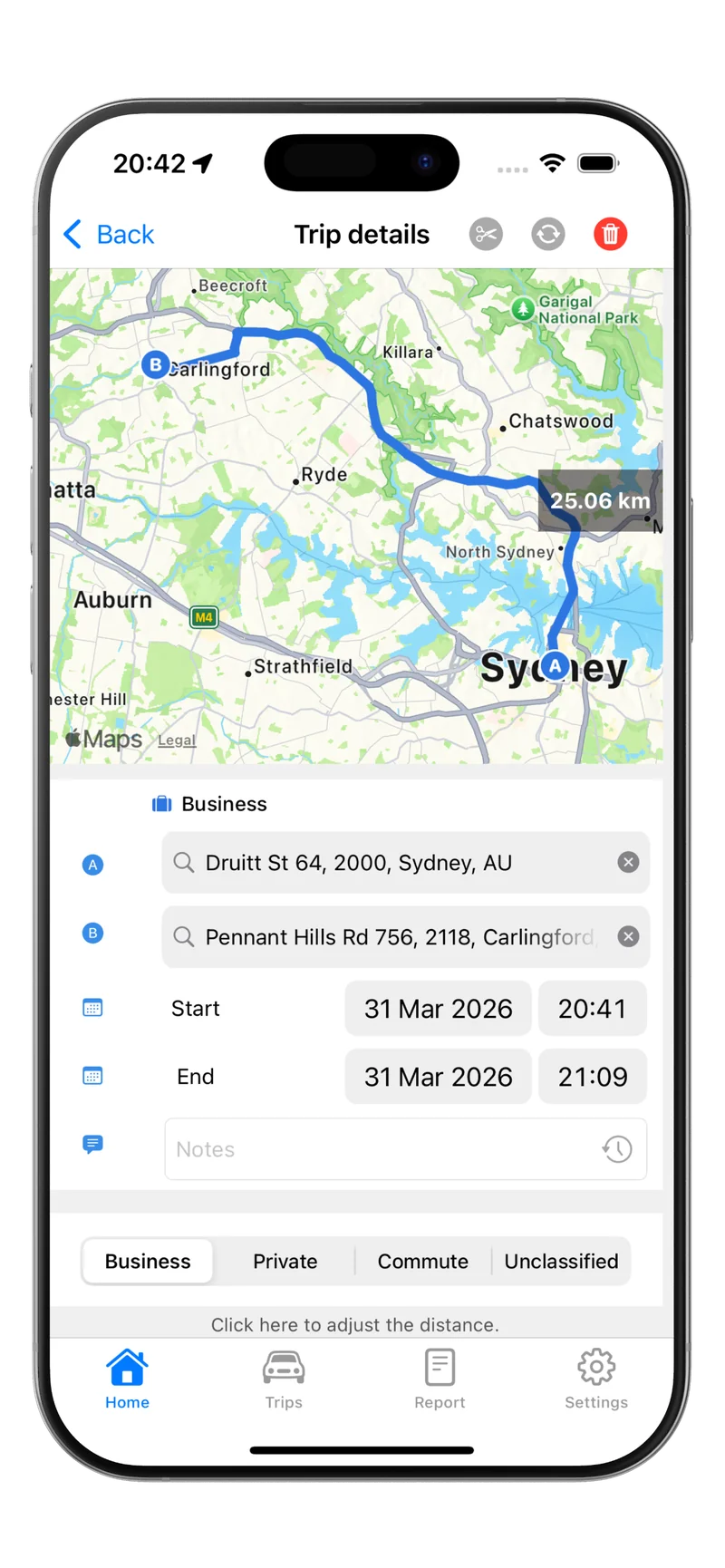
Using Tripbook on your iPhone means every business car journey is logged automatically with GPS, timestamps, and purpose notes. That record then feeds directly into your cents-per-kilometre calculation or underpins your logbook-method percentage — exactly the kind of contemporaneous evidence the ATO expects.
Putting it together on your tax return
Work-related travel deductions Australia appear in several places on your tax return, depending on what you’re claiming:
- Car expenses go to the Work-related car expenses section (Item D1 for employees)
- Other travel expenses (airfares, accommodation, meals) go to Work-related travel expenses (Item D2 for employees)
- Self-employed taxpayers report travel expenses as business deductions in their business schedule
If you receive a travel allowance that is less than the ATO’s reasonable amount, it may not even appear on your payment summary — check with your employer. If it does appear, you declare it as income and then claim the deduction.
For sole traders, the line between car expenses and other work travel deductions is the same, but the reporting differs. See work-related car expenses and sole trader tax deductions Australia for more detail.
A registered tax agent can help if your travel is complex — especially for mixed-purpose trips, FIFO arrangements, or international travel. But for most employees and sole traders, the rules are manageable once you understand the commuting boundary and have your records in order.
Work-related travel deductions Australia can add up to a meaningful tax saving, particularly for tradespeople, salespeople, nurses, and anyone who regularly visits clients or job sites. The key is knowing which trips qualify and making sure you record them at the time.
Download Tripbook to automatically log your work-related travel deductions Australia and build an ATO-ready record with every trip.