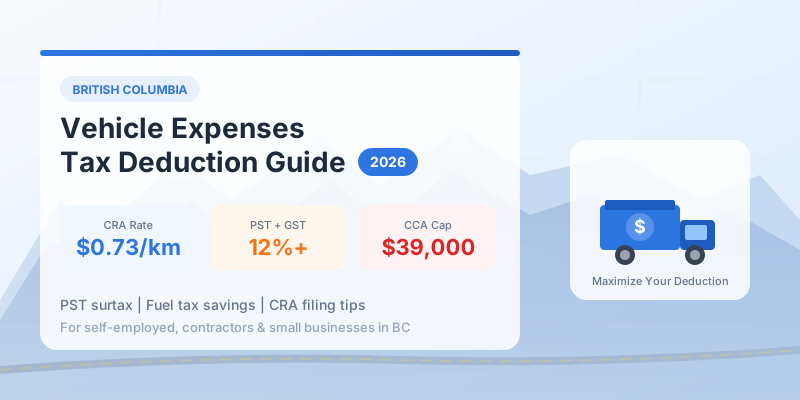
British Columbia is the most expensive province in Canada to own and operate a business vehicle. Between a 7% PST on vehicles, a luxury surtax that pushes rates to 20% on high-end purchases, and Metro Vancouver’s 18.5-cent-per-litre TransLink fuel tax, every BC vehicle expenses tax deduction matters. This guide walks you through every federal and provincial rule affecting your 2026 vehicle deductions, with real dollar calculations so you can maximize your claim.
2026 CRA Vehicle Deduction Limits
All vehicle expense deductions in Canada are governed by federal CRA rules, regardless of province. Here are the key limits for the 2026 tax year:
| Deduction Category | 2026 Limit |
|---|---|
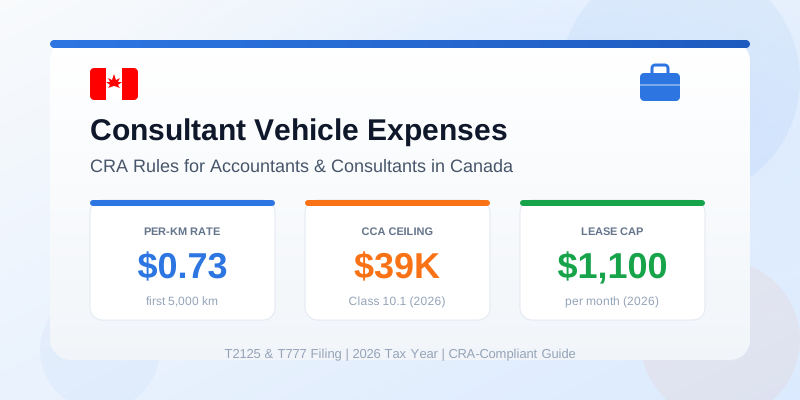
| CRA mileage rate (first 5,000 km) | $0.73/km |
| CRA mileage rate (after 5,000 km) | $0.67/km |
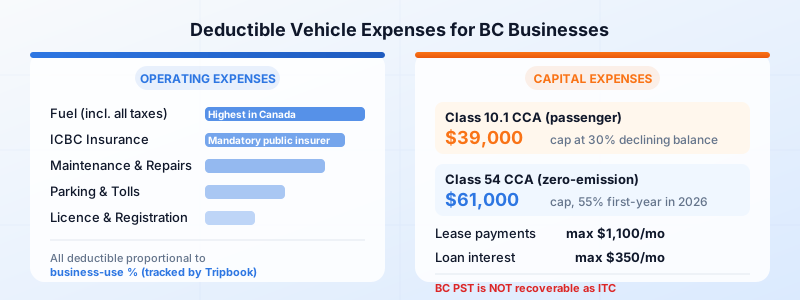
| Class 10.1 CCA ceiling (passenger vehicles) | $39,000 before tax |
| Class 54 CCA ceiling (zero-emission vehicles) | $61,000 before tax |
| Monthly lease deduction cap | $1,100 before tax |
| Monthly interest deduction cap | $350 |
| First-year ZEV enhanced CCA (2026-27) | 55% |
Self-employed BC residents report vehicle expenses on Form T2125. Employees claim through Form T777 with a signed T2200 from their employer. For a complete walkthrough of the self-employed filing process, see T2125 vehicle expenses for self-employed.
Example — per-kilometre method: A Vancouver realtor drives 18,000 business km in 2026. Their deduction is (5,000 × $0.73) + (13,000 × $0.67) = $3,650 + $8,710 = $12,360. Using Tripbook to log every trip automatically ensures no kilometres are missed when filing.
BC PST and the Luxury Vehicle Surtax
BC charges 7% PST on vehicle purchases in addition to the 5% federal GST, creating a combined minimum tax rate of 12%. However, BC’s tiered PST structure means vehicles over $55,000 face significantly higher rates:
| Vehicle Purchase Price | PST Rate | Effective Total Tax (with 5% GST) |
|---|---|---|
| Under $55,000 | 7% | 12% |
| $55,000 – $56,999 | 8% | 13% |
| $57,000 – $124,999 | 10% | 15% |
| $125,000 – $149,999 | 15% | 20% |
| $150,000 or more | 20% | 25% |
The $55,000 threshold has not been adjusted in decades, even though the average new vehicle in Canada now costs over $66,000. This means many standard work trucks and SUVs commonly used in trades, construction, and real estate now trigger the surtax.
Critical tax fact: BC PST is not recoverable as a GST Input Tax Credit. Instead, PST paid on a business vehicle is added to the vehicle’s capital cost for CCA purposes. However, if your purchase price already exceeds the $39,000 Class 10.1 cap, the PST provides no additional deduction.
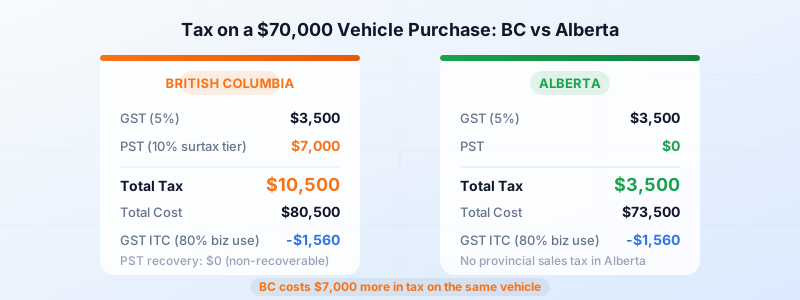
Example — $70,000 work truck purchased in BC:
- GST (5%): $3,500
- PST (10% surtax tier): $7,000
- Total taxes: $10,500
- Total cost: $80,500
- CCA base: capped at $39,000 (Class 10.1)
- GST ITC at 80% business use: $39,000 × 5% × 80% = $1,560
- PST recovered: $0
Compare this to the same truck in Alberta, where there is no PST at all — the Alberta buyer pays $3,500 in GST versus BC’s $10,500 total. That is a $7,000 difference on day one. For a full comparison of Alberta’s advantage, see Alberta vehicle expenses tax deduction.
Fuel Costs and Deductible Expenses in BC
BC drivers face the highest fuel taxes in Canada. Here is what makes up the cost per litre for a Metro Vancouver driver in 2026:
| Component | Rate |
|---|---|
| Federal excise tax | 10.0¢/L |
| BC motor fuel tax (provincial) | 1.75¢/L (Vancouver) |
| BC Transportation Financing Authority | 6.75¢/L |
| TransLink dedicated tax (Metro Van) | 18.5¢/L |
| Provincial consumer carbon tax | 0¢/L (eliminated April 2025) |
| Federal carbon charge | 0¢/L (suspended) |
The elimination of BC’s consumer carbon tax in April 2025 removed roughly 17 cents per litre from pump prices. The federal carbon charge was also suspended in 2025. Despite these reductions, Metro Vancouver fuel prices remain among the highest in North America due to the TransLink surcharge and supply constraints.
Every cent on these fuel receipts is deductible as a vehicle operating expense, proportional to your business-use percentage. Other deductible operating expenses in BC include:
- Fuel (full receipt amount including all taxes)
- Insurance (ICBC premiums, which are among the highest in Canada)
- Maintenance and repairs
- Parking and bridge tolls
- Licence and registration fees
- Lease payments (up to $1,100/month before tax)
- Loan interest (up to $350/month)
Capital Cost Allowance for BC Vehicles
When you purchase a vehicle for business, you claim depreciation through the CRA’s Capital Cost Allowance system rather than deducting the full price in one year. The rules that matter for BC purchases:
Class 10.1 (most passenger vehicles over $39,000): 30% declining-balance CCA rate, capped at $39,000 plus non-recoverable taxes. Since BC PST is non-recoverable, it can be added to the capital cost — but only up to the $39,000 ceiling.
Class 54 (zero-emission passenger vehicles): $61,000 cap with a 55% enhanced first-year allowance in 2026-27 (down from 75% in 2024-25). This is a significant advantage for BC businesses considering an EV.
Class 10 (trucks and vans not classified as passenger vehicles): 30% rate with no cost ceiling. If your vehicle qualifies as Class 10, there is no cap — a major benefit for tradespeople and delivery operators with commercial vehicles.
Example — Class 54 EV purchased for $58,000:
- Capital cost: $58,000 (under $61,000 cap)
- Add GST: $2,900 (claimable as ITC separately)
- Add PST: $5,800 (10% surtax tier for $57K–$124,999)
- First-year CCA at 55%: $58,000 × 55% = $31,900 deduction in year one
- Remaining UCC: $26,100 (30% rate going forward)
For a deeper dive into CCA classes, rates, and strategies, see capital cost allowance vehicle Canada.
EV Rebates and Incentives for BC in 2026
The BC landscape for electric vehicle rebates has shifted significantly:
CleanBC Go Electric (passenger vehicles) — ended November 2025. The province discontinued its passenger EV rebate program, which previously offered up to $4,000 for new zero-emission vehicles. The BC government stated that EV rebates are now primarily a federal responsibility.
Federal PAVE rebate — still available. Battery electric and hydrogen fuel cell vehicles remain eligible for a $5,000 federal rebate in 2026. Long-range plug-in hybrids with 50+ km electric range also qualify.
CleanBC Go Electric fleet and charger programs — still active. Rebates for workplace and home EV charger installations continue, as does the fleet charging program for businesses transitioning to ZEVs.
CCA advantage remains strong. Even without the provincial rebate, the Class 54 enhanced CCA (55% first-year write-off) and the higher $61,000 cost ceiling make EVs a compelling choice for BC businesses looking to reduce both fuel costs and taxable income. For all provincial and federal EV incentives, see provincial EV rebates Canada 2026.
Mileage Tracking and CRA Compliance
The CRA requires a mileage log for every vehicle expense claim, regardless of the method you use. Each log entry must include the date, destination, purpose of the trip, and kilometres driven. The CRA can audit your records going back six years.
BC business owners face unique tracking challenges. A contractor in the Fraser Valley may drive 200 km round-trip to a job site in Whistler, while a property manager in Victoria logs dozens of short trips daily. Both need the same level of documentation.
Tripbook automates this entire process. It records your trips in the background, calculates your business-use percentage, and generates CRA-compliant reports ready for your accountant or a CRA audit. Whether you are crossing the Port Mann Bridge daily or driving between Kelowna and Kamloops for client meetings, every deductible kilometre is captured.
The per-kilometre method vs. actual expenses: Employees using a T2200 typically claim the per-km rate. Self-employed filers on T2125 can choose whichever method produces a larger deduction. In BC, where fuel, insurance, and maintenance costs are among the highest in Canada, the actual-expense method often wins for high-mileage drivers.
Maximize Your BC Vehicle Expenses Tax Deduction
BC’s combination of high PST, elevated ICBC premiums, and expensive fuel creates a large pool of deductible vehicle costs — but only if you track them properly. Missing even one trip per week at $0.73/km over 50 km costs you $1,898 in unclaimed deductions per year.
Start your CRA-compliant mileage log today. Download Tripbook and turn every business kilometre in British Columbia into a tax deduction.