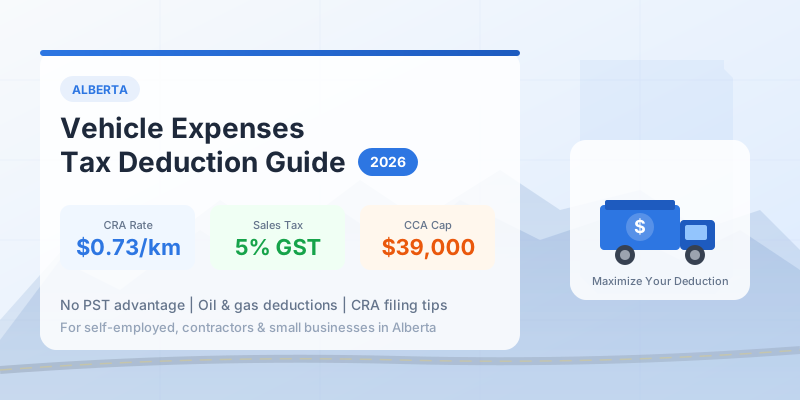
If you drive for business in Alberta, your vehicle expenses are one of the largest deductions available on your tax return. The Alberta vehicle expenses tax deduction follows federal CRA rules, but Alberta’s unique tax landscape — no PST, lower fuel costs, and a thriving oil and gas sector — creates real advantages worth understanding. This guide breaks down every deduction available to Alberta businesses and self-employed workers in 2026, with real calculations and filing steps.
2026 CRA Vehicle Deduction Limits for Alberta
All vehicle expense deductions in Canada are governed by federal CRA rules. Here are the key figures for the 2026 tax year:
| Deduction Category | 2026 Limit |
|---|---|
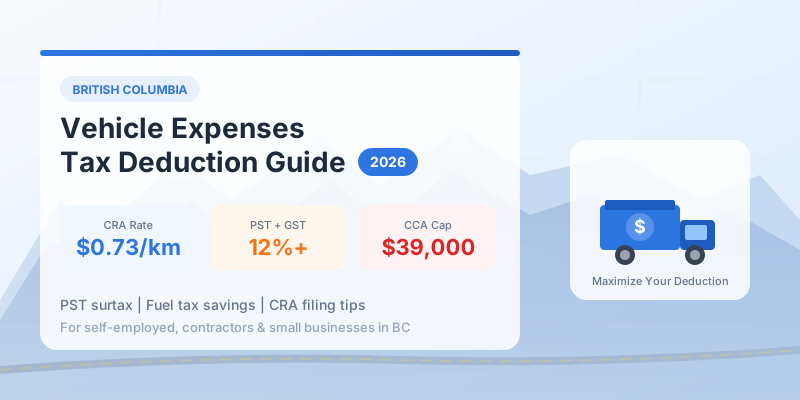
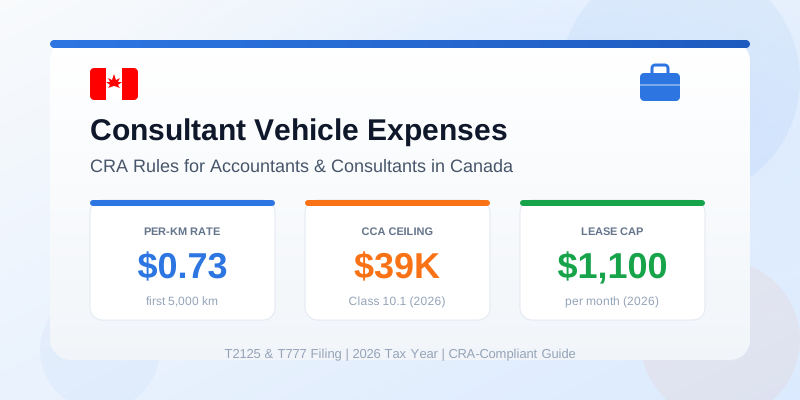
| CRA mileage rate (first 5,000 km) | $0.73/km |
| CRA mileage rate (after 5,000 km) | $0.67/km |
| Class 10.1 CCA ceiling (passenger vehicles) | $39,000 before tax |
| Class 54 CCA ceiling (zero-emission vehicles) | $61,000 before tax |
| Monthly lease deduction cap | $1,100 before tax |
| Monthly interest deduction cap | $350 |
| Class 10 CCA rate (trucks, commercial) | 30% declining balance, no cap |
Because Alberta charges only 5% GST with no provincial sales tax, the “before tax” figures translate to lower total costs. A $39,000 vehicle costs $40,950 in Alberta versus $44,070 in Ontario (13% HST) — a $3,120 difference at the dealership.
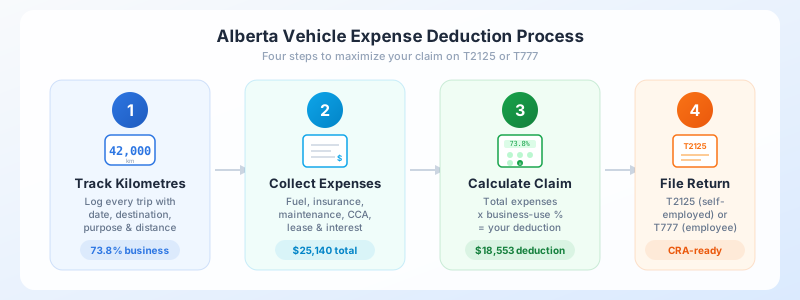
Self-employed Albertans report vehicle expenses on Form T2125, while employees file Form T777 with a signed T2200 from their employer.
Alberta’s No-PST Advantage for Vehicle Costs
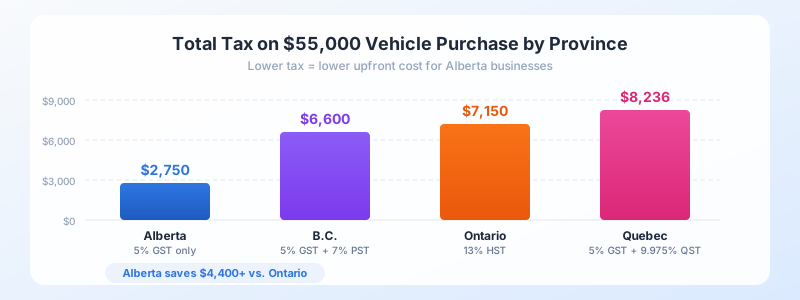
Alberta is one of only three Canadian jurisdictions with no provincial sales tax, and the only major province without PST or HST. This means every vehicle-related cost — purchases, fuel, maintenance, insurance — attracts only 5% GST.
Example: Buying a work truck in Alberta vs. Ontario
| Cost Component | Alberta (5% GST) | Ontario (13% HST) |
|---|---|---|
| Vehicle price | $55,000 | $55,000 |
| Sales tax | $2,750 | $7,150 |
| Total out-of-pocket | $57,750 | $62,150 |
| Annual fuel ($6,000 pre-tax) | $6,300 | $6,780 |
| Annual maintenance ($2,000 pre-tax) | $2,100 | $2,260 |
Over a five-year ownership period, an Alberta business owner saves roughly $7,600 compared to the same vehicle and driving pattern in Ontario. While the GST Input Tax Credit (ITC) recovery is smaller in Alberta — because you paid less tax to begin with — your net out-of-pocket cost is always lower.
For a deeper dive into ITC claims, see our guide on GST/HST input tax credits for vehicles.
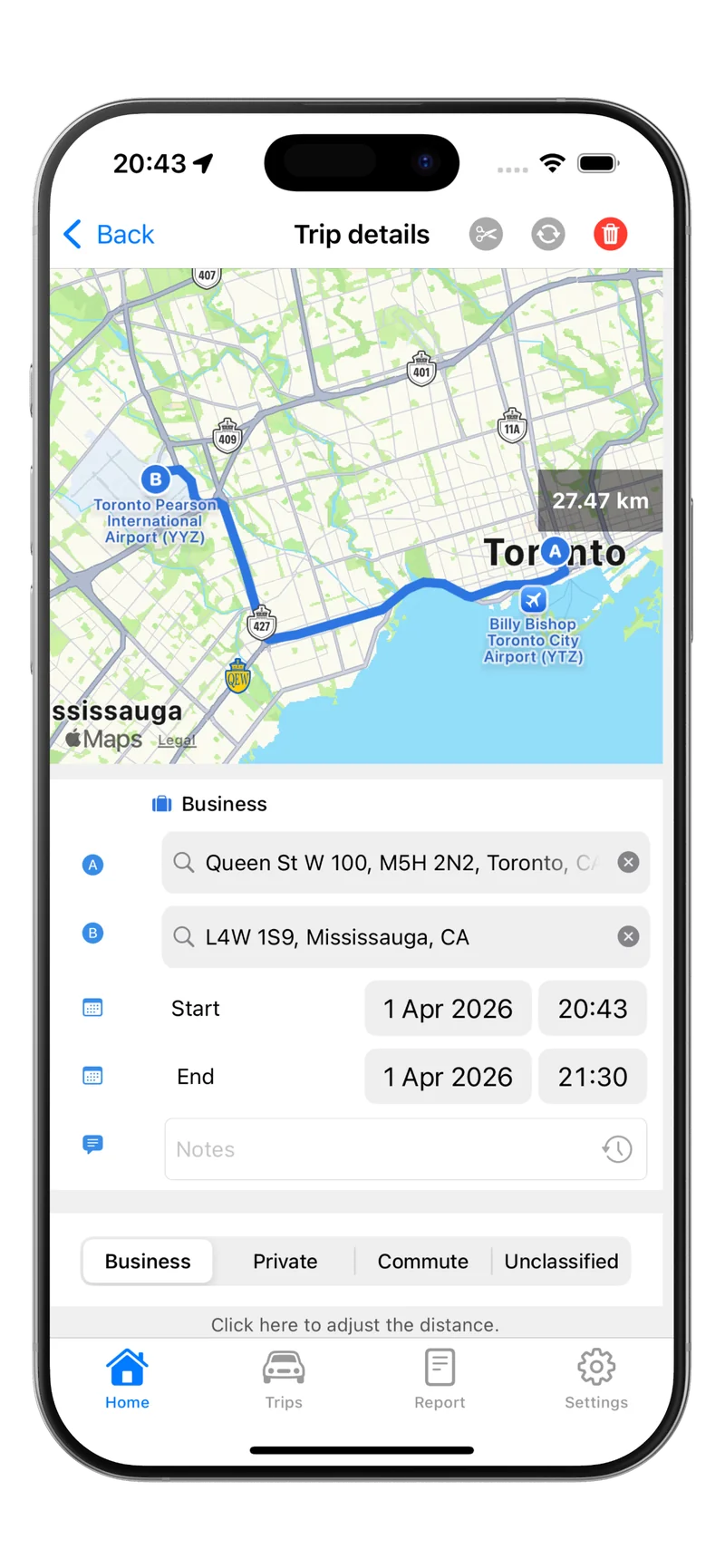
Tracking every business trip accurately is essential to maximizing these deductions. Tripbook automatically logs your kilometres as you drive, ensuring your mileage records meet CRA standards without manual entry.
Oil and Gas Contractor Vehicle Deductions
Alberta’s energy sector drives significant vehicle expense claims. Whether you are an oilfield consultant, pipeline contractor, or well-site supervisor, understanding how CRA vehicle classes apply to your situation can save thousands in taxes.
Class 10 vs. Class 10.1 — why it matters for work trucks:
Most passenger vehicles over $39,000 fall into Class 10.1, which caps the depreciable amount. However, pickup trucks and vans designed primarily for transporting goods or equipment — common in oilfield work — often qualify as Class 10 vehicles. Class 10 has no dollar cap and depreciates at 30% per year on a declining balance.
Calculation: Class 10 work truck CCA
Suppose you purchase a $72,000 heavy-duty pickup for oilfield consulting at 85% business use:
- Year 1 CCA (with Accelerated Investment Incentive): $72,000 × 30% × 1.5 = $32,400
- Deductible amount: $32,400 × 85% = $27,540
- Undepreciated capital cost (UCC) carried to Year 2: $39,600
That first-year deduction of $27,540 is a significant reduction in taxable income. At Alberta’s combined federal-provincial tax rate, a self-employed contractor in the top bracket could save over $13,000 in tax from Year 1 CCA alone.
Remote site driving: Many Alberta energy workers drive 200+ km each way to reach sites near Fort McMurray, Grande Prairie, or the Peace River region. At the CRA rate of $0.73/km, a single 400 km round trip is worth $292 in deductible expenses.
How to Claim Vehicle Expenses on Your Alberta Tax Return
The CRA offers two methods for claiming vehicle expenses. Choosing the right one depends on your situation.
Method 1: Actual expense method (T2125 or T777)
Track all vehicle costs for the year, then multiply by your business-use percentage:
- Total all operating expenses: fuel, insurance, licence, maintenance, car washes
- Add capital costs: CCA or lease payments (within limits)
- Add financing costs: loan interest (up to $350/month)
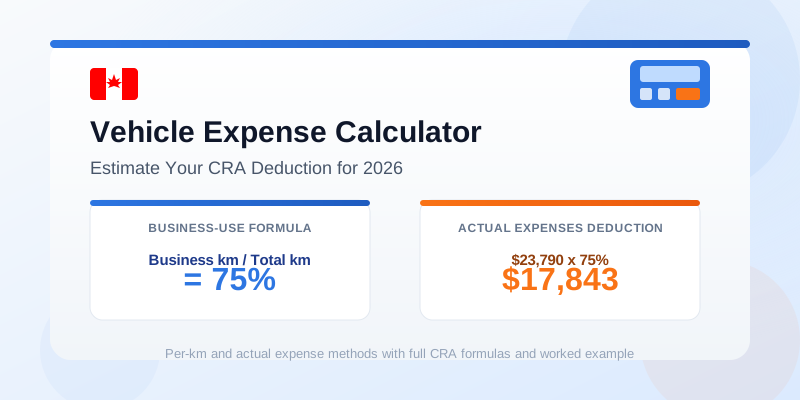
- Calculate business-use percentage: business km ÷ total km
- Multiply total expenses by business-use percentage
Example: Sarah is a self-employed geological consultant in Calgary who drove 42,000 km total in 2026, with 31,000 km for business (73.8% business use).
| Expense | Annual Amount |
|---|---|
| Fuel | $5,400 |
| Insurance | $2,100 |
| Maintenance and repairs | $1,800 |
| Licence and registration | $120 |
| CCA (Class 10, Year 2) | $11,880 |
| Loan interest ($320/month) | $3,840 |
| Total vehicle expenses | $25,140 |
| Business portion (73.8%) | $18,553 |
Method 2: CRA per-kilometre rate
Employees receiving a reasonable per-km allowance from their employer do not need to claim on their return — the allowance is already tax-free. Self-employed individuals who prefer simplicity can reference the CRA rate, but most benefit from the actual expense method when vehicle costs are high.
For Sarah above, the per-km method would yield: (5,000 × $0.73) + (26,000 × $0.67) = $3,650 + $17,420 = $21,070. In her case, the per-km method actually produces a slightly higher figure, which highlights why running both calculations is worthwhile.
Learn more about CRA record-keeping expectations in our CRA mileage log requirements guide.
Fuel Costs and Carbon Tax Changes in Alberta
Alberta’s fuel costs are among the lowest in Canada, which benefits both your operating budget and your bottom line. Several factors affect what you pay at the pump:
Provincial fuel tax: Alberta adjusts its fuel tax quarterly based on WTI oil prices. When oil prices are above $90/barrel, the provincial fuel tax is fully suspended. At lower price levels, partial rates of 4.5 or 9 cents per litre apply, up to the full rate when oil drops below $80/barrel.
Consumer carbon tax eliminated: As of April 1, 2025, the federal consumer carbon tax was set to zero. Alberta drivers no longer pay the carbon levy at the pump, which had previously added roughly 17 cents per litre.
What remains deductible: All GST paid on fuel is eligible for ITC recovery on the business-use portion. Provincial fuel taxes, while included in your total fuel cost, are deductible as part of your operating expenses on T2125 but do not generate a separate ITC.
For a self-employed driver burning 4,000 litres annually at $1.35/litre, the GST component is roughly $257 — fully recoverable as an ITC at the business-use percentage.
Start Claiming Your Alberta Vehicle Expenses Tax Deduction
The CRA audits vehicle expense claims frequently, so keeping thorough records is essential. Make sure you have: odometer readings for January 1 and December 31, a trip-by-trip mileage log with dates and purposes, all fuel and maintenance receipts, your lease or loan documents, and your CCA schedule carried forward. Avoid common audit triggers like claiming above 90% business use without justification or submitting round-number estimates.
Using Tripbook to log every business trip gives you a digital record with dates, routes, distances, and purposes — exactly what the CRA requests during a review. For more on what triggers a review, read our guide on CRA audit triggers for small businesses in 2026.
Alberta’s combination of no provincial sales tax, competitive fuel prices, and a strong energy economy makes vehicle expense deductions especially valuable. Whether you are a self-employed oilfield consultant claiming $25,000+ in annual vehicle costs or a small business owner tracking city driving in Edmonton, accurate records are the foundation of every successful claim.
The key steps: track every business kilometre, keep all receipts, run both the actual and per-km calculations to find your best deduction, and file using T2125 or T777 as appropriate.
Download Tripbook to automate your mileage tracking across Alberta. From Highway 2 commutes between Calgary and Red Deer to remote oilfield routes through the Athabasca region, every eligible business kilometre is captured and ready for your CRA filing.