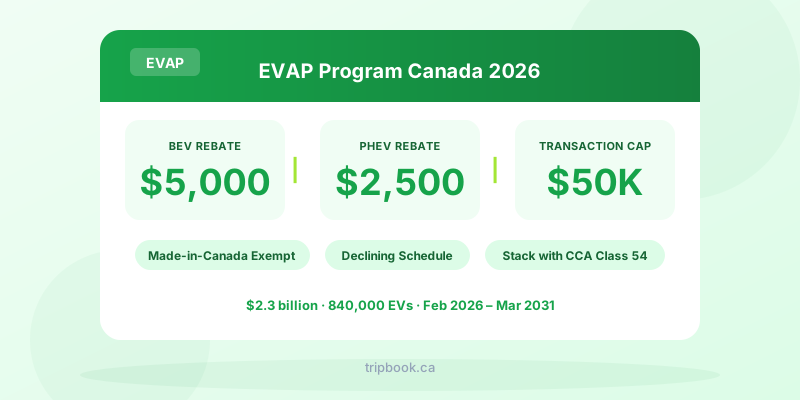
The EVAP program Canada 2026 launched on February 16, 2026, replacing the expired iZEV program with a larger budget, stricter eligibility rules, and a declining rebate schedule that rewards early buyers. Backed by $2.3 billion in federal funding, the Electric Vehicle Affordability Program aims to put more than 840,000 new EVs on Canadian roads by March 2031. Whether you are buying a personal commuter or electrifying a business fleet, this guide covers every detail you need — rebate amounts, the $50,000 transaction cap, the made-in-Canada exemption, how to apply, and how to stack EVAP with CCA Class 54 deductions tracked through Tripbook.
What Is the EVAP Program?
The Electric Vehicle Affordability Program (EVAP) is the federal government’s successor to the Incentives for Zero-Emission Vehicles (iZEV) program that expired in 2025. While the structure is similar — a point-of-sale rebate applied directly at a participating dealership — several key rules changed.
EVAP vs. iZEV at a glance:
- Price test: iZEV used base-model MSRP caps of $55,000 (up to $65,000 for higher trims). EVAP uses a final transaction value of $50,000, which includes optional features, dealer fees, and accessories installed at delivery. Taxes, freight, PDI, winter tires, and extended warranties are excluded from the cap.
- Made-in-Canada exemption: Vehicles manufactured in Canada have no transaction value limit — they qualify regardless of sticker price.
- Trade agreement requirement: Eligible vehicles must be built in Canada or in a country with an active free-trade agreement. Chinese-manufactured EVs do not qualify.
- Lifetime limits: One incentive per individual over the five-year program. Businesses can claim up to 10 incentives. Approved carsharing companies can receive up to 50 per calendar year.
- Budget: $2.3 billion over five years, compared to iZEV’s $2.9 billion over six years.
Your prior iZEV history does not affect EVAP eligibility — it is a brand-new program.
EVAP Rebate Amounts and Declining Schedule
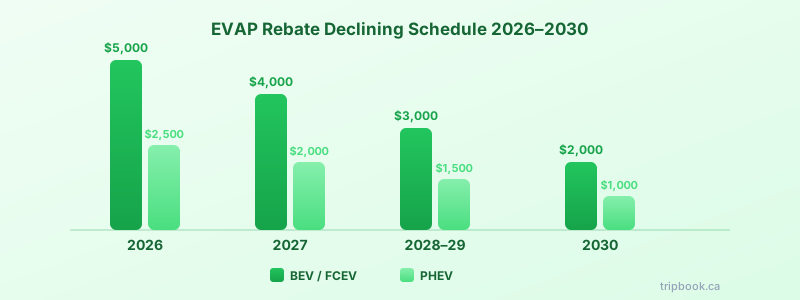
The 2026 amounts are the highest the program will offer. Rebates step down annually to encourage early adoption:
| Year | BEV / FCEV | PHEV |
|---|---|---|
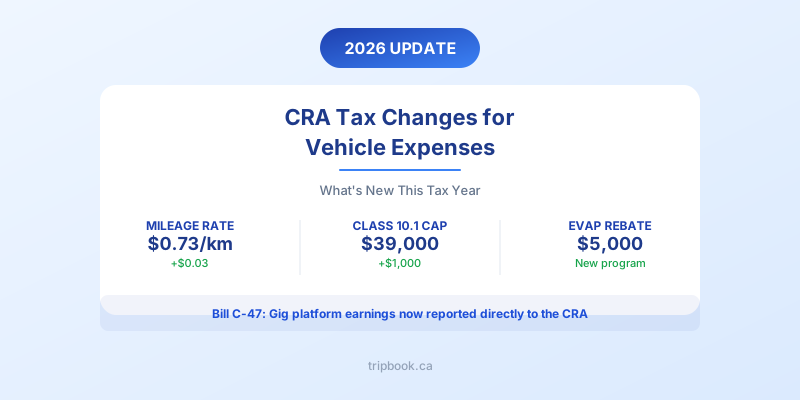
| 2026 | $5,000 | $2,500 |
| 2027 | $4,000 | $2,000 |
| 2028–2029 | $3,000 | $1,500 |
| 2030 | $2,000 | $1,000 |
The rate that applies is set by the date your eligibility assessment is submitted — not the vehicle delivery date. If you submit before December 31, 2026, the 2026 rate applies even if delivery occurs in January 2027.
Lease pro-rating: The full incentive applies to leases of 48 months or longer. Shorter leases are pro-rated: a 12-month lease receives 25 percent, a 24-month lease receives 50 percent, and a 36-month lease receives 75 percent of the applicable rebate.
Who Is Eligible and What Vehicles Qualify
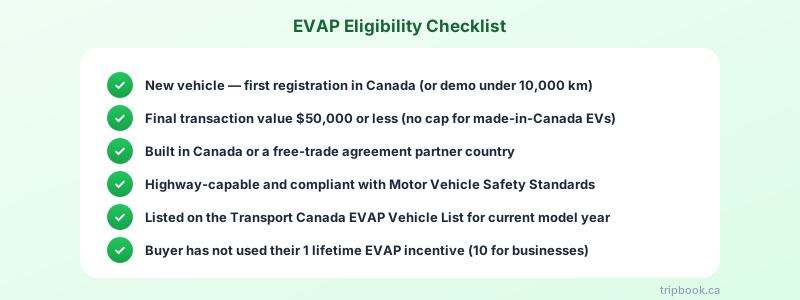
To qualify for EVAP, the vehicle must meet all of the following requirements:
- New vehicle: First-time registration in Canada; demonstrators with fewer than 10,000 km on the odometer also qualify.
- Highway-capable: Must comply with Canada’s Motor Vehicle Safety Standards and be intended for public road use.
- Transaction value at or below $50,000 — unless the vehicle is manufactured in Canada.
- Built in Canada or a free-trade partner country.
Notable eligible vehicles for 2026 include models from Hyundai, Kia, Chevrolet, Nissan, Subaru, VinFast, and others on the Transport Canada list. The made-in-Canada exemption currently benefits Stellantis models assembled in Ontario — including the Dodge Charger Daytona BEV and the Chrysler Pacifica PHEV — which qualify despite exceeding the $50,000 cap.
Transport Canada maintains the official EVAP Vehicle List and updates it as new model years are certified. Always confirm your specific trim qualifies before signing.
How to Apply for EVAP
You do not apply directly. The dealership handles the entire process on your behalf, and the rebate is deducted from your bill of sale after sales tax is calculated on the purchase price.
Step-by-step process:
- Sign the Consumer Consent Form — authorizes the dealer to submit your eligibility assessment to Transport Canada.
- Dealer submits eligibility assessment through the EVAP portal before delivering the vehicle.
- Receive confirmation — Transport Canada emails a Service Request ID. Eligibility is valid for 90 days.
- Dealer uploads documents — the sale or lease agreement and an Attestation Form.
- Dealer receives reimbursement within 20 business days of approval.
The EVAP submission portal opened on March 31, 2026. Transactions signed on or after February 16, 2026, are retroactively eligible and can be submitted through the portal. Dealers previously enrolled in iZEV were automatically enrolled in EVAP.
Stacking EVAP With CCA Class 54
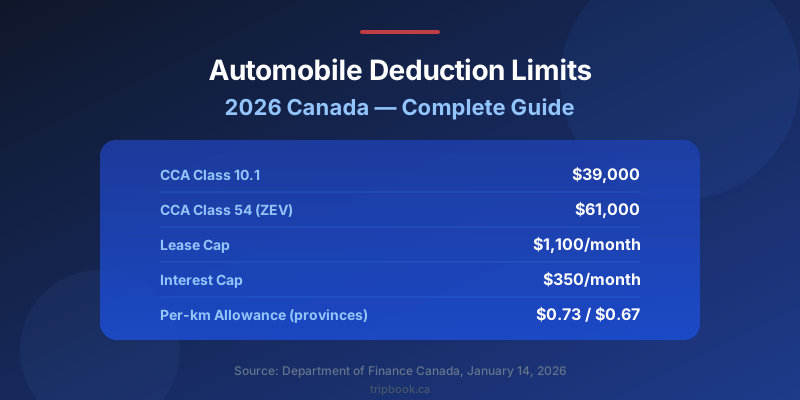
Business owners who purchase an eligible EV can combine the EVAP rebate with CCA Class 54, which provides a 55 percent depreciation rate and a first-year enhanced deduction. The EVAP rebate is generally treated as government assistance, reducing the vehicle’s capital cost for CCA purposes.
Example — $48,000 BEV, 75% business use:
- EVAP rebate: −$5,000 (applied at purchase)
- Adjusted capital cost: $43,000
- Year 1 CCA: $43,000 × 55% × 1.5 (first-year enhanced) × 75% = $26,606
- Combined Year 1 benefit: $5,000 rebate + $26,606 CCA deduction = $31,606
That is before adding operating expense deductions for fuel, insurance, and maintenance. The CCA deduction continues in subsequent years on the declining balance, making the total tax benefit significantly larger over the vehicle’s useful life. For the full Class 54 rules, see capital cost allowance vehicle Canada.
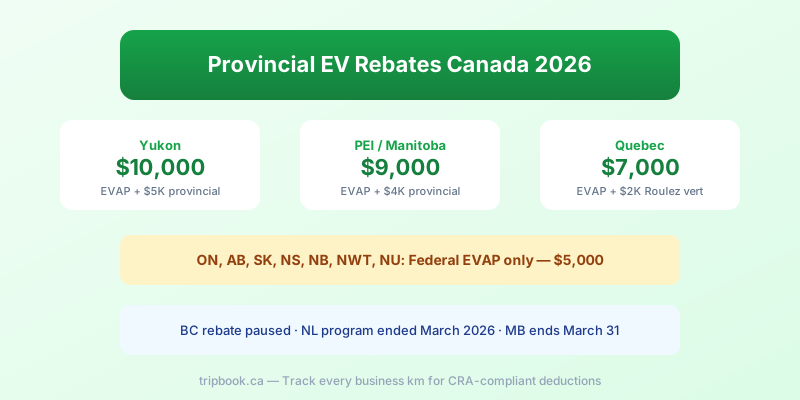
The EVAP rebate can also be stacked with provincial incentives — for example, British Columbia’s CleanBC program or Quebec’s Roulez vert. Check provincial EV rebates Canada 2026 for current amounts and eligibility.
Tracking Your Business-Use Percentage With Tripbook
Every dollar of CCA and operating expense deductions depends on an accurate business-use percentage, which the CRA expects you to support with a contemporaneous mileage log. If you claim 75 percent business use, you need records showing 75 percent of kilometres driven were for business purposes.
Tripbook builds that GPS-verified mileage log automatically. Each trip is recorded with date, distance, origin, destination, and purpose — exactly what CRA requires. At tax time, export the log and hand it to your accountant alongside your EVAP paperwork and Class 54 schedule.
Without a reliable log, the CRA can reassess your vehicle deductions and deny the business-use percentage entirely. The EVAP rebate is a one-time benefit, but CCA deductions recur every year — protecting them with proper records is essential.
For a complete breakdown of deductible vehicle costs, see self-employed vehicle expenses Canada. To understand the current per-kilometre rate for simplified claims, see CRA mileage rate 2026.
Why the EVAP Program Canada 2026 Rewards Early Buyers
The EVAP program Canada 2026 offers the highest rebate values in the program’s five-year run. With $5,000 available for BEVs and $2,500 for PHEVs this year — declining annually through 2030 — early buyers capture the most savings. Combined with CCA Class 54 and provincial rebates, the total incentive package can reduce the after-tax cost of an eligible EV by tens of thousands of dollars.
Act in 2026 to lock in the maximum rebate. Buy from a participating dealer, let them handle the EVAP application, and start tracking your business mileage with Tripbook from day one so every deduction is audit-ready.