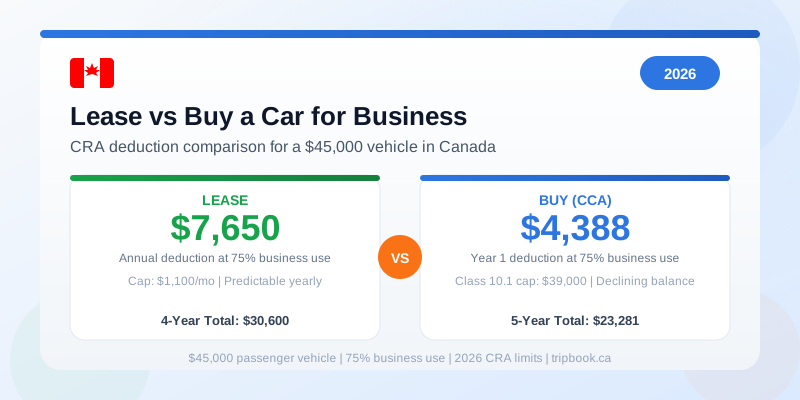
Deciding whether to lease vs buy a car for business in Canada is one of the most consequential tax decisions a self-employed Canadian or incorporated owner will make in 2026. Both paths unlock CRA deductions, but the annual amounts, timing, and long-term totals differ sharply. This guide runs the numbers on a $45,000 vehicle so you can see exactly how each option stacks up — and which one puts more money back in your pocket.
How CRA Treats Buying: CCA Declining Balance
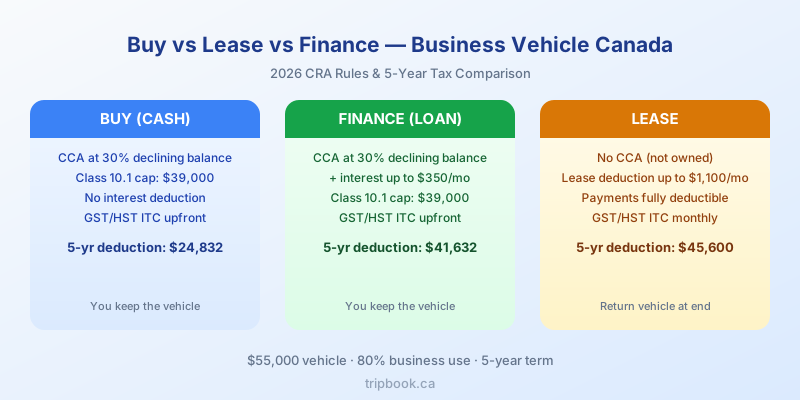
When you purchase a business vehicle, the CRA does not let you deduct the full price in the year of purchase. Instead, you claim capital cost allowance (CCA) using a declining-balance method — a fixed percentage of the remaining undepreciated capital cost (UCC) each year.
Key 2026 purchase limits:
- Class 10 (trucks, vans, work vehicles): 30% CCA rate, no dollar cap
- Class 10.1 (passenger vehicles over the threshold): 30% CCA rate, capital cost capped at $39,000 before tax
- Class 54 (zero-emission passenger vehicles): enhanced first-year CCA of 55%, cost capped at $61,000 before tax
The half-year rule applies in the acquisition year for Class 10 and 10.1, meaning you claim only 50% of the normal CCA in year one.
Example — $45,000 passenger car purchased, 75% business use:
| Year | UCC Start | CCA (30%) | Half-Year Adj. | Business Deduction (75%) |
|---|---|---|---|---|
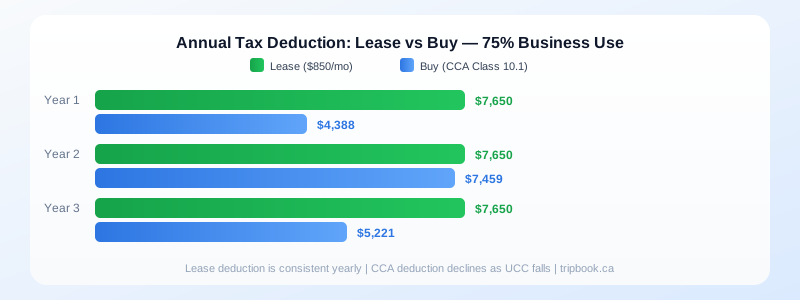
| 1 | $39,000 | $11,700 | $5,850 | $4,388 |
| 2 | $33,150 | $9,945 | — | $7,459 |
| 3 | $23,205 | $6,962 | — | $5,221 |
| 4 | $16,244 | $4,873 | — | $3,655 |
| 5 | $11,370 | $3,411 | — | $2,558 |
After five years of ownership your cumulative business deduction totals roughly $23,281. The remaining UCC continues to decline, but the annual deduction shrinks each year because 30% is applied to a smaller and smaller balance. For a deep dive on depreciation schedules, see capital cost allowance vehicle Canada.
How CRA Treats Leasing: Monthly Cap Deduction
Leasing produces a simpler, more predictable deduction. You expense the lease payments directly, subject to the CRA’s monthly cap of $1,100 before tax for leases entered into on or after January 1, 2026.
If your monthly payment falls below the cap, you deduct the actual payment. If it exceeds the cap, only $1,100/month enters the calculation. An additional formula can reduce the deductible amount further when the vehicle’s manufacturer’s suggested retail price exceeds the prescribed threshold.
Example — $45,000 vehicle leased at $850/month, 48-month term, 75% business use:
- Monthly deduction: $850 (under the $1,100 cap, so fully eligible)
- Annual deduction: $850 x 12 = $10,200
- Business deduction: $10,200 x 75% = $7,650/year
- Four-year total: $30,600
Compare that to the $23,281 buying deduction over five years. Leasing front-loads a larger annual write-off, and you reach a higher cumulative deduction in fewer years.
What about a luxury vehicle? If the same car leased at $1,400/month, only $1,100 is deductible — yielding a business deduction of $9,900/year at 75% use. Even capped, the lease deduction still exceeds the year-one CCA purchase deduction by a wide margin.
What About Loan Interest?
When you finance a purchase, the CRA allows you to deduct loan interest up to $350/month ($4,200/year) in 2026. At a 7% rate on a $39,000 financed amount, your first-year interest is approximately $2,700 — comfortably within the cap. This loan interest deduction stacks on top of your CCA claim, raising the total year-two buying deduction to roughly $10,159 at 75% business use ($7,459 CCA + $2,700 interest x 75%). That narrows the gap with leasing, but the lease deduction is still higher in early years. With a lease, the financing cost is embedded in the monthly payment — there is no separate interest deduction.
Lease vs Buy Car Business Canada: GST/HST Timing
The GST/HST treatment creates a meaningful cash flow difference that many business owners overlook.
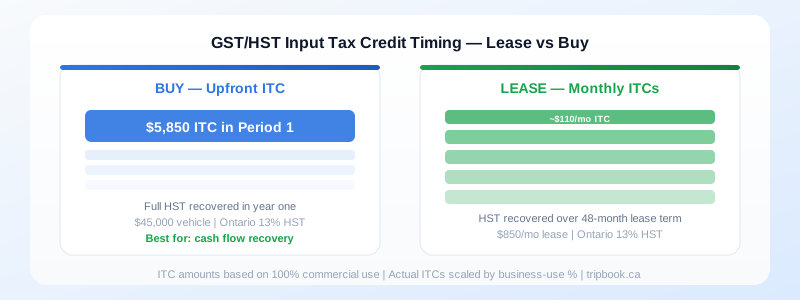
Purchasing: You pay GST/HST on the full vehicle price at the time of sale. If you are a registrant using the vehicle primarily (over 50%) for commercial activities, you claim the full input tax credit (ITC) in the reporting period of acquisition. On a $45,000 vehicle in Ontario (13% HST), that is a $5,850 ITC claimed upfront — a significant one-time cash recovery.
Leasing: You pay GST/HST on each monthly lease payment and claim a proportional ITC each period. On an $850/month lease in Ontario, you recover roughly $110/month in ITCs. Over a 48-month term, the total ITC recovery is similar, but the cash benefit is spread across four years.
For businesses with tight cash flow or quarterly GST/HST filing, the upfront purchase ITC can make a noticeable difference in the first year. For a full breakdown of vehicle ITC rules, see GST/HST input tax credit vehicle.
End-of-Term: Ownership vs Return
What happens when the payments stop matters more than most owners expect.
Buying: You own the vehicle outright. You can continue driving it with no monthly cost while still claiming CCA on the remaining UCC. You can sell it (triggering recapture or terminal loss rules), or trade it in. If the vehicle still has years of service life, the cost-per-year drops substantially.
Leasing: You return the vehicle or exercise a buyout option. Returning means you walk away clean — no depreciation risk, no disposal paperwork. However, excess-kilometre charges can add up quickly. A typical penalty of $0.12 to $0.20 per km over the limit can turn a 20,000 km overage into a $2,400 to $4,000 surprise bill at lease end.
If you plan to keep a vehicle for six or more years, buying almost always wins on total cost. If you prefer to drive a newer vehicle every three to four years, leasing avoids the steepest part of the depreciation curve.
When Each Option Wins
Leasing makes more sense when:
- You drive fewer than 20,000 km/year and will stay within lease kilometre limits
- You want higher, predictable annual deductions from day one
- The vehicle costs more than the $39,000 Class 10.1 cap, making CCA less efficient
- You prefer lower upfront cash outlay and plan to upgrade every few years
Buying makes more sense when:
- You drive high kilometres (over 24,000 km/year) that would trigger lease overage penalties
- You plan to keep the vehicle for five or more years, maximizing post-payment use
- You are purchasing a zero-emission vehicle eligible for the Class 54 enhanced 55% first-year CCA and $61,000 cap
- You want the upfront GST/HST ITC and long-term equity in the asset
Electric vehicles deserve special attention. The Class 54 enhanced 55% first-year CCA with a $61,000 cap makes purchasing an EV significantly more attractive than leasing one. A $55,000 EV purchased in 2026 would generate a first-year CCA deduction of $30,250 before business-use proration — far exceeding any lease deduction scenario. If you are considering an EV, see electric vehicle tax credit Canada 2026 for the full breakdown.
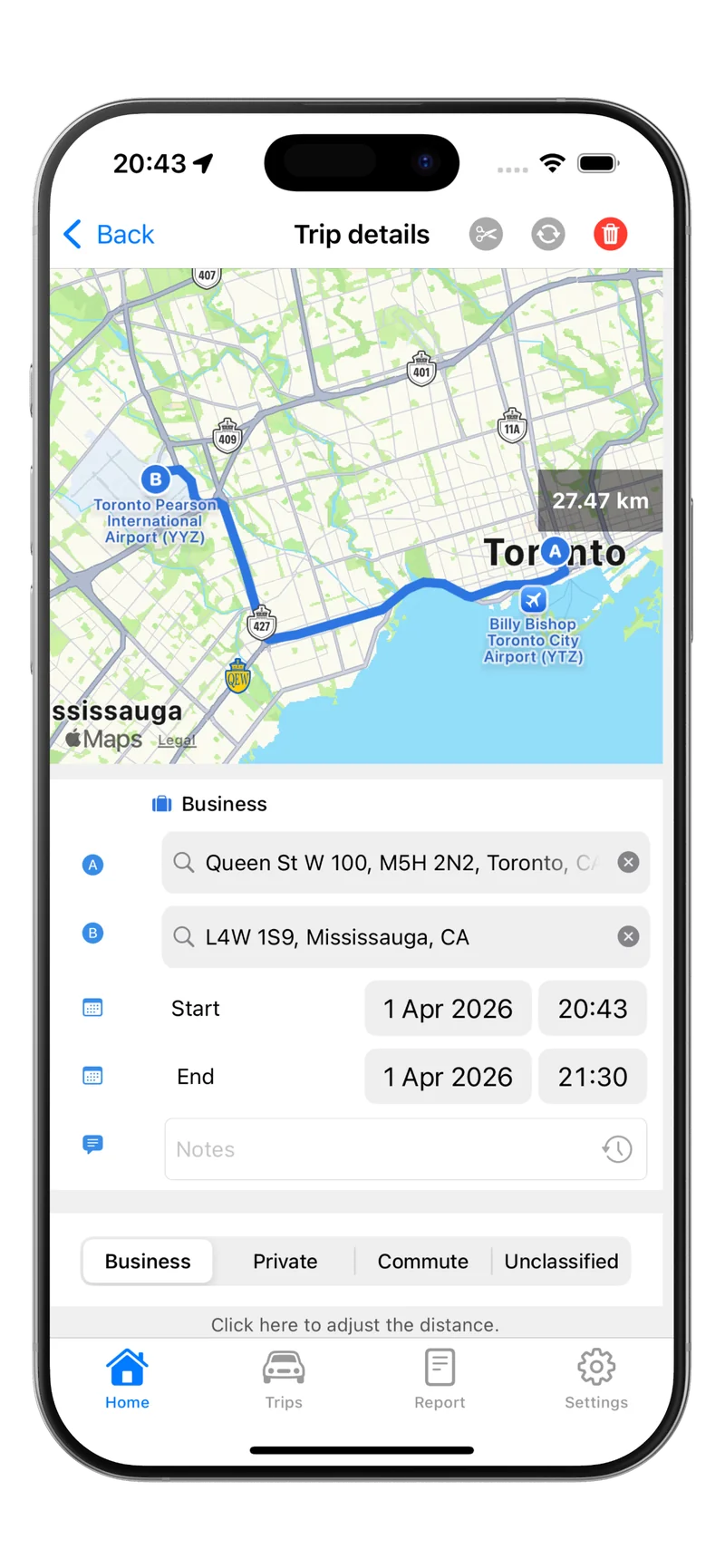
Either way, the deduction depends on your business-use percentage — and that percentage comes from a CRA-compliant mileage log. Every business trip needs a date, destination, purpose, and odometer reading. Tripbook automates this tracking so your log is audit-ready whether you lease or buy. For all deductible vehicle costs beyond CCA and lease payments, see self-employed vehicle expenses Canada.
Make the Right Choice for Your Business
The lease vs buy car business Canada decision ultimately hinges on how long you will keep the vehicle, how many kilometres you drive, and whether the CCA cap or lease cap is more favourable for your price range. Run the numbers for your specific situation using the 2026 limits — $39,000 CCA cap, $1,100/month lease cap, and $350/month interest cap — and factor in your actual business-use percentage.
No matter which route you choose, accurate mileage tracking is the foundation of every vehicle deduction you claim. Download Tripbook to log every business kilometre automatically and keep your records CRA-ready all year long.