Pastors, ministers, and church staff drive extensively for their ministry work. Hospital visits, home visits to congregation members, meetings at satellite church locations, denominational conferences, and community outreach all involve travel that can generate significant mileage deductions. Clergy have a unique tax situation that creates both opportunities and complexities when it comes to deducting business miles.
Understanding how the mileage deduction works for ministry professionals helps ensure you capture every legitimate write-off while staying compliant with IRS rules.
The Unique Tax Status of Clergy
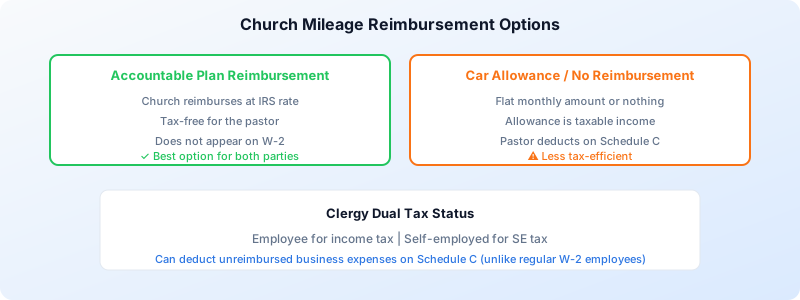
Ministers and clergy occupy an unusual position in the tax code. For federal income tax purposes, most ordained ministers are treated as employees of their church. However, for self-employment tax purposes, they are treated as self-employed individuals. This dual status has important implications for mileage deductions.
Because clergy are considered self-employed for self-employment tax purposes, they can deduct business expenses, including mileage, on Schedule SE and Schedule C (or as an adjustment to their ministerial income). This is a significant advantage over regular W-2 employees, who cannot deduct unreimbursed business mileage under current tax law.
However, the deduction only applies to miles that are not reimbursed by the church. If your church reimburses mileage under an accountable plan, those reimbursements are tax-free but the miles cannot also be deducted.
What Counts as Business Mileage for Clergy?
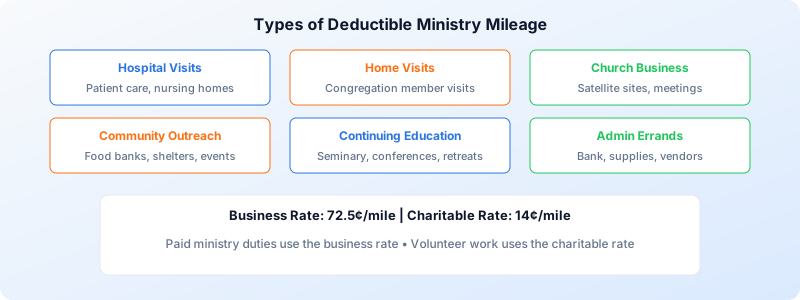
Ministry travel covers a wide range of activities. The following types of trips generally qualify as business mileage for pastors and church staff.
Pastoral Care and Visitation
Driving to hospitals, nursing homes, and private residences to visit congregation members is business travel. These visits are a core function of pastoral ministry and are clearly connected to your work.
Church Business Travel
Travel between the main church campus and satellite locations, community centers, or rented meeting spaces qualifies as business mileage. Trips to denominational offices, presbytery meetings, synod gatherings, or other organizational meetings are also deductible.
Community Outreach and Events
Driving to community events, outreach programs, food banks, shelters, and other ministry-related locations is deductible when the travel serves a business purpose connected to your role.
Continuing Education
Travel to seminary classes, pastoral conferences, retreats, and continuing education events is deductible when the education maintains or improves your professional skills.
Administrative Errands
Trips to the bank, post office, office supply store, or print shop for church business are deductible, as is travel to meet with vendors, contractors, or other professionals on church matters.
Commuting vs Ministry Travel
The IRS does not allow deductions for commuting, which is defined as travel between your home and your regular place of work. For clergy, the regular place of work is typically the church building.
Travel from your home to the church each day is commuting and is not deductible. However, if you travel from the church to a hospital to visit a member and then return to the church, the hospital trip is business mileage.
If your home qualifies as your principal place of business because you maintain a home office where you do substantial administrative or management work, trips from home to the church may qualify as business travel rather than commuting. Many pastors use a home office for sermon preparation, counseling appointments, and church administration. For more on this topic, see our guide on home office mileage deductions.
Charitable Mileage Rate vs Business Mileage Rate
Clergy should understand the difference between the business mileage rate and the charitable mileage rate.
Business mileage rate (72.5 cents per mile in 2026). This applies to miles driven as part of your professional duties, regardless of whether you work for a church or a for-profit business. Ministry travel in your capacity as a pastor or church employee uses this rate.
Charitable mileage rate (14 cents per mile in 2026). This lower rate applies to volunteer driving for charitable organizations. If you volunteer at a food bank or community event in a capacity that is not part of your paid ministry work, the charitable rate applies.
The distinction matters because the business rate is more than five times the charitable rate. Miles driven as part of your paid ministry position should be deducted at the business rate. For more on the charitable rate, see our article on charitable mileage deductions.
Church Reimbursement vs Self-Deduction
Churches can reimburse pastors and staff for mileage in two ways.
Accountable plan reimbursement. The church reimburses mileage at or below the IRS rate based on substantiated records. These payments are tax-free for the recipient and do not appear on the W-2. This is the most tax-efficient approach for both parties.
Non-accountable plan or car allowance. The church pays a flat monthly amount for vehicle use. This is treated as taxable income and reported on the W-2. The pastor can then deduct actual business mileage on Schedule C to offset the allowance.
If your church does not reimburse mileage at all, you can deduct unreimbursed business miles on Schedule C because of your self-employed status for SE tax purposes.
Record-Keeping for Ministry Mileage
The IRS requires the same documentation for ministry mileage as for any business mileage: date, destination, business purpose, and miles driven for each trip. For clergy, the business purpose should describe the ministry activity, such as “hospital visit — John Smith” or “presbytery meeting — First Presbyterian, Springfield.”
Ministry travel often involves many short trips throughout the week, which makes consistent logging essential. A pastor who visits three hospital patients, stops at the church office, and then drives to a committee meeting at a deacon’s home has four or five individual business trips in a single day.
For guidance on what the IRS expects in mileage documentation, review our article on IRS mileage log requirements.
Track Ministry Miles with Tripbook
Pastors and church staff juggle sermon preparation, counseling, administration, and community work. Adding manual mileage tracking to an already full schedule is burdensome. Tripbook automatically records every trip with GPS, lets you tag trips with a ministry purpose, and generates IRS-compliant reports at tax time. For clergy who drive extensively for their ministry, automated mileage tracking ensures every deductible mile is captured without the hassle of paper logs.