
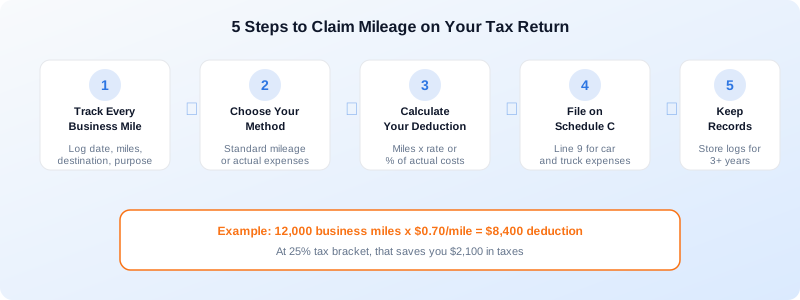
If you’re self-employed and drive for work, every unclaimed business mile is money left on the table. At the 2026 IRS standard mileage rate of 70 cents per mile, a freelancer who drives 12,000 business miles per year can deduct $8,400 from their taxable income. In the 25% tax bracket, that’s $2,100 back in your pocket.
But claiming mileage isn’t as simple as writing a number on your tax return. The IRS has specific rules about which trips qualify, what records you need, and how to report the deduction. This guide walks you through the entire process step by step.
Step 1: Understand Which Miles Qualify
Not every trip you take counts as a business mile. The IRS draws a clear line between business driving and personal driving, and getting it wrong can trigger an audit.
Qualifying business miles include:
- Driving to meet a client or customer
- Traveling to a job site, co-working space, or temporary work location
- Running business errands (post office, bank, supply store)
- Traveling between two work locations in the same day
- Driving to networking events, conferences, or professional development
Miles that do NOT qualify:
- Commuting from home to your regular office or workspace
- Personal errands, even if combined with a business trip
- Driving that isn’t directly connected to your business activity
If you work from a home office, the rules work in your favor. Since your home is your principal place of business, any drive from home to a client, job site, or business errand counts as a deductible business mile. For more details on where the line falls, see our guide on business miles vs. commuting miles.
Step 2: Choose Your Deduction Method
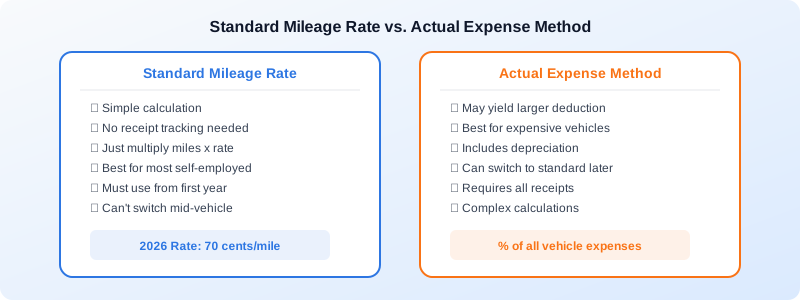
The IRS gives you two ways to calculate your mileage deduction: the standard mileage rate and the actual expense method. You need to choose one, and the choice you make in the first year you use a vehicle for business can affect your options going forward.
Standard Mileage Rate
This is the simpler option. You multiply your total business miles by the IRS rate for the year — 70 cents per mile for 2026. That’s your deduction. You can also deduct parking fees and tolls on top of the standard rate.
The standard mileage rate works well for most self-employed workers, especially those who drive a moderately priced vehicle. It requires less recordkeeping since you don’t need to track individual expenses like gas receipts and repair bills. If you’re wondering whether you can simply deduct fuel costs instead, see our guide on whether you can write off gas for work.
Important restriction: If you want to use the standard mileage rate, you must choose it in the first year you use the vehicle for business. You can switch to the actual expense method later, but you can’t go the other direction — if you start with actual expenses, you can’t switch back to the standard rate for that vehicle.
Actual Expense Method
With this method, you track all costs associated with operating your vehicle — fuel, oil, tires, repairs, insurance, registration, lease payments, and depreciation. Then you calculate the percentage of your total miles that were for business and apply that percentage to your total expenses.
For example, if you drove 20,000 total miles and 12,000 were for business, your business-use percentage is 60%. If your total vehicle expenses were $10,000, your deduction would be $6,000.
The actual expense method can produce a larger deduction if you drive an expensive vehicle or have high operating costs. But it requires tracking every receipt, which is significantly more work. For a deeper comparison, check our article on standard mileage rate vs. actual expenses.
Run the numbers both ways in your first year. You can claim whichever produces the higher deduction, and you'll have the data to make an informed choice going forward.
Step 3: Keep the Right Records
This is where many self-employed workers fall short — and where audits happen. The IRS requires “contemporaneous” records, meaning you need to log trips at or near the time they occur. Reconstructing a year’s worth of mileage from memory at tax time won’t hold up.
For each business trip, your mileage log must include:
- Date of the trip
- Starting location and destination
- Business purpose (who you met, what you did)
- Total miles driven
If you use the actual expense method, you also need receipts for fuel, repairs, insurance, and every other vehicle expense. Under the standard mileage rate, the mileage log alone is sufficient (plus receipts for tolls and parking).
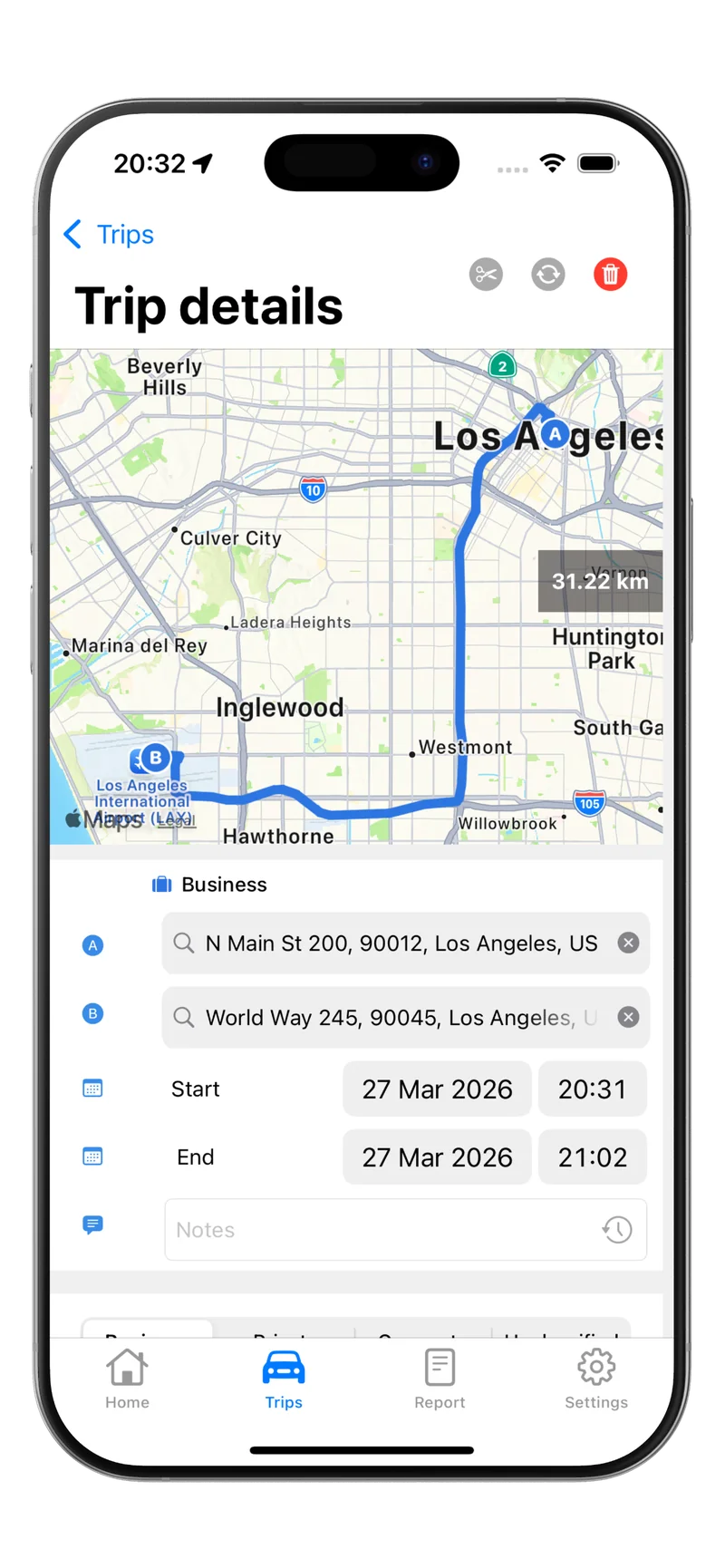
An automatic mileage tracker like Tripbook records all of this in the background using GPS. You classify each trip as business or personal with a swipe, and the app generates reports you can hand directly to your accountant or attach to your return.
For the full list of what the IRS expects, see our guide on IRS mileage log requirements.
Step 4: Report It on Schedule C
As a self-employed individual, you report your mileage deduction on Schedule C (Form 1040), which is the form for reporting profit or loss from a business.
Here’s where to enter your mileage deduction:
- Line 9: Car and truck expenses. Enter your total mileage deduction here. If you use the standard mileage rate, this is simply your business miles multiplied by the rate. If you use the actual expense method, it’s the business-use percentage of your total vehicle costs.
- Part IV: Information on your vehicle. Complete this section with details about your vehicle, including when you placed it in service, total miles driven, business miles driven, and whether you have written documentation to support your claim.
If you also use Form 4562 (Depreciation and Amortization), you’ll report actual expense method depreciation there.
Your Schedule C deduction directly reduces your business income, which in turn reduces both your income tax and your self-employment tax (the 15.3% combined Social Security and Medicare tax that self-employed workers pay).
Step 5: Don’t Forget Quarterly Estimated Taxes
Unlike W-2 employees whose taxes are withheld from each paycheck, self-employed workers must pay estimated taxes quarterly using Form 1040-ES. Your mileage deduction reduces the taxable income you use to calculate these payments.
The quarterly due dates for 2026 are:
- Q1: April 15, 2026
- Q2: June 15, 2026
- Q3: September 15, 2026
- Q4: January 15, 2027
If you’re claiming a significant mileage deduction, factor it into your quarterly estimates so you’re not overpaying throughout the year. Many self-employed workers overpay their estimated taxes because they don’t account for deductions until they file their annual return.
Review your mileage deduction each quarter when calculating estimated taxes. A running total of your business miles helps you project your annual deduction and avoid overpaying.
Common Mistakes That Cost Self-Employed Workers Money
Not tracking miles at all. This is the most expensive mistake. If you drive for work and don’t log your miles, you’re giving up hundreds or thousands of dollars in deductions every year. Even if you only drive 5,000 business miles, that’s a $3,500 deduction at the 2026 rate.
Claiming personal miles as business. Inflating your mileage is a red flag for auditors. Your daily commute to a coffee shop where you work doesn’t count — unless it’s your principal place of business and you’re driving from there to a client meeting.
Rounding or estimating. Entries like “about 50 miles” or “weekly client visits, 200 miles” won’t satisfy the IRS. Each trip needs a specific date, destination, purpose, and mileage figure.
Forgetting to log short trips. A five-mile drive to the post office or a quick run to the office supply store adds up. Over a year, these small trips can represent hundreds of deductible miles that most people never record.
Missing the first-year election. If you plan to use the standard mileage rate, you must elect it in the first year you use the vehicle for business. If you start with actual expenses, you lose the option to switch for that vehicle.
Not keeping records long enough. The IRS can audit returns up to three years after filing (six years if they suspect substantial underreporting). Keep your mileage logs and supporting documents for at least three years after the filing date. For practical steps to prepare, see our IRS mileage audit defense guide.
How Much Can You Actually Save?
The savings depend on how much you drive and your tax bracket. Here are some realistic examples for 2026:
- 5,000 business miles at $0.70/mile = $3,500 deduction. At 22% tax bracket = $770 saved.
- 10,000 business miles = $7,000 deduction. At 24% bracket = $1,680 saved.
- 15,000 business miles = $10,500 deduction. At 32% bracket = $3,360 saved.
These figures don’t include the self-employment tax reduction, which adds roughly 15% more savings on the deducted amount.
Start Tracking Today
The best mileage log is the one you actually keep. Tripbook runs in the background on your iPhone, automatically recording every trip via GPS. At the end of each day, you swipe to classify trips as business or personal, and when tax time comes, you export an IRS-compliant report in seconds. No forgotten trips, no guesswork, no audit risk.