
Choosing between mileage reimbursement vs gas card programs is one of the most common decisions employers face when employees drive for work. Both approaches put money back in employees’ pockets, but the IRS treats them very differently — and picking the wrong option can create thousands of dollars in unnecessary tax liability every year.
This guide walks through how each method works, the tax rules that apply, and the practical trade-offs so you can make the right call.
How Mileage Reimbursement Works
Mileage reimbursement pays employees a set rate for every business mile they drive. The IRS publishes a standard mileage rate each year. For 2026, that rate is 72.5 cents per mile.
Employers can reimburse at the IRS rate, below it, or above it — though anything above the standard rate creates tax complications (more on that below). Employees submit mileage logs documenting the date, destination, business purpose, and distance of each trip, and the company pays based on those reported miles.
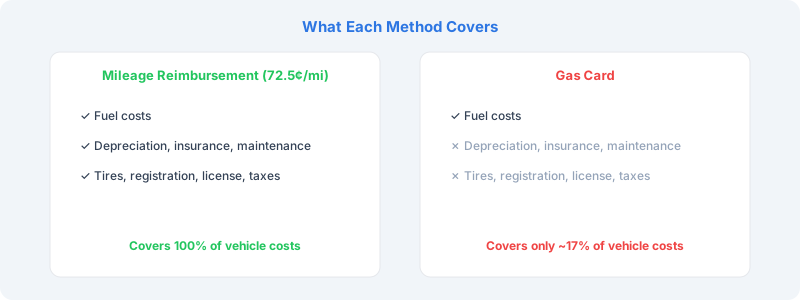
The important detail: the IRS standard rate is designed to cover all vehicle operating costs, not just fuel. That 72.5 cents accounts for gasoline, depreciation, insurance, maintenance, tires, and registration fees combined. Fuel alone represents roughly 17% of total driving costs, so mileage reimbursement provides a far more complete picture of what it actually costs to operate a vehicle.
How Gas Cards Work
A company gas card (or fuel card) gives employees access to an employer-funded account they can use to purchase fuel. Some companies issue branded fleet cards; others reimburse gas receipts directly.
The appeal is obvious — employees never pay for work-related fuel out of pocket, and the process feels straightforward. But from a compliance perspective, gas cards introduce problems that many employers don’t anticipate until audit season.
Gas cards only cover fuel costs. They don’t address depreciation, insurance, maintenance, or any of the other expenses employees incur when driving a personal vehicle for work. And because employees can swipe the card for personal fill-ups just as easily as business ones, separating business use from personal use becomes a constant administrative challenge.
Tax Treatment: The Key Difference
The IRS rules around mileage reimbursement vs gas card programs create a significant gap in tax efficiency. Understanding this difference is critical for both employers and employees.
Mileage Reimbursement Under an Accountable Plan
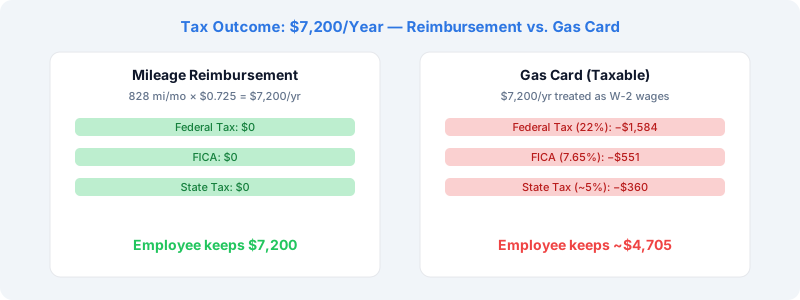
When an employer reimburses mileage at or below the IRS rate through an accountable plan, those payments are completely tax-free for the employee. They don’t appear on the W-2, and the employer owes no FICA taxes on the reimbursed amount.
An accountable plan requires three things:
- Business connection — the expense must have a clear business purpose
- Adequate accounting — the employee must document trips with dates, miles, destinations, and purposes
- Return of excess — any reimbursement above actual documented expenses must be returned
Meet all three requirements and the reimbursement stays entirely off the tax rolls. For a detailed breakdown, see our guide on whether mileage reimbursement is taxable.
Gas Cards Are Taxable by Default
Here’s where gas cards run into trouble. The IRS treats company gas cards as taxable compensation unless the employer can prove that every dollar of fuel purchased was used for business driving only.
In practice, this is extremely difficult. Unlike mileage reimbursement — where the per-mile rate ties directly to documented trips — gas card spending has no built-in connection to specific business miles. An employee might fill a 15-gallon tank but only use 8 gallons for business driving. Without a corresponding mileage log proving exactly which gallons went to business use, the entire purchase is taxable income.
When gas card expenses are treated as taxable:
- The employee pays federal and state income tax on the amount
- Both employer and employee pay FICA taxes (7.65% each)
- The employer faces additional payroll tax overhead
- The amounts must be reported on the employee’s W-2
Even if you try to run a gas card through an accountable plan, you still need detailed mileage logs to substantiate business use — which effectively means you’re tracking mileage anyway, eliminating the simplicity advantage gas cards are supposed to provide.
Side-by-Side Comparison
| Factor | Mileage Reimbursement | Gas Card |
|---|---|---|
| 2026 IRS rate | 72.5 cents/mile | N/A (actual fuel costs) |
| Tax-free for employee? | Yes, under an accountable plan | Only if 100% business use is proven |
| Employer FICA savings? | Yes — no payroll tax on reimbursements | No — taxable portions incur FICA |
| What costs are covered? | Gas, depreciation, insurance, maintenance, tires | Fuel only |
| Documentation required | Mileage log with trip details | Mileage log + per-purchase fuel tracking |
| Fraud/misuse risk | Lower (tied to documented miles) | Higher (personal use hard to separate) |
| Fairness across employees | Same rate for everyone | Varies by vehicle fuel efficiency |
Why the OBBBA Makes This Decision More Important
Before 2018, W-2 employees who paid unreimbursed vehicle expenses out of pocket could recover some of that cost through an itemized deduction on their tax return. The TCJA suspended that deduction starting in 2018, and the One Big Beautiful Bill Act (OBBBA) has now made the suspension permanent.
This means W-2 employees have no fallback. If your company provides a gas card that doesn’t cover all driving costs — or if gas card benefits get taxed because business use isn’t properly documented — employees cannot deduct the difference on their personal returns. The only path to tax-free reimbursement is through the employer’s accountable plan.
For employers, this raises the stakes. Choosing an inefficient reimbursement method directly reduces your employees’ take-home compensation with no way for them to make up the shortfall at tax time.
When a Gas Card Might Make Sense
Gas cards aren’t always the wrong choice. They can work in narrow situations:
- Company-owned fleet vehicles — when the company owns the vehicle and pays all operating costs, a gas card tied to that specific vehicle simplifies fuel purchasing. Personal use isn’t an issue because the vehicle stays in the fleet.
- Defined routes with centralized fueling — delivery companies with set routes and on-site fuel stations can control and document usage more easily.
Outside these scenarios, per-mile reimbursement almost always wins on tax efficiency, compliance simplicity, and fairness.
How to Set Up a Compliant Mileage Reimbursement Program
Getting mileage reimbursement right isn’t complicated, but it does require a system. Here’s what you need:
- Write an accountable plan policy that spells out the reimbursement rate, documentation requirements, and the process for returning excess payments.
- Set your per-mile rate at or below the IRS standard rate of 72.5 cents per mile for 2026.
- Require trip-level documentation — every reimbursable trip needs a date, starting point, destination, business purpose, and miles driven.
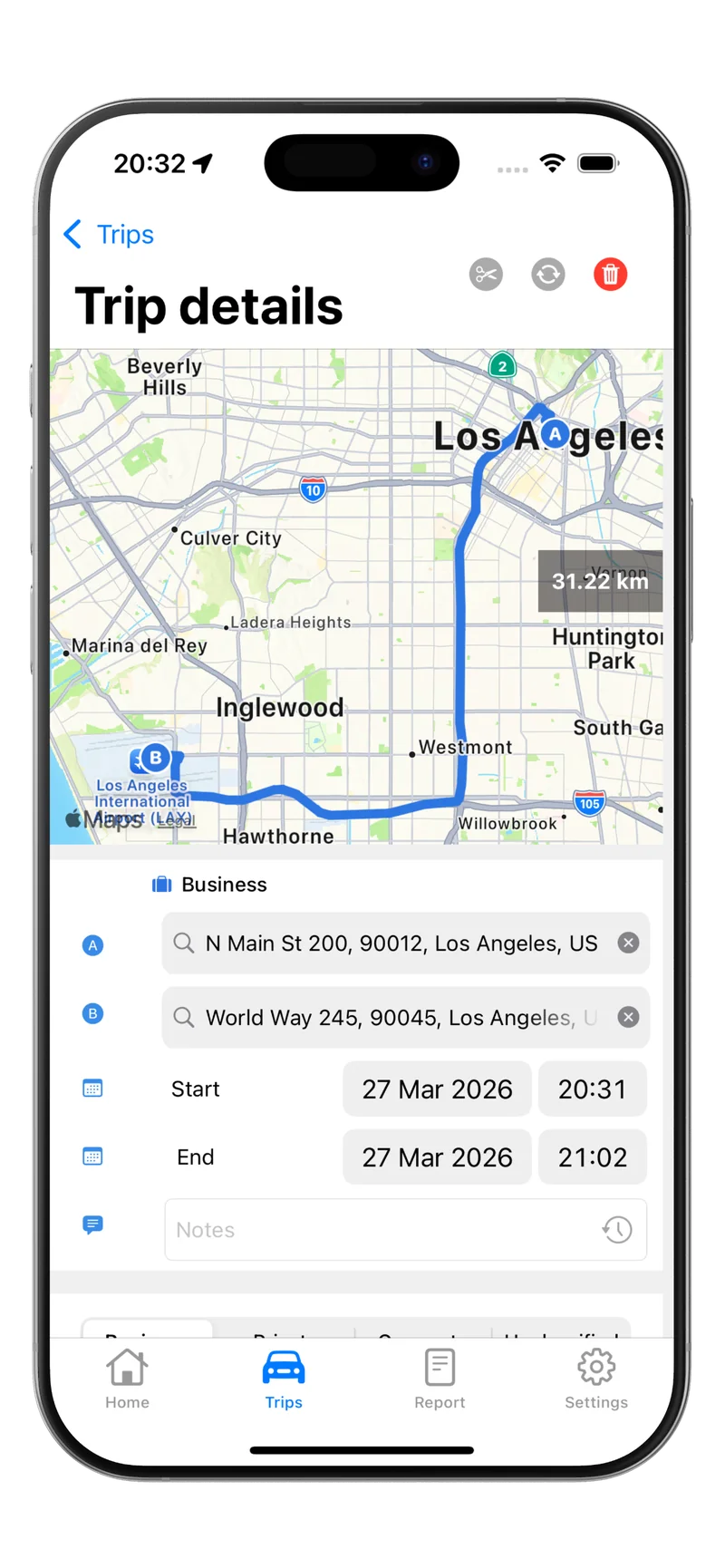
- Use a mileage tracking app to eliminate manual logging errors. Tools like Tripbook automatically record GPS-verified trips, so employees capture IRS-compliant records without writing anything down.
- Process reimbursements on a regular schedule — monthly or per pay period — and keep records for at least three years.
For a full walkthrough on building your policy, see our employer mileage reimbursement best practices guide.
The Bottom Line on Mileage Reimbursement vs Gas Card
For most employers with employees driving personal vehicles for work, mileage reimbursement vs gas card is not a close call. Per-mile reimbursement under an accountable plan is tax-free for employees, avoids FICA for employers, covers the full cost of vehicle operation, and is straightforward to administer with the right tools.
Gas cards create tax headaches, cover only a fraction of actual driving costs, and require just as much documentation as mileage reimbursement to stay compliant — yet still fall short on fairness and coverage.
The easiest way to manage the switch is to start tracking miles automatically. Download Tripbook to give your team GPS-verified mileage logs that satisfy IRS requirements — no manual entry, no spreadsheets, no compliance gaps.