Active-duty military members are among the few taxpayers who can still deduct moving expenses on their federal tax return. When you receive Permanent Change of Station (PCS) orders, the miles you drive to your new duty station are deductible, along with other qualified moving costs. This deduction is especially valuable for service members who choose a Personally Procured Move (PPM, formerly called a DITY move) or who drive their own vehicles to a new assignment.
Understanding the PCS mileage deduction rules helps military families maximize their tax benefits during an already stressful time.
Why Military Members Can Still Deduct Moving Expenses
The Tax Cuts and Jobs Act of 2017 suspended the moving expense deduction for most taxpayers through 2025, and subsequent legislation has extended this suspension. However, Congress carved out an explicit exception for active-duty members of the Armed Forces who move pursuant to a military order for a permanent change of station.
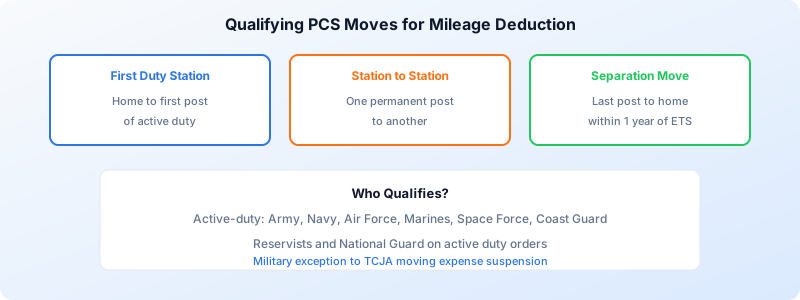
This means that if you are on active duty in the Army, Navy, Air Force, Marine Corps, Space Force, or Coast Guard, and you move because of PCS orders, you can deduct your moving expenses on Form 3903. This deduction is available regardless of whether you itemize deductions; it is an above-the-line deduction that reduces your adjusted gross income.
Reservists and National Guard members can also claim this deduction if they are called to active duty and receive PCS orders.
What Qualifies as a PCS Move?
A permanent change of station includes a move from your home to your first post of active duty, a move from one permanent post to another, and a move from your last post of duty to your home or a nearer point in the United States within one year of ending active duty.
The key requirement is that the move must be incident to military orders. Voluntary relocations, moves for personal convenience, or moves that are not connected to a change of station do not qualify.
How the PCS Mileage Deduction Works
When you drive your personal vehicle from your old duty station to your new duty station, you can deduct the mileage at the IRS standard mileage rate for moving purposes. For 2026, the moving mileage rate is 24 cents per mile. Note that this is different from the business mileage rate of 72.5 cents per mile; moving expenses use a separate, lower rate.
In addition to the per-mile rate, you can deduct parking fees and tolls incurred during the move. You cannot deduct meals, lodging, or general travel expenses. The deduction covers the cost of operating your vehicle over the distance of the move.
Calculating Your Deduction
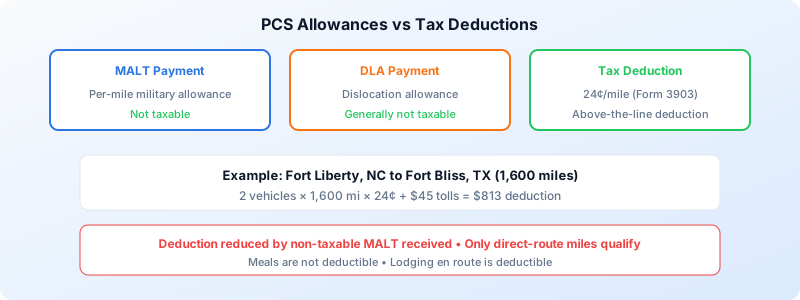
Suppose you receive PCS orders to move from Fort Liberty, North Carolina, to Fort Bliss, Texas, a distance of approximately 1,600 miles. If you drive two vehicles (one for each spouse), the calculation works as follows:
- Vehicle 1: 1,600 miles x $0.24 = $384
- Vehicle 2: 1,600 miles x $0.24 = $384
- Tolls: $45
- Total moving mileage deduction: $813
While the per-mile rate is lower than the business rate, the deduction can still be meaningful for long-distance PCS moves, especially when combined with other deductible moving costs.
For more on the general moving mileage deduction rules, see our guide on moving mileage deductions.
Other Deductible PCS Moving Costs
The mileage deduction is just one piece of the PCS moving expense puzzle. You can also deduct the cost of packing, crating, and transporting household goods and personal effects, as well as storage and insurance for those items for up to 30 days. The cost of shipping your vehicle and connecting or disconnecting utilities that are required because of the move may also qualify.
Lodging during the actual travel days of the move is deductible, but meals are not. The lodging must be en route to the new duty station and cannot include hotel stays at the origin or destination while you wait for housing.
PCS Mileage vs Dislocation Allowance and MALT
The military provides several travel allowances during a PCS that interact with the tax deduction.
Monetary Allowance in Lieu of Transportation (MALT). This is the per-mile payment the military provides when you drive your own vehicle to a new duty station. MALT is not taxable income. However, you must reduce your mileage deduction by the amount of MALT received if MALT exceeds your actual deductible expenses.
Dislocation Allowance (DLA). This flat-rate payment helps cover miscellaneous moving expenses. DLA is generally not taxable.
Temporary Lodging Expense (TLE). Reimbursement for temporary lodging near your old or new duty station. TLE is typically not taxable.
The general rule is that you can only deduct moving expenses to the extent they exceed the non-taxable reimbursements you receive from the military. If the military’s MALT payment covers your entire driving cost, there is no additional deduction to claim. If your actual driving expenses exceed MALT, you can deduct the difference.
Filing Your PCS Moving Deduction
To claim the deduction, file Form 3903 (Moving Expenses) with your federal tax return. You will need records of the miles driven, the route taken, tolls and parking fees, and documentation of your PCS orders.
The deduction flows to line 14 of Schedule 1 (Form 1040), reducing your adjusted gross income. Because it is an above-the-line deduction, you benefit from it whether you take the standard deduction or itemize.
Keep copies of your PCS orders, travel vouchers, MALT and DLA payment records, and a mileage log documenting your drive. If you took a detour for personal reasons (such as visiting family en route), only the direct-route mileage is deductible.
State Tax Considerations
Many states follow the federal treatment and allow military members to deduct PCS moving expenses. However, the rules vary by state, and your state of legal residence may differ from your duty station state. Some states with no income tax, such as Texas, Florida, and Nevada, make this a non-issue. Others require separate state forms.
Military members should consult their installation’s tax assistance center or a military-friendly tax professional for state-specific guidance. For an overview of state mileage rules, see our guide on state mileage reimbursement laws.
Track Your PCS Miles with Tripbook
PCS moves are hectic, and documenting mileage manually while driving across the country adds stress. Tripbook automatically records your route and mileage using GPS, making it easy to generate an accurate mileage log for your Form 3903. Start tracking when you leave your old duty station and stop when you arrive at the new one. Tripbook captures the distance, route, and dates, giving you the documentation you need for your tax return without the hassle of writing down odometer readings at every fuel stop.