
Texas has no state income tax, which makes federal mileage deductions even more valuable for Lone Star State drivers. Every business mile you track at the 2026 IRS rate of 72.5 cents per mile directly reduces your federal tax bill without the complication of state-level adjustments. This Texas mileage deduction guide covers everything you need to claim every dollar.
With sprawling metro areas and long distances between cities, Texas professionals log some of the highest business mileage in the country. A self-employed contractor in the Dallas-Fort Worth metroplex driving 25,000 business miles per year earns a deduction of $18,125. That is real money that stays in your pocket.
Texas Mileage Reimbursement: No State Mandate for Private Employers
Unlike California or Illinois, Texas has no state law requiring private employers to reimburse employees for business mileage. There is no Texas mileage reimbursement statute for the private sector.
This means Texas employers can choose to reimburse mileage or not. Many do, especially for roles that require regular driving like sales, delivery, and field service. But the decision is entirely voluntary.
The one exception involves the federal Fair Labor Standards Act. If unreimbursed driving expenses push an employee’s effective hourly rate below the federal minimum wage of $7.25 per hour, the employer must cover the difference. This primarily affects low-wage workers with heavy driving requirements.
For Texas state employees, the rules are different. The State Comptroller sets the reimbursement rate at the IRS standard of 72.5 cents per mile for 2026, though agencies can adopt a lower rate with written notice to employees.
Who Can Deduct Business Mileage in Texas
Your ability to claim a mileage deduction depends on your employment classification, not your state.
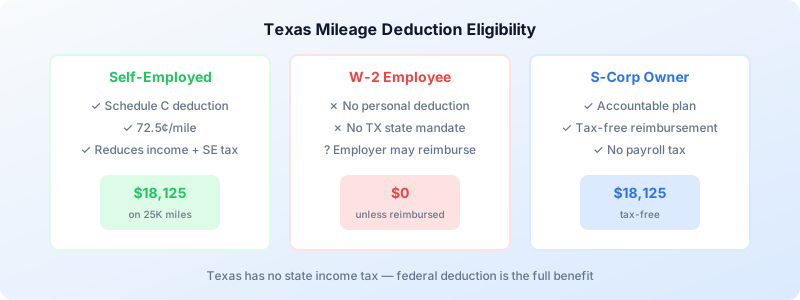
Self-employed individuals and independent contractors deduct business mileage on Schedule C of their federal Form 1040. This includes freelancers, gig workers, sole proprietors, and single-member LLC owners. The deduction reduces both federal income tax and self-employment tax (15.3 percent).
W-2 employees cannot deduct unreimbursed business mileage on their federal return. This deduction was permanently eliminated by the One Big Beautiful Bill Act signed in 2025. If your employer does not reimburse you, the cost comes out of your pocket with no tax benefit.
S-Corp and C-Corp owners handle mileage through their corporation. The company reimburses the owner-employee under an accountable plan, and the corporation deducts the reimbursement as a business expense. See our S-Corp mileage reimbursement guide for details.
The Texas No-Income-Tax Advantage
Texas is one of nine states with no personal income tax. This creates a unique advantage for mileage deductions.
In states with income tax, your mileage deduction reduces both federal and state taxes. In Texas, the deduction only reduces federal taxes. That might sound like a disadvantage, but the opposite is true. Texas residents already pay zero state tax on all income, including mileage reimbursements. You get the federal deduction benefit without the state tax burden that residents of California, New York, or Illinois face.
For self-employed Texans, the federal mileage deduction is worth its full face value. A $15,000 mileage deduction at a 24 percent federal tax bracket plus 15.3 percent self-employment tax saves you approximately $5,895 in taxes. There is no state tax offset to worry about.
Mileage Deduction Methods for Texas Drivers
Texas drivers use the same two federal methods available to all US taxpayers.
Standard mileage rate. Multiply your total business miles by 72.5 cents for 2026. This rate covers gas, maintenance, insurance, depreciation, and all other vehicle costs. You can add parking fees and tolls on top. This method works well for most drivers and requires less record-keeping.
Actual expense method. Track every vehicle-related cost, calculate the total, and multiply by your business-use percentage. Texas-specific factors that might favor this method include higher fuel costs for drivers covering long rural distances, premium insurance rates in urban areas like Houston and Dallas, and accelerated wear on vehicles driven on unpaved ranch roads or construction sites.
For a detailed comparison of both methods, see our guide on the standard mileage rate vs actual expenses.
Texas Industries With High Business Mileage
Several industries that dominate the Texas economy involve heavy driving.
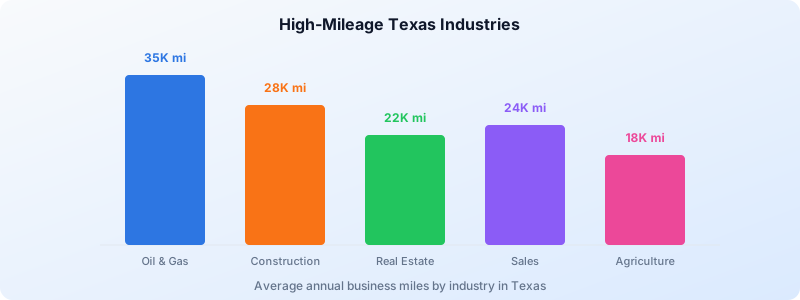
Oil and gas. Field workers, inspectors, and consultants in the Permian Basin and Eagle Ford Shale routinely drive 30,000 to 40,000 miles per year visiting well sites, pipelines, and processing facilities.
Construction. General contractors and subcontractors travel between job sites, supply yards, and inspection offices. Texas construction boom areas like Austin, San Antonio, and the I-35 corridor create long daily routes.
Agriculture and ranching. Farm and ranch operators covering large properties and traveling between locations accumulate significant mileage. Every mile driven for livestock management, feed runs, or equipment repair is a business mile.
Real estate. Texas real estate agents showing properties across sprawling metro areas can easily drive 20,000 business miles per year. See our dedicated guide on mileage tracking for real estate agents.
Sales. Outside sales reps covering Texas territories face some of the longest drives in the country. Dallas to Houston is 240 miles. San Antonio to Austin is 80 miles. These inter-city trips add up fast.
Texas Franchise Tax Considerations for LLCs
While Texas has no personal income tax, it does impose a franchise tax (also called the margin tax) on LLCs and corporations. The franchise tax applies to businesses with total revenue exceeding $2.47 million.
For businesses below that threshold, the franchise tax obligation is zero, meaning the mileage deduction strategy remains purely a federal matter. For larger businesses, the franchise tax calculation uses revenue minus certain deductions, and vehicle reimbursements paid to employees are deductible business expenses that reduce the franchise tax base.
Tracking Mileage in a Spread-Out State
Texas geography creates unique tracking challenges. Here are strategies that work.
Use automatic GPS tracking. With long drives between cities and multiple stops per day, manual logging is impractical. Tripbook records every trip automatically using GPS and motion detection, capturing distances even on rural roads without strong cell signal thanks to offline functionality.
Track inter-city travel separately. A 240-mile drive from Dallas to Houston is a single deductible trip worth $174 at the IRS rate. Make sure long-distance business travel gets captured alongside short local trips.
Log fuel stops on long trips. While the standard mileage rate already covers fuel, keeping fuel receipts as backup documentation supports your mileage claim if questions arise during an audit.
Export reports quarterly. If you make estimated tax payments (required for most self-employed Texans), pull mileage reports each quarter to calculate accurate estimates. Tripbook exports reports by date range in XLS, CSV, or PDF formats.
Maximize Your Texas Mileage Deduction
Texas drivers benefit from a combination of no state income tax, high business mileage potential, and a generous federal deduction rate. The only requirement is accurate records. Track every business mile, classify trips consistently, and export your logs for tax time.
Download Tripbook and make sure every mile you drive across Texas counts toward your tax deduction.