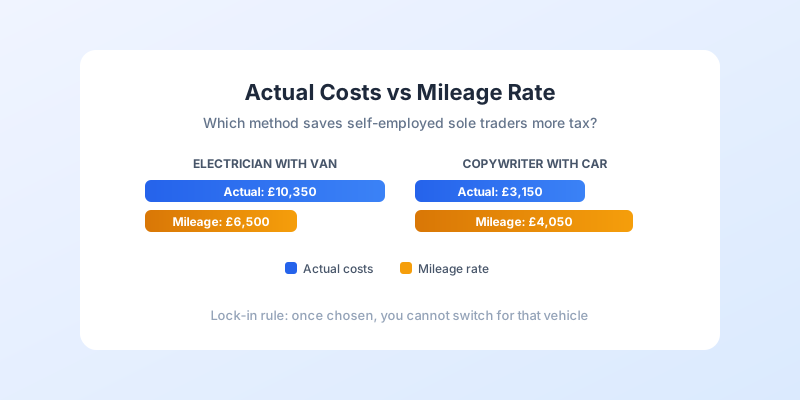
Every self-employed sole trader who drives for business faces a critical tax decision: claim the HMRC simplified expenses mileage rate, or total up your actual vehicle running costs? The difference can be thousands of pounds per year, and thanks to the lock-in rule, the choice you make on your first tax return for that vehicle is permanent.
This guide compares actual costs vs mileage rate self-employed methods with worked examples, explains the lock-in rule, and gives you a framework for choosing before your first Self Assessment.
How the Two Methods Work
HMRC gives sole traders and business partnerships two ways to claim vehicle expenses. You must choose one per vehicle, and each has a fundamentally different approach to calculating your deduction.
Simplified expenses (the mileage rate)
You claim a flat rate for every business mile driven:
| Mileage band | Rate per mile |
|---|---|
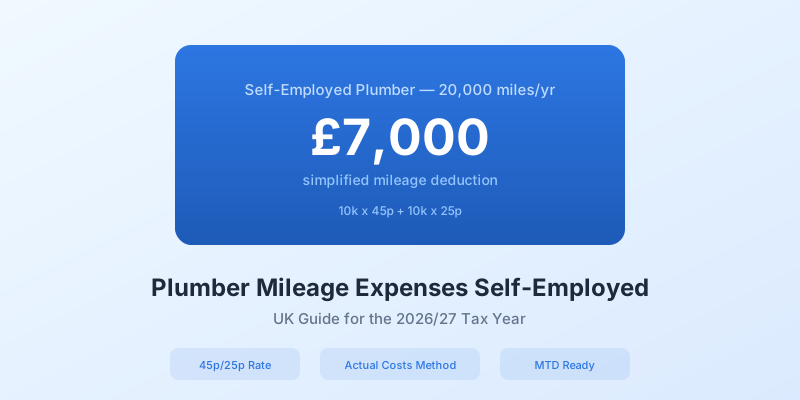
| First 10,000 business miles | 45p |
| Each mile above 10,000 | 25p |
That single figure is designed to cover everything: fuel, insurance, road tax, servicing, tyres, depreciation, and breakdown cover. You do not claim any of those costs separately. The only records you need are a mileage log showing the date, destination, purpose, and distance of each business trip.
Actual costs method
You add up every penny you spend running the vehicle during the tax year: fuel, insurance, road tax, MOT, servicing, repairs, breakdown cover, finance or lease payments, and — for purchased vehicles — capital allowances on the purchase price. You then calculate your business-use percentage (business miles divided by total miles) and claim that proportion.
For example, if your total running costs are £9,000 and 70% of your mileage is for business, you claim £9,000 x 70% = £6,300.
The Lock-In Rule: Why Your First Choice Is Final
This is the single most important thing to understand before filing. Once you use either method for a specific vehicle on a Self Assessment tax return, you are locked into that method for as long as you use that vehicle in your business. You cannot switch from mileage to actual costs, or from actual costs to mileage, for the same vehicle — ever.
The lock-in applies per vehicle, not per business. If you replace your car with a new one, you get a fresh choice for the replacement. But for the vehicle you have already claimed on, the decision is irreversible.
This means rushing into your first return without running the numbers could cost you hundreds or thousands of pounds every single year until you change vehicles. It is worth spending an hour with a calculator before you file.
Worked Examples: When Each Method Wins
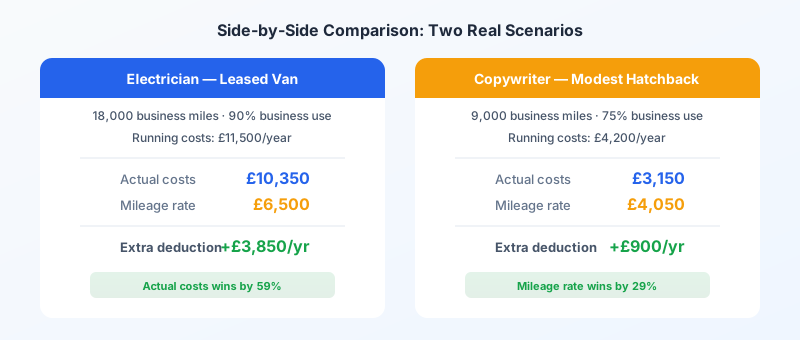
Sarah — self-employed copywriter with a modest hatchback
- Annual business miles: 9,000
- Total vehicle running costs: £4,200 (fuel £1,800, insurance £650, road tax £180, servicing and MOT £420, depreciation £1,150)
- Business use: 75%
| Method | Calculation | Deduction |
|---|---|---|
| Mileage rate | 9,000 miles x 45p | £4,050 |
| Actual costs | £4,200 x 75% | £3,150 |
The mileage rate gives Sarah £900 more per year. At the basic rate of income tax (20%), that saves her an extra £180 annually. Over five years with the same car, that adds up to £900 in real tax savings — all from making the right choice on day one.
The mileage rate tends to win when your car is relatively cheap to run, your annual mileage sits below 10,000 business miles, and you want the simplest possible record-keeping.
James — self-employed electrician with a leased van
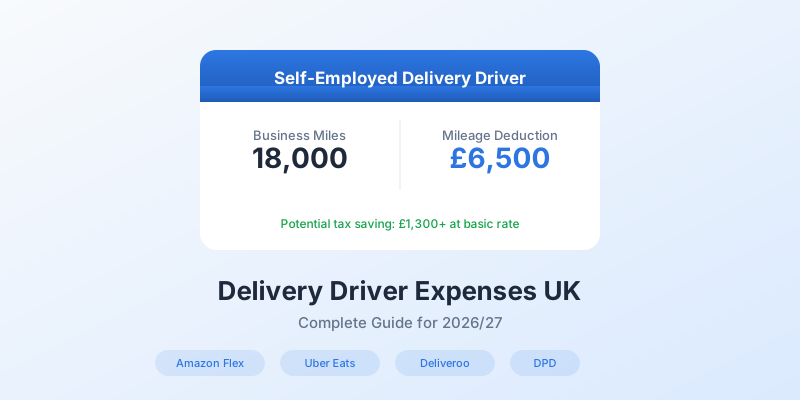
- Annual business miles: 18,000
- Total vehicle running costs: £11,500 (fuel £4,200, lease payments £4,800, insurance £1,100, road tax £290, servicing £680, tyres £430)
- Business use: 90%
| Method | Calculation | Deduction |
|---|---|---|
| Mileage rate | (10,000 x 45p) + (8,000 x 25p) | £6,500 |
| Actual costs | £11,500 x 90% | £10,350 |
Actual costs give James £3,850 more per year. At the basic rate, that is £770 extra off his tax bill annually. If James is a higher-rate taxpayer (40%), the saving jumps to £1,540 per year.
Actual costs tend to win when your vehicle has high running costs (expensive lease, heavy fuel use, frequent servicing), your business-use percentage is very high, and you are comfortable keeping every receipt. Tradespeople with vans are often significantly better off on actual costs.
Capital Allowances: The Hidden Advantage of Actual Costs
If you own your vehicle (rather than leasing it) and choose actual costs, you can also claim capital allowances on the purchase price. This is where the gap between the two methods can widen even further, particularly for vans.
Cars follow CO2-based writing down allowance rules:
| Car type | Allowance | Rate from April 2026 |
|---|---|---|
| New zero-emission (electric) | 100% First Year Allowance | Full cost in year one |
| CO2 emissions 50g/km or less | Main rate pool | 14% per year (reducing balance) |
| CO2 emissions above 50g/km | Special rate pool | 6% per year (reducing balance) |
Note that the main rate falls from 18% to 14% from April 2026, making low-emission petrol and diesel cars slightly less favourable on capital allowances going forward.
Car capital allowances are also restricted by your private-use percentage. If your car is 80% business use, you can only claim 80% of the writing down allowance.
Vans are treated as plant and machinery, which means they qualify for the Annual Investment Allowance (AIA). The AIA lets you deduct up to £1,000,000 of the purchase price in full in the year you buy the van. For most self-employed tradespeople, this means the entire van cost is deductible in year one — a massive advantage over the mileage rate.
This is why actual costs are so often better for van owners. If James bought his van for £30,000 instead of leasing it, he could claim £27,000 (90% business use) via AIA in year one on top of his running costs.
Record-Keeping: What Each Method Demands
The two methods have very different paperwork requirements, and this is a genuine factor in the decision.
Mileage rate record-keeping:
- A mileage log recording date, start and end points, business purpose, and distance for every business trip
- No receipts required for fuel, insurance, servicing, or anything else vehicle-related
Actual costs record-keeping:
- Every receipt and invoice for fuel, insurance, road tax, MOT, servicing, repairs, breakdown cover, and lease or finance statements
- A mileage log to calculate your business-use percentage (business miles divided by total miles)
- Capital allowance calculations if you own the vehicle
Whether you choose the mileage rate or actual costs, you need a mileage log. Tripbook automates this entirely — it tracks your business trips by GPS and generates an HMRC-ready log, so your mileage records are always accurate and available if HMRC asks questions. For actual costs, you will still need to keep your vehicle expense receipts separately, but the mileage side is handled.
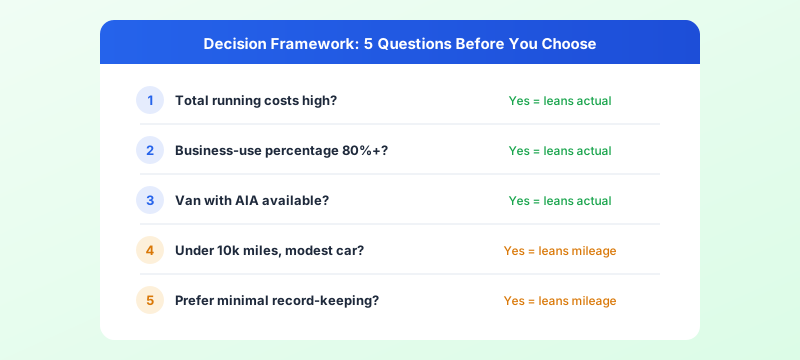
Decision Framework: Five Questions to Ask
Before you file your first Self Assessment for a vehicle, work through these questions:
1. What are your total annual vehicle running costs? Add up fuel, insurance, road tax, MOT, servicing, repairs, lease or finance costs, and breakdown cover. If the total is high relative to your mileage, actual costs likely wins.
2. What is your business-use percentage? The higher your business use, the more actual costs benefits you. At 90%+ business use, actual costs almost always produces a larger deduction.
3. Do you own or lease? If you own a van, the AIA can make actual costs dramatically better. If you own a car, the writing down allowance rates (especially at 6% for higher-emission cars) may reduce the advantage.
4. How many business miles do you drive? The 45p rate is relatively generous for the first 10,000 miles. If your mileage is low to moderate and your costs are modest, the mileage rate often comes out ahead or very close.
5. How much admin are you willing to do? The mileage rate is simpler. If the two methods produce similar deductions, the lower admin burden of simplified expenses has real value.
Run both calculations before you commit. Use Tripbook to track your mileage accurately from day one — whichever method you choose, the mileage log is essential.
Remember that the lock-in applies per vehicle. When you replace your business vehicle, you start fresh and can choose either method for the new one — so a vehicle change is your moment to reassess.

For a full breakdown of the 45p rate, see our 45p per mile HMRC explained guide. For capital allowances in detail, read our capital allowances on cars UK guide. And if you are deciding between leasing and buying, our lease vs buy car for business guide covers the tax implications.