Every financial year, Australian taxpayers wait for the ATO to announce the cents per kilometre rate — the figure used to calculate car expense deductions under the simplified method. With the 2025–26 rate set at 88 cents, the question on everyone’s mind is: what will the cents per km rate for 2026–27 look like?
This guide reviews how the rate is determined, what historical trends suggest, and how to prepare regardless of the outcome.
How the ATO sets the rate
The cents per kilometre rate is not an arbitrary figure. The ATO determines it based on an estimate of the average cost of operating a vehicle in Australia, taking into account:
- Fuel prices
- Insurance premiums
- Registration costs
- Servicing and maintenance
- Depreciation (decline in value)
The rate is set by a Taxation Determination issued before or at the start of each financial year. It reflects a broad average — it does not account for your specific vehicle, location, or driving patterns.
Historical rate changes
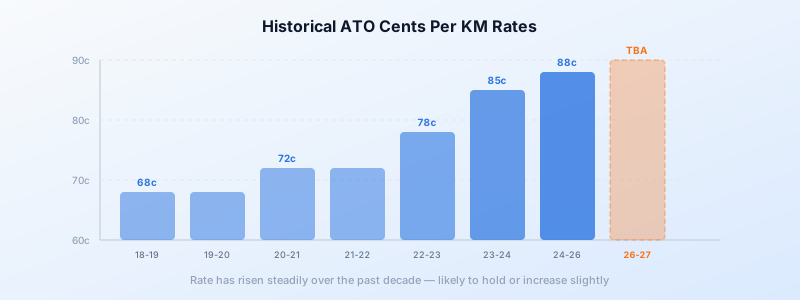
| Financial year | Rate (cents per km) |
|---|---|
| 2026–27 | To be announced |
| 2025–26 | 88 |
| 2024–25 | 88 |
| 2023–24 | 85 |
| 2022–23 | 78 |
| 2021–22 | 72 |
| 2020–21 | 72 |
| 2019–20 | 68 |
| 2018–19 | 68 |
The rate has risen steadily over recent years, driven by increases in fuel costs, insurance premiums, and the general cost of motoring. The 2024–25 to 2025–26 period saw no change, with the rate holding at 88 cents.
What could happen in 2026–27
Several factors will influence whether the rate increases, stays flat, or (less likely) decreases:
Arguments for an increase:
- Insurance premiums continue to rise across Australia
- Servicing and parts costs have increased due to supply chain pressures
- If fuel prices spike during 2025–26, the ATO’s modelling may reflect this
Arguments for no change:
- Fuel prices have stabilised or fallen from their 2022–23 peaks
- The ATO tends to make incremental changes rather than large jumps
- Electric vehicle running costs could begin to influence the average downward
A realistic expectation: Based on recent trends, the 2026–27 rate is likely to remain at 88 cents or increase marginally to 89–91 cents. A decrease would be unusual given the broad upward trend in motoring costs.
The ATO typically publishes the new rate in a Taxation Determination before 1 July. We will update this article once the 2026–27 rate is confirmed.
How the cents per km method works
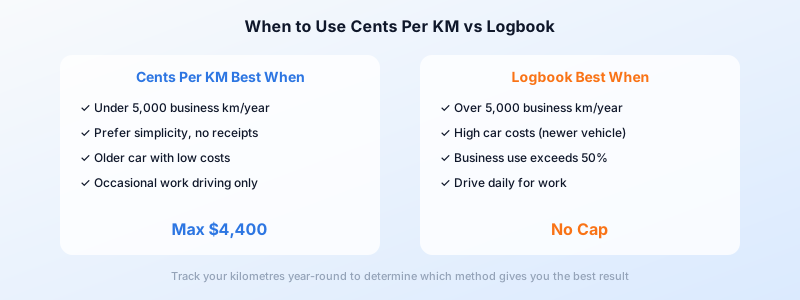
Under this method, you claim a flat rate for every business kilometre you drive, up to a maximum of 5,000 km per car per year. At 88 cents, the maximum deduction is $4,400.
You do not need receipts for fuel, servicing, or other running costs. However, you must be able to demonstrate:
- You own or lease the car
- The kilometres you are claiming are genuinely work-related
- How you calculated the number of kilometres
The ATO expects a reasonable basis for your estimate — not a guess. A trip diary or tracking app provides this evidence.
When the logbook method is better
If you drive more than 5,000 business kilometres per year, the cents per km method leaves money on the table. The logbook method has no kilometre cap and is based on your actual expenses, which means high-mileage workers almost always claim more.
Consider the logbook method if:
- You are a sales rep, tradesperson, delivery driver, or healthcare worker covering large distances
- Your vehicle costs are high (e.g., a newer car with significant depreciation)
- Your business-use percentage exceeds 50%
Our logbook vs cents per km comparison breaks down the numbers for different scenarios.
How to prepare for 2026–27
Regardless of what the new rate turns out to be, the best preparation is accurate kilometre tracking throughout the year.
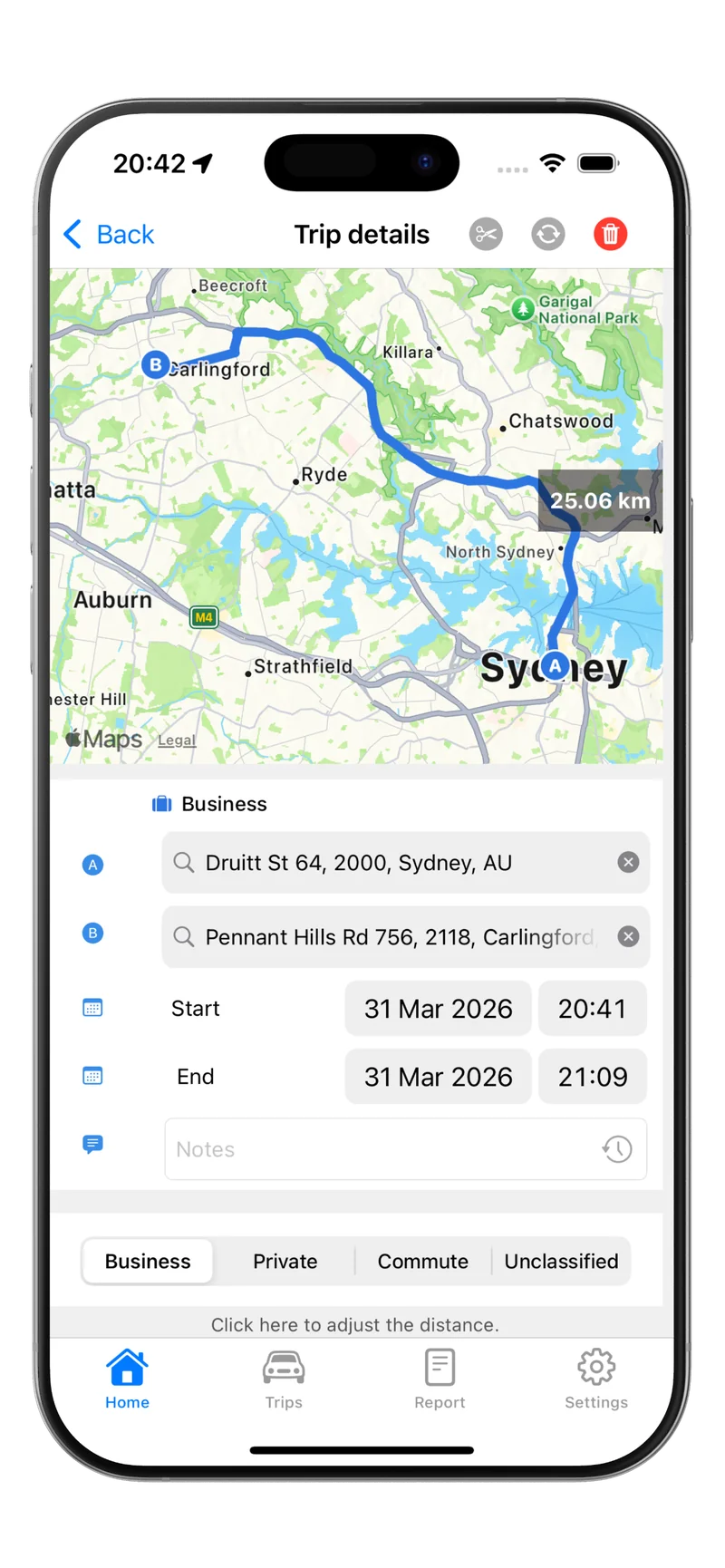
Track every trip from 1 July. Use Tripbook to automatically record your business kilometres. At year-end, you will know your exact total and can choose the method that gives you the best result.
Consider starting a logbook. If you are currently using cents per km and suspect you exceed 5,000 business kilometres, starting a 12-week logbook early in the financial year locks in your business-use percentage for up to five years. See our ATO logbook requirements guide for what a valid logbook must contain.
Keep receipts either way. Even if you plan to use cents per km, retaining fuel and maintenance receipts gives you the option to switch to the logbook method if the numbers work out better.
Key takeaway
The cents per km rate for 2026–27 in Australia has not yet been announced, but historical trends suggest it will stay at or slightly above the current 88 cents. Whichever rate applies, the real value lies in tracking your kilometres accurately so you can claim every dollar you are entitled to.
Tripbook makes this effortless — start tracking today and be ready for whatever rate the ATO sets.