Uber driver tax deductions Australia are substantial — but so are the compliance obligations. If you drive for Uber or any other rideshare platform, you are treated as a sole trader running your own business. That means income tax, mandatory GST registration, quarterly BAS lodgements, and the ability to claim a wide range of deductions.
This guide covers everything you need to know, from GST registration to car expense claims and record-keeping.
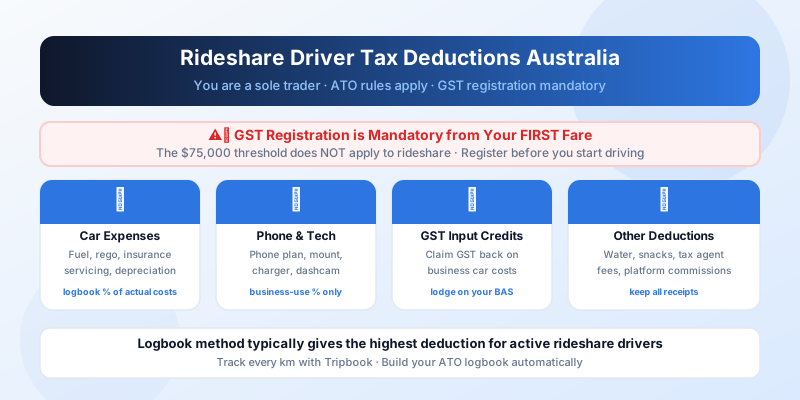
Rideshare drivers must register for GST before their first fare, regardless of annual turnover. The normal $75,000 threshold does not apply to rideshare income.
Are Uber drivers sole traders or employees?
Under Australian law, rideshare drivers are independent contractors, not employees. The ATO treats your rideshare activity as running a business. This means:
- You report rideshare income as business income in your individual tax return (or through a sole trader ABN)
- You are responsible for your own superannuation (though the ATO may assess employer-like obligations for platforms in some circumstances — check current rules)
- You can claim business expenses against your income
- You must meet GST and BAS obligations
The distinction matters. Unlike employees, you cannot simply deduct car expenses using the work-related car expense section of your tax return. Instead, your vehicle costs are business expenses offset against your rideshare income.
Mandatory GST registration for rideshare drivers
This is the most important compliance rule for Uber drivers: you must register for GST immediately, before your first ride. The usual $75,000 annual turnover threshold does not apply to taxi or rideshare services under the GST Act.
What this means in practice:
- You charge GST on your fares (Uber typically handles this on your behalf)
- You collect 1/11th of your fare as GST and remit it to the ATO via BAS
- You can claim GST credits on your business expenses (fuel, vehicle running costs, phone, etc.)
- You must lodge a BAS quarterly (or monthly if your turnover is high)
If you also have other income and your total business turnover is below $75,000, you are still required to register for GST on the rideshare component. Many drivers operate under a single ABN that covers both the rideshare activity and any other self-employment income.
For a broader overview of sole trader obligations, see Sole Trader Car Expenses ATO.
Car expense deductions for Uber drivers
Your vehicle is your primary business tool. There are two methods for claiming car expenses:
Cents per kilometre (88c/km):
- Simple: multiply business kilometres by 88 cents
- Capped at 5,000 km per vehicle per year
- Includes all running costs in the rate
- Not suitable for most full-time rideshare drivers who will exceed 5,000 km
Logbook method:
- No kilometre cap
- Claim the business-use percentage of actual car costs
- Must keep a 12-week logbook establishing your business-use percentage
- Deductible costs include fuel, servicing, tyres, registration, insurance, loan interest, depreciation
For most Uber drivers, the logbook method produces a larger deduction because annual rideshare kilometres far exceed 5,000 and actual running costs are high.
Your business-use percentage is key. If you use your car 70% for rideshare and 30% personally, you can claim 70% of each running cost. Keep your logbook from the start of rideshare activity and update it if your driving pattern changes significantly.
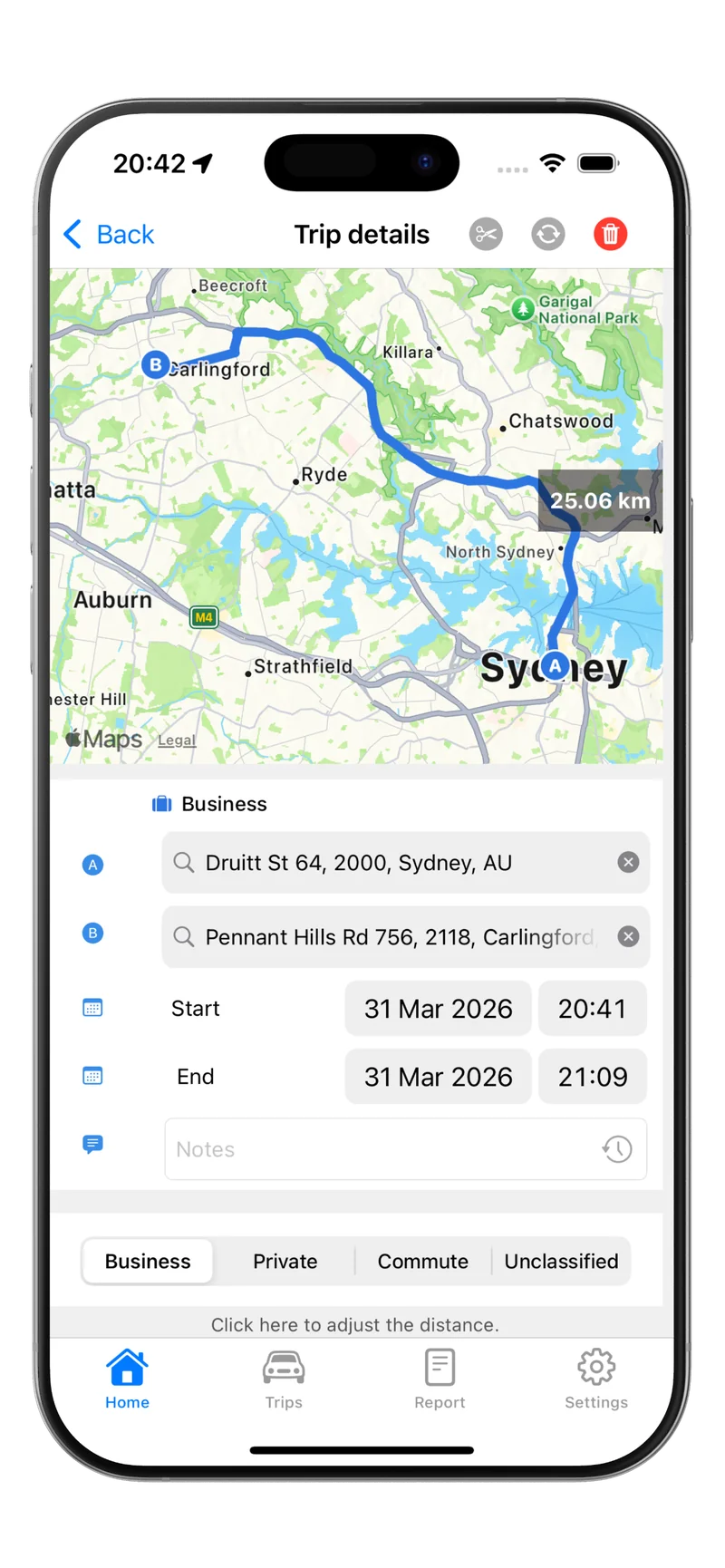
Track every rideshare kilometre accurately. Tripbook lets you log trips automatically — tap to start and stop, categorise as business, and export a report for your accountant or BAS agent.
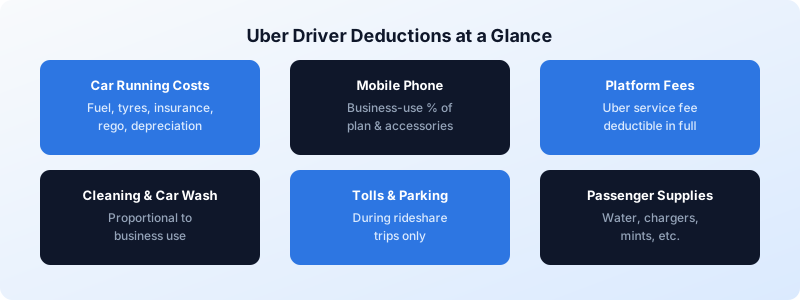
Other deductions: phone, accessories, platform fees
Car costs are the biggest deduction, but rideshare drivers can claim several others:
Mobile phone: Your phone is essential for the Uber app. You can claim the business-use proportion of your phone plan. If you use your phone 60% for rideshare and 40% personally, claim 60% of your phone costs. Keep your phone bills.
Phone mount and accessories: The cost of a phone mount, car charger, dashcam, and similar items is deductible as a work-related expense. Items under $300 can be deducted immediately; items over $300 are depreciated.
Uber platform fees (service fee): The platform fee or “service fee” Uber deducts from your earnings is a deductible business expense. This amount is shown on your weekly statement from Uber and reduces your assessable income.
Cleaning and car wash: Keeping your vehicle clean is a business requirement for rideshare. Car wash costs are deductible proportional to business use.
Water and snacks for passengers: Complimentary items you provide to passengers (bottled water, phone chargers) are deductible business expenses. Keep receipts.
Parking during rideshare activity: Parking fees incurred while waiting for or completing fares are deductible. Note that parking fines are never deductible.
Tolls: Tolls paid during rideshare trips are deductible. Tolls on personal trips are not.
Tracking kilometres automatically
Accurate kilometre records are non-negotiable. For the logbook method, you need to record every trip during your 12-week logbook period, and ongoing records that support your business-use claim for subsequent years.
Manual logs are time-consuming and easy to forget. Using Tripbook, you can start a trip log with one tap before picking up your first passenger and stop it when you go offline. The app records the distance, time, and route automatically.
During your 12-week logbook period, log every rideshare trip. After the period, continue logging your business trips to monitor your annual business-use percentage. This ensures your deduction remains accurate year to year.
See Kilometre Tracking Guide for tips on maintaining an ATO-compliant logbook.
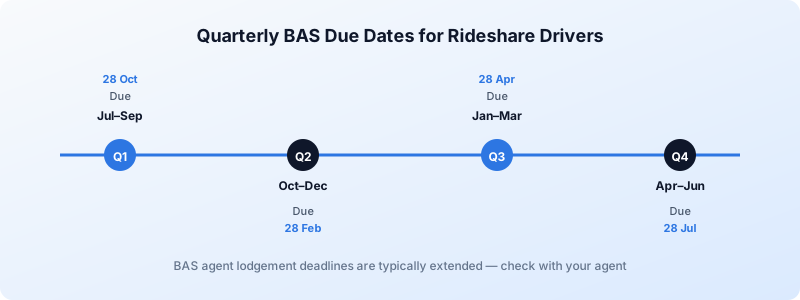
Quarterly BAS and income tax for Uber drivers
As a GST-registered sole trader, you must lodge a Business Activity Statement (BAS) every quarter. The BAS reports:
- GST collected on your fares
- GST credits on your business expenses
- PAYG income tax instalments (once you start paying income tax)
BAS due dates (quarterly):
- Q1 (Jul–Sep): due 28 October
- Q2 (Oct–Dec): due 28 February
- Q3 (Jan–Mar): due 28 April
- Q4 (Apr–Jun): due 28 July
If you lodge through a registered BAS or tax agent, the due dates are typically extended.
Annual income tax: At year end, you lodge a personal income tax return (or trust/company return if applicable). Your rideshare income minus deductible expenses equals your net business income, which is added to any other income and taxed at your marginal rate.
PAYG instalments: Once your tax bill exceeds a threshold, the ATO will put you on a PAYG instalment schedule. You pay estimated income tax quarterly to avoid a large bill at year end.
If you are new to rideshare driving, speak to a tax agent before your first BAS is due. Understanding your obligations early prevents penalties and ensures you are claiming everything you are entitled to.
Uber driver tax deductions in Australia can add up to thousands of dollars a year. Track your kilometres from day one, register for GST before your first fare, and keep receipts for every business expense.
Download Tripbook to start logging your rideshare kilometres today.