CRA audit triggers for small business in 2026 are more sophisticated than ever. The Canada Revenue Agency now uses AI-powered risk scoring, machine-learning algorithms, and automated cross-referencing to flag returns that deviate from industry norms. If you claim vehicle expenses on your T2125 or T777, your return is already under closer scrutiny than the average filer. Understanding what triggers an audit — and how to defend against one — is the difference between a minor inconvenience and a five-figure reassessment.
How the CRA Selects Returns for Audit in 2026
The CRA blends two audit-selection methods: risk-based targeting and random selection. Their 2026-27 Departmental Plan confirms expanded investment in data analytics and artificial intelligence to improve audit efficiency.
On the risk-scoring side, CRA algorithms compare your return against statistical benchmarks for your industry code, province, revenue bracket, and expense ratios. Returns that fall outside normal ranges are assigned a higher risk score and routed to auditors. Vehicle expenses are among the most commonly flagged categories because they involve mixed personal and business use, making inflated claims easy to attempt and relatively simple for auditors to detect.
Random selection still exists too. The CRA audits a percentage of returns each year regardless of risk score. If your records are complete, a random audit is just paperwork. If they are not, it becomes an expensive problem.
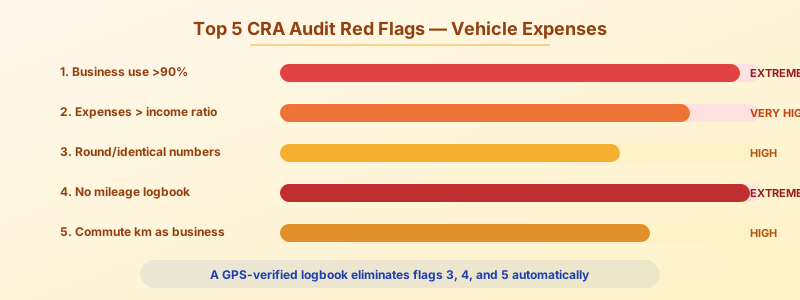
Top 5 Vehicle Expense Red Flags
These are the specific patterns that CRA auditors and AI systems look for when reviewing small business vehicle claims.
1. Business-use percentage above 90%. Claiming 90-100% business use on a personal vehicle implies you almost never drive for groceries, appointments, or family errands. If you own only one vehicle, this claim is nearly impossible to defend. Auditors know this, and it is one of the fastest ways to get flagged.
2. Vehicle expenses disproportionate to income. If you report $40,000 in net business income but claim $25,000 in vehicle expenses, the ratio will trigger a review. CRA benchmarks compare your expense-to-revenue ratio against others in your industry. Significant deviations get flagged automatically.
3. Round numbers and identical mileage year over year. A logbook showing exactly 500 km every week for 52 weeks is not realistic. Neither is claiming the exact same total business kilometres three years running. Real driving patterns have natural variation, and auditors are trained to spot fabricated logs.
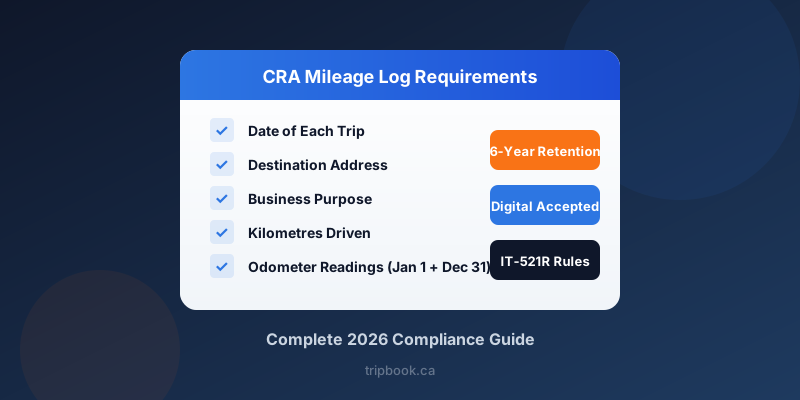
4. No mileage logbook at all. This is the single most common reason vehicle deductions are denied. Without a logbook that records the date, destination, purpose, and kilometres for each trip, the CRA will disallow your entire vehicle expense claim. There is no workaround, no exception, and no grace period.
5. Commuting kilometres claimed as business use. Driving from your home to your regular place of business is a personal commute under CRA rules. If your logbook includes these trips as business kilometres, an auditor who cross-references the addresses will catch it immediately.
For a full breakdown of what your logbook must contain, see CRA mileage log requirements.
Beyond Vehicle Expenses: Other Triggers to Watch
Vehicle claims do not exist in isolation. The CRA looks at your entire return, and several other patterns increase the likelihood of a full review.
Consecutive years of business losses. If your business reports losses for three or more years in a row, the CRA may reclassify the activity as a personal hobby and deny all related deductions — including vehicle expenses.
Large home-office deductions. Claiming 40% of your home as office space when you live in a two-bedroom apartment will raise questions. The deduction must reflect the actual proportion of your home used exclusively for business.
GST/HST input tax credits that outpace revenue. If your ITC claims are large relative to the revenue you report, CRA systems will flag the return for potential over-claiming.
Third-party income mismatches. The CRA now receives income reports from gig economy platforms, banks, and payment processors. If your T2125 income does not match these third-party filings, your return will be flagged before a human even reviews it. For more on platform reporting requirements, see gig worker platform reporting CRA 2026.
Penalties and Consequences of a Failed Audit
When the CRA disallows vehicle expense claims, the financial consequences extend well beyond the denied deduction itself.
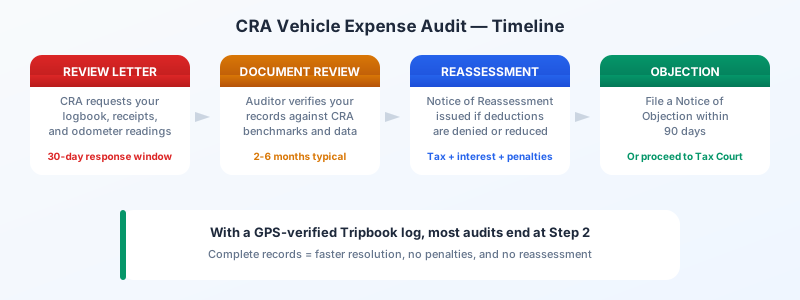
Tax owing plus interest. The CRA will reassess your return and issue a Notice of Reassessment for the additional tax owing. Interest is compounded daily starting from the original filing deadline — not the reassessment date. At current prescribed rates, a $10,000 reassessment can grow significantly over two or three years of compounding.
Gross negligence penalty — 50% of understated tax. Under Section 163(2) of the Income Tax Act, if the CRA determines that you knowingly made a false statement or showed indifference to whether your claim was accurate, they can impose a penalty equal to 50% of the additional tax owing. On a $10,000 tax shortfall, that is an extra $5,000 in penalties alone.
Repeated failure penalty — 10%. Under Section 163(1), if you failed to report income in any of the three preceding tax years, the CRA may apply a 10% penalty on the unreported amount in the current year.
Extended reassessment window. The CRA normally has three years to reassess an individual return. However, if they find misrepresentation or fraud, there is no time limit. A fabricated logbook discovered years later can reopen every tax year it was used.
Cascading audits. A vehicle expense audit that uncovers problems often leads to a broader review of your entire return, including home office, supplies, and subcontractor payments. One red flag can open multiple files.
How to Survive a CRA Vehicle Expense Audit
If you receive a vehicle expense review letter, here is what the CRA will typically request and how to respond.
What they ask for:
- Your mileage logbook for the tax year under review
- Receipts for all claimed vehicle expenses (fuel, insurance, maintenance, parking)
- Vehicle registration, insurance documents, and lease or financing agreements
- Odometer readings from January 1 and December 31 of the tax year
- A written explanation of your business-use percentage calculation
How to prepare now — before the letter arrives:
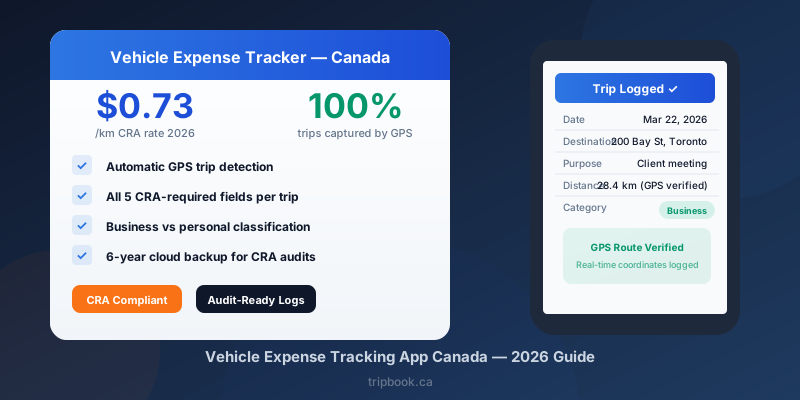
Keep a CRA-compliant mileage log with all five required fields for every trip: date, destination, purpose, kilometres driven, and starting odometer. A GPS-verified digital log is the strongest possible documentation because it eliminates any question about accuracy.
Retain original receipts for six years. The CRA’s retention requirement means your 2026 receipts must be available until at least 2032. Credit card statements alone are generally not accepted as proof of vehicle expenses — you need the original invoices.
Be honest about your business-use percentage. If your actual split is 75% business and 25% personal, claim 75%. Inflating to 95% may save a few hundred dollars in tax but dramatically increases your audit risk and potential penalties.
Log personal trips too. A logbook that only shows business trips looks suspicious because it implies you never drive for personal reasons. Record all trips and clearly mark which are personal.
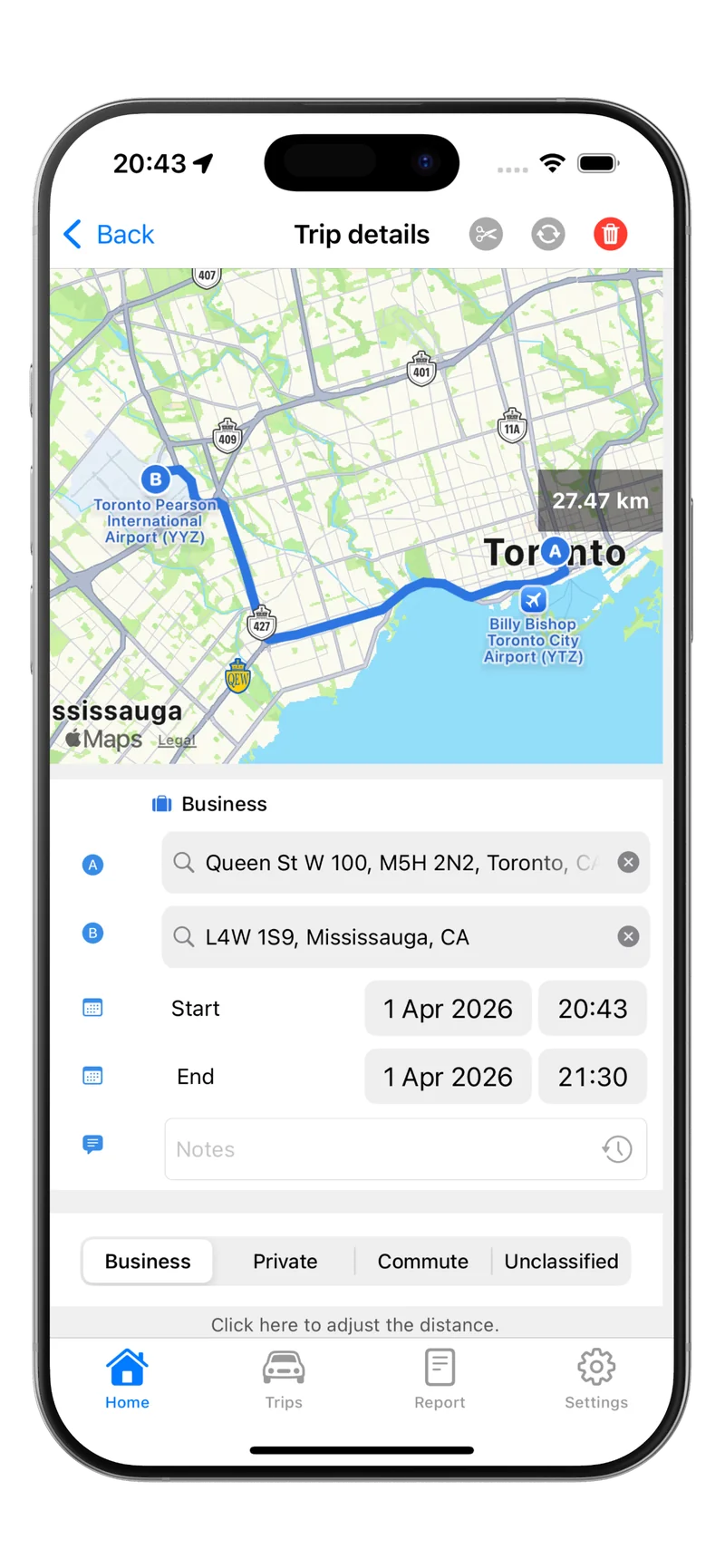
Tripbook automates this entire process. It records GPS-verified trips in real time, calculates your business-use percentage automatically, and stores everything in a format that satisfies CRA requirements. When an audit letter arrives, you export your log and respond with confidence instead of scrambling to reconstruct records from memory.
Protect Your Deductions Before Tax Season
The CRA’s AI-driven audit selection means that poorly documented vehicle claims are more likely to be caught in 2026 than in any previous year. The agency’s own departmental plans confirm continued investment in machine learning and data analytics for compliance enforcement.
The good news: a well-documented return has nothing to fear. A GPS-verified mileage log, organized receipts, and an honest business-use percentage are your best defence against both targeted and random audits.
Do not wait until you receive a review letter. Start building your audit-proof records today.
Download Tripbook to create a CRA-compliant mileage log automatically — GPS-verified, always up to date, and ready for any audit.
For more on record-keeping requirements, see CRA record keeping requirements for vehicle expenses.