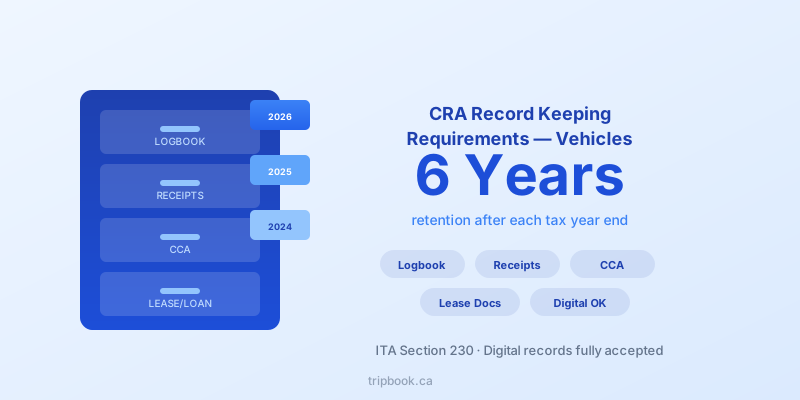
Meeting CRA record keeping requirements for vehicle expenses is not optional — it is the foundation of every legitimate deduction you claim. Whether you file as a self-employed individual on the T2125 or as an employee on the T777, the Canada Revenue Agency expects a complete paper trail. Fall short and your entire vehicle expense claim can be denied. This guide covers every document you need, how long to keep it, and what the CRA actually asks for during an audit.
Complete List of Records the CRA Requires
Under Section 230 of the Income Tax Act, every person carrying on business must keep adequate books and records. For vehicle expenses, the CRA interprets this broadly. Here is the full inventory of documents you need to maintain.
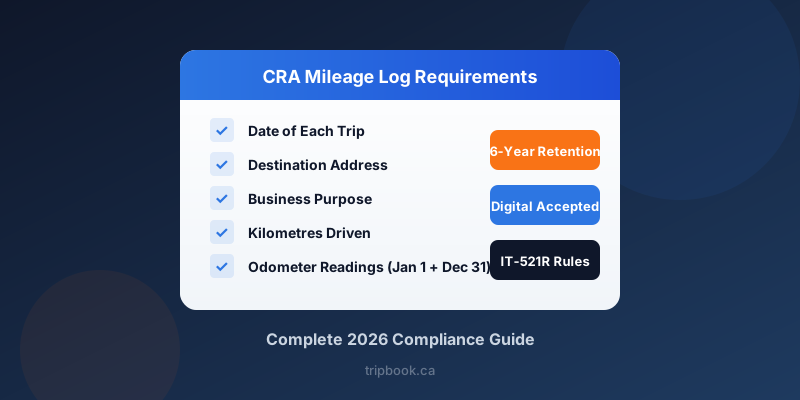
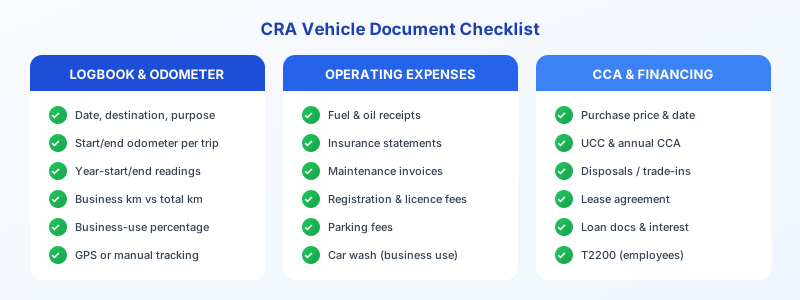
Mileage logbook (mandatory):
- Date of each business trip
- Destination and purpose (client name, meeting type, delivery, etc.)
- Odometer reading at the start and end of each trip
- Year-start and year-end odometer readings
- Running totals of business kilometres and total kilometres driven
The CRA states that an accurate logbook maintained for the entire year is the best way to support business use of a vehicle. Without one, every other vehicle expense receipt becomes worthless.
Operating expense receipts:
- Fuel and oil purchases
- Insurance premium statements
- Maintenance and repair invoices (oil changes, tires, brakes, etc.)
- Vehicle registration and licence fees
- Parking fees and supplementary business insurance
- Car wash and detailing (if business-related)
Capital cost allowance (CCA) schedule:
- Vehicle acquisition date and purchase price
- Prior-year undepreciated capital cost (UCC)
- CCA claimed in each tax year
- Any disposals, trade-ins, or recaptured depreciation amounts
- Class 10 or Class 10.1 designation for each vehicle
Lease or loan documents:
- Full lease agreement (for calculating the deductible lease payment cap)
- Loan agreement showing principal, interest rate, and term
- Monthly payment statements showing interest paid
T2200 (employees only):
- Employer-signed Declaration of Conditions of Employment
- One original or copy per employer, per tax year
The Six-Year Retention Rule
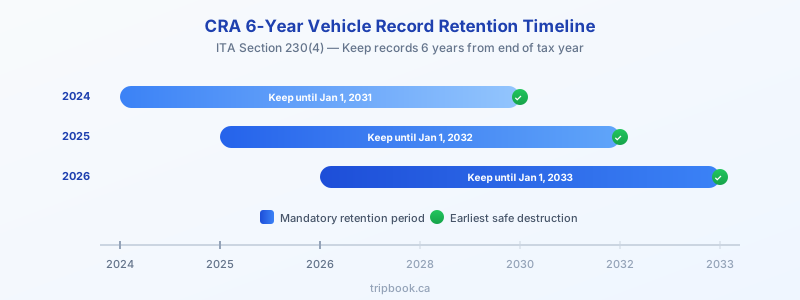
Section 230(4) of the Income Tax Act requires you to keep all records for at least six years from the end of the tax year to which they relate. This applies equally to paper and electronic documents.
| Tax Year | Earliest You Can Destroy Records |
|---|---|
| 2026 | January 1, 2033 |
| 2025 | January 1, 2032 |
| 2024 | January 1, 2031 |
Important exceptions that extend the retention period:
- Late filing: Six years from the date you actually filed, not the original deadline
- Objection or appeal: Keep records until all appeal rights are exhausted plus six years
- Active CRA dispute: Retain until the matter is fully resolved plus six years
- Capital property records (CCA vehicles): Six years after you dispose of the vehicle, not six years after you first claimed CCA
The retention rule applies to both the T777 (employee vehicle expenses) and the T2125 (self-employed vehicle expenses). There is no shortcut and no exception for small claims. If the CRA audits you in year five and you discarded records early, the deduction is gone.
For more on what happens when records are missing, see Penalty for No Mileage Logbook — CRA.
Digital Records vs. Physical Records
The CRA fully accepts digital records under Information Circular IC05-1R1, but the digital copies must meet specific conditions:
- Legible and complete — the digital version must contain the same information as the paper original
- Printable on request — the CRA auditor must be able to print any record during a review
- Stored securely — records must be protected from alteration, loss, and unauthorized access
- Backed up — the CRA recommends storing backups at a separate location within Canada
What counts as a valid digital record:
- GPS-tracked mileage logs exported as PDF or CSV
- Scanned images of fuel and maintenance receipts
- App-generated trip logs with date, destination, distance, and purpose
- Digital copies of insurance statements and lease agreements
One critical rule: If a document was originally created electronically (a PDF receipt from an online purchase, for example), subsection 230(4.1) of the ITA requires you to retain the electronic version. A printed copy of a born-digital document is not sufficient.
Thermal receipt warning: Fuel and parking receipts are typically printed on thermal paper that fades within months. Scan these receipts immediately or photograph them the day you receive them. A faded receipt is as useless as no receipt at all.
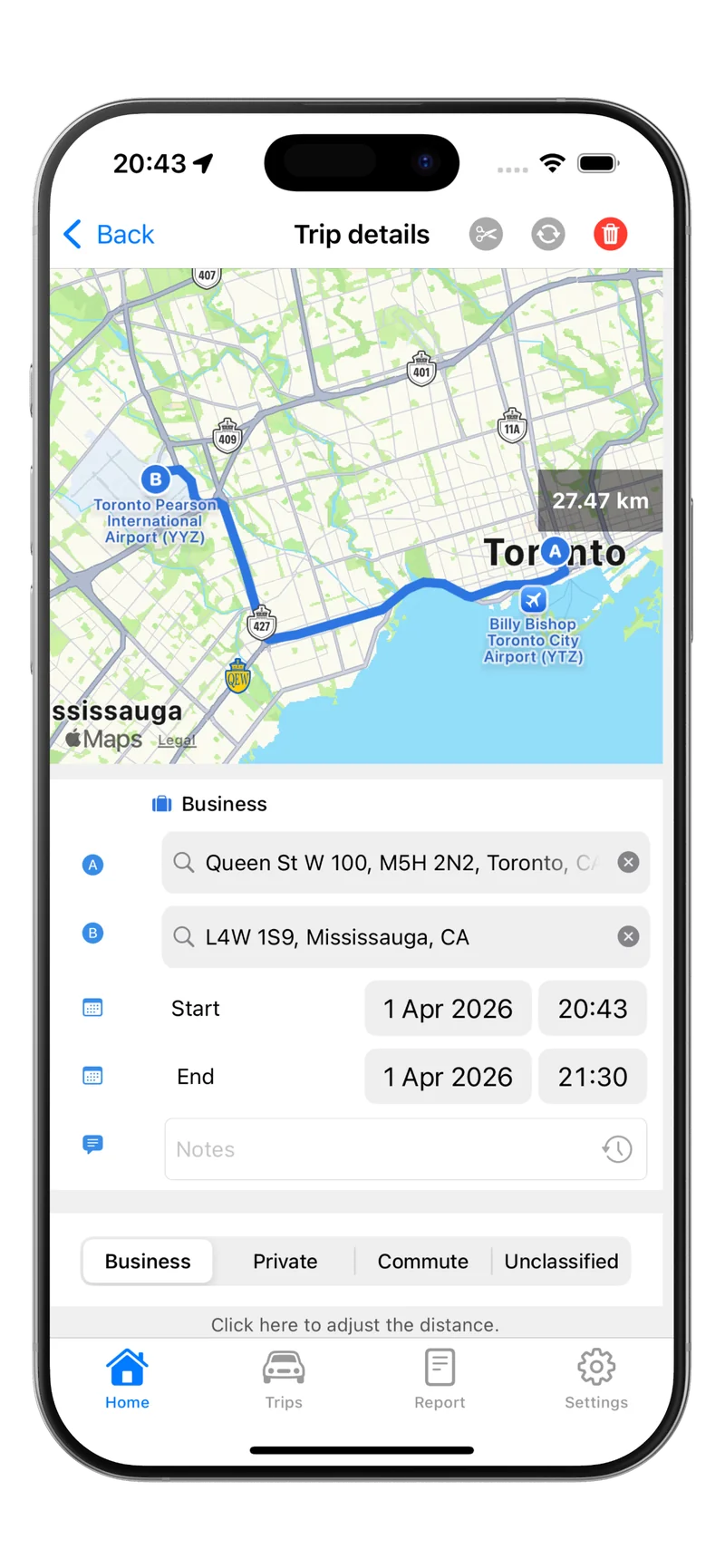
Tripbook generates CRA-compliant digital mileage logs automatically. Every trip is GPS-verified with the date, destination, distance, and business purpose already recorded — no manual entry required. For details on what a compliant log must contain, see CRA Mileage Log Requirements.
What the CRA Requests During an Audit
When the CRA selects your vehicle expense claim for review, the auditor will send an initial letter listing the documents they want to examine. Under Section 231.1 of the ITA, CRA officials have broad powers to request taxpayer records and inspect an audit trail from source documents to financial statements.
Typical audit document requests include:
- Complete mileage logbook for the tax year under review
- Year-start and year-end odometer readings
- Calculation of business-use percentage (business km ÷ total km)
- All fuel, insurance, maintenance, and repair receipts
- CCA schedule showing UCC, current-year CCA, and any disposals
- Lease agreement or loan documents with interest calculations
- T2200 Declaration of Conditions of Employment (for employees)
- Bank or credit card statements corroborating expense amounts
The CRA is specifically looking for consistency. If your logbook shows 18,000 business kilometres but your fuel receipts only support 12,000 km of total driving, that discrepancy will trigger further scrutiny.
If records are missing: The CRA may accept reconstructed records using bank statements, credit card records, or calendar entries as supporting evidence — but this is not guaranteed. Credible documentation always prevails. Under paragraph 162(7)(b) of the ITA, failure to maintain required records can result in civil penalties of $100 to $2,500 per instance of non-compliance.
For a deeper look at what triggers a CRA review in the first place, see CRA Audit Triggers for Small Business in 2026.
Record Keeping for Multiple Vehicles
If you use more than one vehicle for business purposes, the CRA requires separate tracking for each:
- Separate logbook per vehicle — each vehicle must have its own complete mileage record
- Individual business-use percentages — different vehicles often have different ratios of business to personal use
- CCA class separation — Class 10.1 vehicles (luxury/passenger vehicles over the prescribed limit) each get their own separate class; Class 10 vehicles are pooled together on one CCA schedule
- Separate expense tracking — fuel, insurance, and maintenance records must be attributable to the specific vehicle
Mixing records across vehicles is one of the fastest ways to have a vehicle expense claim denied during an audit. Keep every receipt, invoice, and log entry clearly linked to a single vehicle.
The Simplest Way to Stay CRA-Compliant
Maintaining six years of vehicle records across logbooks, receipts, CCA schedules, and loan documents is a significant administrative burden. The risk is not just disorganization — it is a denied deduction, back taxes, interest charges, and potential penalties.
Tripbook eliminates the most error-prone part of CRA record keeping requirements for vehicle expenses: the mileage logbook. Every trip is automatically tracked with GPS verification, and your complete log is available for export at any time — whether for year-end filing or in response to a CRA audit letter.
Pair Tripbook with a habit of scanning receipts on the day you receive them, and you have a complete, CRA-compliant vehicle expense archive that will hold up for the full six-year retention period.
Download Tripbook to start building your audit-proof vehicle record today.