Understanding the Colorado mileage reimbursement law is essential for both employers and employees who drive for work in the Centennial State. Unlike the majority of U.S. states, Colorado has a regulatory framework that creates meaningful obligations around expense reimbursement, even for private-sector companies. Whether you manage a fleet of field reps or simply drive to client meetings, knowing the rules can protect your paycheck and keep your business compliant.
This guide covers how Colorado’s COMPS Order shapes mileage reimbursement in 2026, the applicable IRS rate, state employee rules, tax treatment, and how to document every mile.
How the Colorado Mileage Reimbursement Law Works
Colorado does not have a single statute that says “employers must reimburse mileage at X cents per mile.” Instead, the obligation arises from the Colorado Overtime and Minimum Pay Standards (COMPS) Order, a regulation issued annually by the Colorado Department of Labor and Employment (CDLE). The current version is COMPS Order #40, which took effect on February 1, 2026.
Under the COMPS Order, employers must pay employees at least the Colorado minimum wage for all hours worked. If unreimbursed business expenses, including vehicle costs for work-related driving, reduce an employee’s effective hourly pay below the state minimum wage, the employer is in violation of Colorado law.
This is not a technicality. Colorado’s minimum wage for 2026 is $15.16 per hour, one of the highest state minimums in the country. Several localities go further:
- Denver: $19.29/hour
- Edgewater: $18.17/hour
- Boulder and unincorporated Boulder County: $16.82/hour
Because these thresholds are relatively high, it takes fewer unreimbursed miles to push an employee’s effective pay below the legal floor. Employers with driving-heavy roles in Colorado should pay close attention to this rule.
The 2026 IRS Standard Mileage Rate
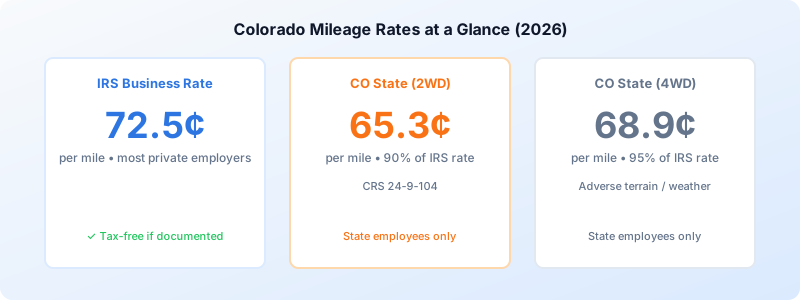
The IRS business mileage rate for 2026 is 72.5 cents per mile. This rate reflects the average annual cost of operating a vehicle for business purposes, covering fuel, insurance, depreciation, maintenance, and tires.
Colorado does not require private employers to use the IRS rate. However, 72.5 cents per mile acts as the dividing line for tax treatment. Reimbursements at or below the IRS rate are tax-free for the employee and fully deductible for the employer when submitted under an accountable plan. Any reimbursement above 72.5 cents is treated as taxable income and must appear on the employee’s W-2.
Most private employers in Colorado follow the IRS rate because it simplifies compliance, satisfies the minimum wage protection, and avoids taxable-income complications.
Colorado State Employee Mileage Rates
Under Colorado Revised Statutes section 24-9-104, state officers and employees receive mileage reimbursement based on a percentage of the IRS rate:
- Two-wheel-drive vehicles: 90% of the IRS rate (approximately 65.3 cents per mile in 2026)
- Four-wheel-drive vehicles: 95% of the IRS rate (approximately 68.9 cents per mile in 2026)
These rates apply to all types of vehicles, including fully electric and hybrid cars. State employees must use the most economical route and submit proper documentation for reimbursement.
Private employers are not bound by these percentages. They exist only for Colorado government employees traveling on official state business.
When Colorado Employers Must Reimburse Mileage
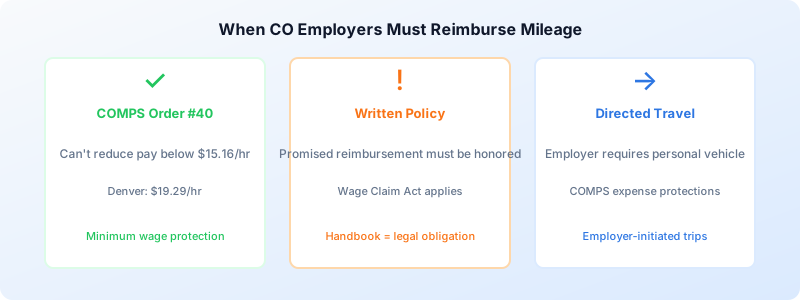
The COMPS Order creates several scenarios where mileage reimbursement is effectively required:
Minimum wage protection. If unreimbursed driving costs pull an employee’s hourly earnings below $15.16 (or the applicable local minimum), the employer must reimburse enough to restore lawful pay. For a worker earning $18 per hour in Denver who drives 100 miles a week, the vehicle costs alone could exceed $70, making minimum wage compliance a real concern.
Written policy obligations. Colorado’s Wage Claim Act (C.R.S. 8-4-101 et seq.) requires employers to pay all wages and compensation they have agreed to provide. If a mileage reimbursement policy exists in a handbook, employment contract, or written agreement, the employer must honor it. Failure to pay promised reimbursements can result in penalties, including waiting-time penalties for late payment of wages.
Employer-directed travel. When an employer requires an employee to use a personal vehicle for business purposes, the COMPS Order’s expense protections apply. The key factor is whether the employer directed the travel, not whether the employee volunteered.
For a broader look at which states require reimbursement and which do not, see our state mileage reimbursement laws overview.
Tax Treatment of Mileage Reimbursement
Mileage reimbursement has important tax consequences for both employers and employees.
Accountable plan. When an employer reimburses mileage through an IRS-compliant accountable plan, the payments are tax-free for the employee and deductible as a business expense for the employer. An accountable plan requires a business connection, adequate documentation (date, destination, mileage, purpose), and the return of any excess reimbursement.
Non-accountable plan. If the employer pays a flat car allowance or reimburses without requiring documentation, the entire amount is treated as taxable wages subject to income tax and payroll taxes.
No employee deduction. Under the Tax Cuts and Jobs Act (TCJA), the deduction for unreimbursed employee business expenses was suspended starting in 2018. The One Big Beautiful Bill Act (OBBBA) made this elimination permanent. Employees can no longer deduct unreimbursed mileage on their personal federal tax returns, regardless of how much they drive for work. This makes employer reimbursement the only tax-efficient path for W-2 employees.
For more details on when reimbursements are and are not taxable, read our guide on whether mileage reimbursement is taxable.
How Colorado Compares to Neighboring States
Colorado stands out among its neighbors because the COMPS Order creates a stronger framework for expense reimbursement than most states provide. Here is a quick comparison:
| State | Mandate for Private Employers? | Key Rule |
|---|---|---|
| Colorado | Effective yes (COMPS Order) | Expenses cannot reduce pay below minimum wage ($15.16/hr) |
| Wyoming | No | No state mileage law; FLSA minimum wage floor only |
| Nebraska | No | Voluntary; FLSA protections apply |
| Kansas | No | No state mandate; federal rules only |
| Utah | No | No state mandate |
| New Mexico | No | No state mileage law |
Colorado’s high minimum wage combined with the COMPS Order means employers face practical pressure to reimburse mileage even when no standalone mandate exists. Pennsylvania has a similar dynamic through its Wage Payment and Collection Law, which we cover in our Pennsylvania mileage reimbursement guide.
Best Practices for Colorado Employees and Employers
For employees:
- Track every business mile with a GPS-based app. Manual logs are error-prone and harder to defend in a dispute.
- Save records for at least four years, consistent with Colorado’s statute of limitations for wage claims.
- If your employer does not reimburse mileage, calculate whether your driving costs reduce your effective pay below the applicable minimum wage. If they do, you have a valid claim under the COMPS Order.
For employers:
- Adopt a written mileage reimbursement policy and distribute it with your employee handbook.
- Reimburse at or near the IRS rate of 72.5 cents per mile to simplify tax compliance and avoid minimum wage issues.
- Use an accountable plan that requires employees to submit trip details within a reasonable timeframe.
- Maintain records of all reimbursements for at least four years.
- Pay attention to local minimum wages in Denver, Boulder, and Edgewater, which raise the threshold for COMPS Order compliance.
Track Every Mile in Colorado with Tripbook
Colorado’s mileage reimbursement rules reward thorough documentation. Whether you are filing a reimbursement request or defending your policy during an audit, accurate mileage records are the foundation of compliance under the Colorado mileage reimbursement law.
Tripbook automatically tracks your drives using GPS, categorizes trips as business or personal, and generates IRS-ready reports. No manual entry, no guesswork, no forgotten trips.
Download Tripbook and start logging your Colorado business miles today.