
Florida mileage reimbursement works differently than in states like California or Illinois. The Sunshine State has no law requiring private employers to reimburse employees for business miles driven in a personal vehicle. That does not mean employees are left without options, but it does mean the rules depend heavily on company policy, federal tax law, and a few narrow exceptions worth understanding.
This guide breaks down everything Florida employees and employers need to know about mileage reimbursement in 2026, including current rates, tax treatment, legal exceptions, and practical steps for tracking miles properly.
Does Florida Require Mileage Reimbursement?
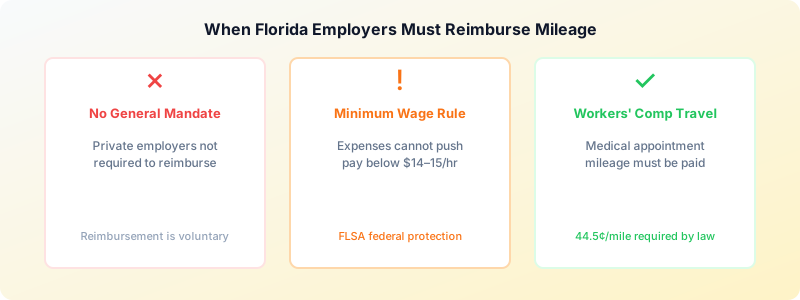
No. Florida does not have a state statute that compels private-sector employers to reimburse employees for mileage or other vehicle expenses. Unlike California (Labor Code 2802), Illinois (Wage Payment and Collection Act), and Massachusetts (MGL Chapter 149), Florida places no such obligation on businesses.
This means a private employer in Florida can legally choose to offer zero mileage reimbursement. Many employers do reimburse voluntarily because it helps with recruitment, retention, and tax efficiency, but they are not required to do so by state law.
For a full comparison of which states mandate reimbursement and which do not, see our guide to state mileage reimbursement laws.
The 2026 IRS Standard Mileage Rate
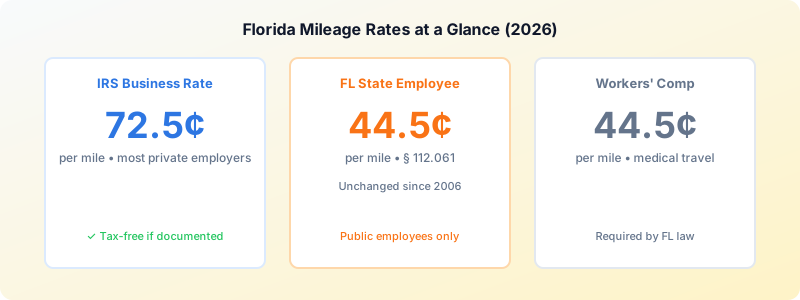
Even without a state mandate, most Florida employers who reimburse mileage follow the IRS standard mileage rate. For 2026, the IRS business mileage rate is 72.5 cents per mile. This rate reflects the average cost of operating a vehicle, including fuel, insurance, depreciation, maintenance, and repairs.
Employers can reimburse at, above, or below the IRS rate. However, the 72.5-cent figure is the benchmark that determines tax treatment. Reimbursements at or below this rate are tax-free for the employee when submitted under an accountable plan. Amounts exceeding the IRS rate are treated as taxable income.
Florida State Employee Reimbursement Rate
While private employers have no mandate, Florida does set a statutory mileage rate for state employees. Under Florida Statute Section 112.061, state employees receive 44.5 cents per mile for authorized business travel. This rate has remained unchanged since 2006 and is considerably lower than the current IRS rate.
State employees must use the most direct route and are required to use the state motor pool when available. The 44.5-cent rate applies to public officers, employees, and authorized persons whose travel costs are paid by a public agency.
When Reimbursement Becomes Legally Required
Although Florida lacks a general reimbursement mandate, there are two situations where paying for business mileage effectively becomes a legal requirement.
Minimum Wage Protection
Under the Fair Labor Standards Act (FLSA), an employer cannot allow unreimbursed business expenses to push an employee’s effective hourly wage below the federal or state minimum wage. Florida’s minimum wage is $14.00 per hour (rising to $15.00 on September 30, 2026).
If an employee earning near minimum wage spends significant money on gas and vehicle wear for work travel, the employer may need to reimburse enough to ensure the employee’s net compensation stays above the legal floor. This is not a mileage-specific rule, but it creates a practical obligation for employers with lower-paid workers who drive extensively.
Workers’ Compensation Travel
Florida law requires mileage reimbursement for travel to authorized medical appointments under the workers’ compensation system. The reimbursement rate for workers’ compensation medical travel in Florida is 44.5 cents per mile, matching the state employee rate.
Tax Treatment of Florida Mileage Reimbursement
Understanding the tax rules is critical for both employers and employees. The IRS distinguishes between two types of reimbursement plans, and the tax outcome depends entirely on which type the employer uses.
Accountable Plans
Under an accountable plan, mileage reimbursements are tax-free for the employee and deductible for the employer. To qualify, three conditions must be met. The expense must have a business connection. The employee must substantiate the expense with records showing date, destination, business purpose, and miles driven. Any excess reimbursement must be returned to the employer within a reasonable time.
When these requirements are met, the reimbursement does not appear on the employee’s W-2 and is not subject to income tax, Social Security, or Medicare withholding.
Non-Accountable Plans
If the employer uses a non-accountable plan, meaning there is no requirement for documentation or return of excess amounts, then all reimbursement payments are treated as taxable wages. The employer must withhold income tax, Social Security, and Medicare taxes on the full amount.
For employees wondering whether their reimbursement is taxable, check out is mileage reimbursement taxable for a detailed breakdown.
Can Florida Employees Deduct Unreimbursed Mileage?
For W-2 employees, the answer is no. The Tax Cuts and Jobs Act of 2017 eliminated the deduction for unreimbursed employee business expenses, and the One Big Beautiful Bill Act (2025) made this permanent. Florida employees who do not receive mileage reimbursement from their employer cannot claim a deduction on their federal tax return.
Self-employed individuals and independent contractors in Florida can still deduct business mileage on Schedule C using the IRS standard mileage rate of 72.5 cents per mile. This makes accurate mileage tracking especially valuable for freelancers and gig workers.
For a comprehensive look at how reimbursement works for W-2 employees across the country, see our guide on mileage reimbursement for employees.
Best Practices for Florida Employers
Even without a legal mandate, offering mileage reimbursement makes good business sense. Here are the key steps for building a compliant and effective policy.
Set a clear per-mile rate. Using the IRS rate of 72.5 cents per mile is the simplest approach and ensures tax-free treatment under an accountable plan.
Require trip documentation. Employees should log the date, starting point, destination, business purpose, and total miles for every trip. This documentation satisfies IRS substantiation rules and protects the company during audits.
Establish submission deadlines. Require employees to submit reimbursement requests within 60 days of the expense to maintain accountable plan status.
Cover tolls and parking separately. The IRS mileage rate covers vehicle operating costs but does not include tolls or parking fees. Reimburse these separately with receipts.
Review annually. The IRS adjusts mileage rates each year. Update your policy every January to reflect the current rate.
Tracking Mileage Accurately in Florida
Whether you are an employer managing a team of mobile workers or an employee keeping records for your own reimbursement, accurate mileage logs are essential. The IRS requires contemporaneous records, meaning logs created at or near the time of each trip.
Paper logs and spreadsheets work but are prone to errors and difficult to maintain consistently. A GPS-based mileage tracking app eliminates manual entry and creates the kind of verifiable, timestamped records the IRS expects.
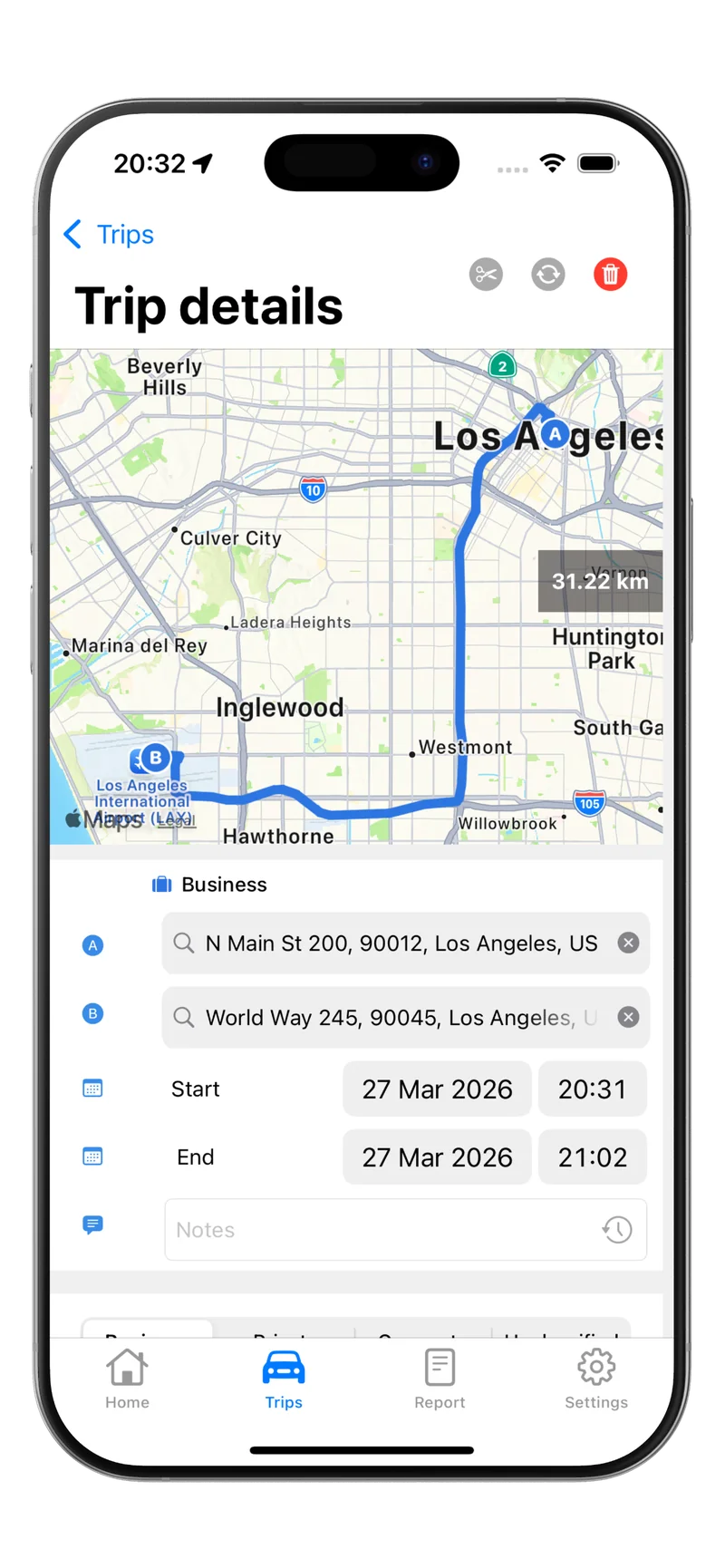
Download Tripbook to automatically track every business mile with GPS accuracy. The app logs your trips in real time, categorizes them as business or personal, and generates IRS-ready reports you can hand directly to your employer or accountant.
Conclusion
Florida mileage reimbursement is not required by state law for private employers, but that does not make it optional in practice. Minimum wage protections, tax efficiency, and employee satisfaction all push smart employers toward adopting a reimbursement policy. For employees, knowing the rules helps you advocate for fair compensation or, if you are self-employed, claim every deduction you are entitled to.
Track your miles from day one. Accurate records protect you whether you are submitting for reimbursement or filing your taxes.