If you drive to work every day, you have probably wondered whether you can claim a commute mileage deduction on your taxes. The short answer is no. The IRS treats regular commuting as a personal expense, meaning those daily drives between your home and your workplace are never deductible. But there are important exceptions that could save you thousands of dollars each year.
This guide explains exactly what the IRS considers commuting, which exceptions apply, and how you can structure your driving to maximize the miles that actually qualify for a deduction.
Why Commuting Miles Are Not Deductible
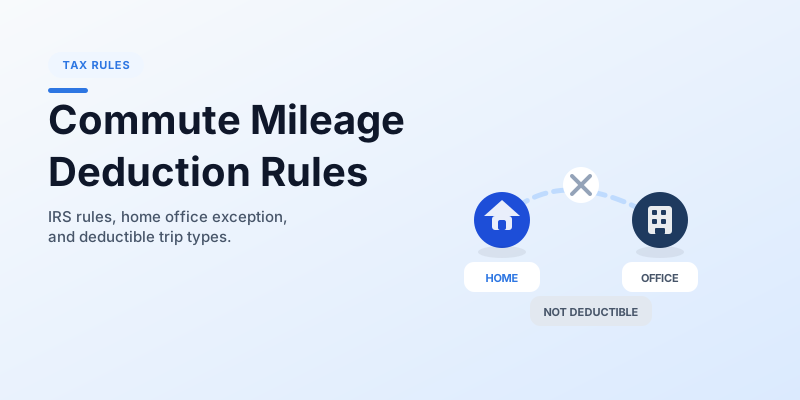
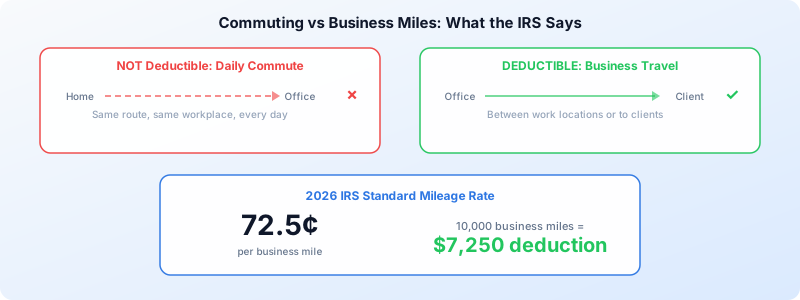
The IRS has a straightforward position: driving from your home to your regular place of work is a personal expense. It does not matter how long the drive is, whether you make business calls during it, or whether you carry work equipment in your car. If you are going from home to the same workplace and back, those miles are commuting miles.
The reasoning behind this rule is that the IRS considers where you choose to live a personal decision. Because your commute distance is a result of that personal choice, the government does not subsidize it through tax deductions.
This rule applies equally to W-2 employees and self-employed individuals who drive to the same fixed location every day.
What Qualifies as Deductible Business Mileage Instead?
While commuting fails the deduction test, many other types of work-related driving do qualify. Understanding the difference between business miles and commuting miles is essential for anyone who drives for work.
Deductible business miles include:
- Travel between two work locations during the same day (e.g., your office to a client site)
- Trips to temporary work locations expected to last less than one year
- Travel from your regular workplace to a meeting, vendor, or business event
- All trips from a qualifying home office to any work-related destination
The 2026 IRS standard mileage rate for business driving is 70 cents per mile for 2025 and 72.5 cents per mile for 2026. At that rate, even modest business driving adds up quickly. Someone logging 8,000 deductible business miles in 2026 would save $5,800 before taxes.
The Home Office Exception: Turning Commutes into Deductions
The single most powerful way to convert what would be commuting miles into deductible business miles is to establish a qualifying home office. When your home is your principal place of business, every trip you make from home to a work-related destination becomes a business mile rather than a commute.
To qualify, your home office must be:
- Used regularly and exclusively for business — a dedicated room or a clearly defined workspace that serves no personal purpose
- Your principal place of business — where you perform most of your administrative or management work, or where you regularly meet clients
If you meet these requirements, the first trip of your day is no longer a commute. It is a business trip. Learn more about how this works in our guide to the home office mileage deduction.
A freelance consultant works from a dedicated home office and drives to three client sites per week. Without the home office deduction, those trips would be non-deductible commutes. With it, every mile from front door to client and back counts at 72.5 cents per mile in 2026.
The Temporary Work Location Exception
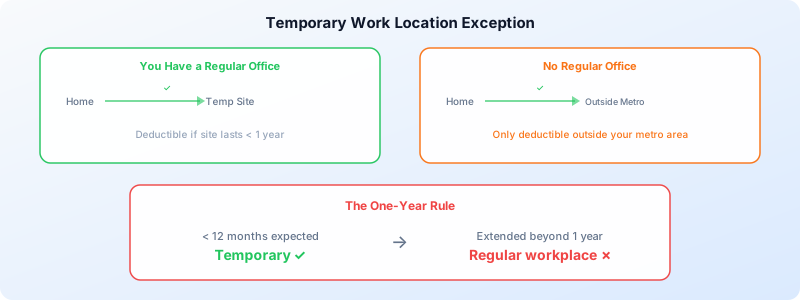
Even if you do not have a home office, you may still be able to deduct certain drives that feel like commutes. The IRS allows you to deduct mileage to a temporary work location — any place where you realistically expect to work for less than one year.
Here is how it works in practice:
- If you have a regular office, you can deduct travel between your home and any temporary work location, whether it is inside or outside your metropolitan area
- If you do not have a regular office, you can deduct home-to-temporary-location travel only if the temporary site is outside your metropolitan area
The one-year rule is critical. If an assignment that was originally expected to last six months gets extended beyond a year, the location becomes your regular workplace from that point forward, and trips there become non-deductible commutes.
W-2 Employees: What Changed and Why It Matters
If you are a W-2 employee, the rules are especially important to understand. The Tax Cuts and Jobs Act of 2017 suspended the ability for employees to deduct unreimbursed business expenses, including mileage, on their personal tax returns. The One, Big, Beautiful Bill Act made that suspension permanent.
This means that even if you drive extensively for work, you cannot claim a mileage deduction on your own return as a W-2 employee. The deduction is only available to:
- Self-employed individuals (sole proprietors, single-member LLCs) who deduct on Schedule C
- Independent contractors and 1099 workers including gig economy drivers
- Partners in partnerships who deduct unreimbursed partner expenses
However, W-2 employees are not completely out of options. Your employer can reimburse your business mileage tax-free under an accountable plan at up to the IRS standard rate. If your employer does not currently offer mileage reimbursement, it may be worth raising the topic — it costs them less than equivalent salary because reimbursements under an accountable plan are not subject to payroll taxes.
How to Maximize Your Deductible Miles
Knowing the rules is only half the battle. Here are practical strategies to ensure you capture every mile that qualifies:
1. Establish a home office if you can
If you do any administrative work from home, consider setting up a qualifying home office. It is the simplest way to convert commuting miles into deductible business miles. Even a small dedicated space can qualify if it meets the IRS requirements for regular and exclusive business use.
2. Use the first-stop and last-stop strategy
If you have a qualifying home office or your first stop is a temporary work location, plan your route so that your first destination of the day is a business stop (a client, the bank, the post office for a business errand). The miles from home to that first business stop become deductible. Without a home office or temporary-location exception, the first leg from home is still commuting per IRS Publication 463.
3. Track every business mile in real time
The IRS requires contemporaneous records — mileage logged at or near the time of travel. Reconstructing a mileage log at year-end is both inaccurate and risky in an audit. A tracking app that records your trips automatically eliminates this problem entirely.
For each trip, your records should include the date, starting location, destination, business purpose, and total miles driven. Understanding what counts as business mileage helps you capture trips you might otherwise overlook.
4. Separate personal and business trips clearly
Keep your business and personal driving distinct. If you combine a business errand with a personal stop, only the business portion of the trip is deductible. Logging trips individually rather than estimating at the end of the week produces cleaner records and larger legitimate deductions.
Record-Keeping: The Non-Negotiable Requirement
No matter which exception applies to you, the IRS insists on accurate, timely records. A commute mileage deduction claim without supporting documentation will not survive an audit.
Your mileage log should capture:
- Date of each trip
- Starting point and destination
- Business purpose (be specific — “client meeting with ABC Corp” is better than “business”)
- Miles driven
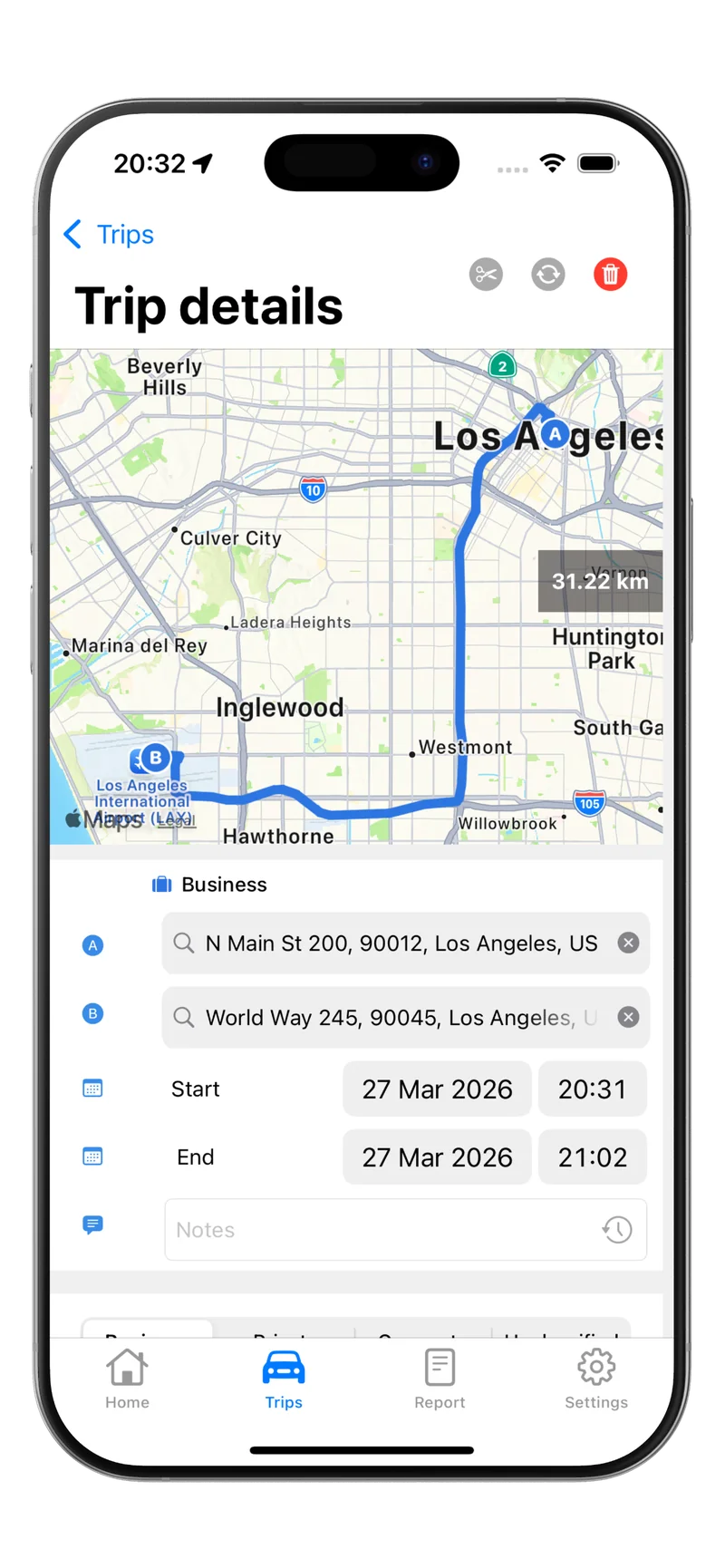
Paper logs work, but they are easy to forget and hard to maintain consistently. A mileage tracking app like Tripbook records trips automatically in the background, categorizes them, and generates IRS-ready reports whenever you need them.
Tripbook automatically separates business miles from commuting miles, so you never miss a deduction and always have audit-ready records. Download Tripbook and start logging today.
Commute Mileage Deduction: The Bottom Line
Regular commuting from home to your workplace is not deductible — that rule is firm and applies to everyone. But with the right setup, many of the miles that feel like commutes can become legitimate business deductions.
The two most valuable exceptions are the home office rule and the temporary work location rule. If either applies to your situation, you could be leaving significant money on the table by not tracking those miles.
Whether you are self-employed and deducting on Schedule C or a W-2 employee seeking reimbursement from your employer, accurate mileage records are the foundation. Download Tripbook to automatically separate your commuting miles from your deductible business miles — and make sure every qualifying mile counts at tax time.