Form 4562 vehicle depreciation is how business owners and self-employed taxpayers claim the cost of a vehicle used for work on their federal tax return. Whether you bought a sedan, a pickup truck, or a heavy SUV, the IRS requires you to report the deduction on this form — and the rules for each section determine how much you can write off in year one versus over time.
This guide walks through the parts of Form 4562 that apply to vehicles, the dollar limits for 2026, and how to combine Section 179, bonus depreciation, and MACRS to maximize your deduction.
What Is Form 4562?
IRS Form 4562, titled “Depreciation and Amortization,” is the form you attach to your tax return to claim deductions for the cost of business assets. For vehicles, three parts of the form matter most:
- Part I — Section 179 expense deduction (immediate write-off of all or part of the purchase price)
- Part II — Special depreciation allowance, commonly called bonus depreciation
- Part V — Listed property, which is where vehicles and their business-use percentages are reported
You file Form 4562 with your Schedule C (self-employed), Form 1120 or 1120-S (corporations), or Form 1065 (partnerships) for the tax year you place the vehicle in service.
Part I: Section 179 Expense Deduction
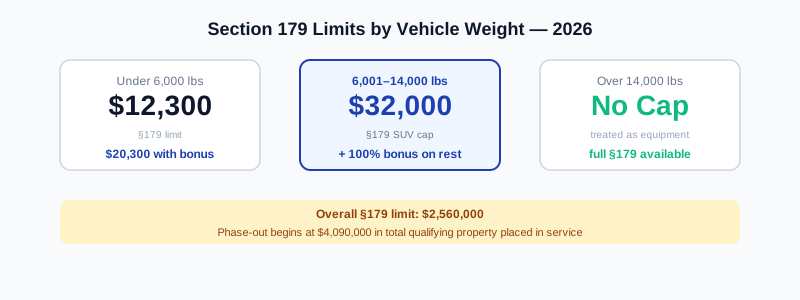
Section 179 lets you deduct the full purchase price of a qualifying business vehicle in the year you buy it, up to the applicable limit. For 2026, the overall Section 179 cap is $2,560,000, with a phase-out starting at $4,090,000 in total qualifying purchases.
However, vehicles have their own sub-limits based on weight:
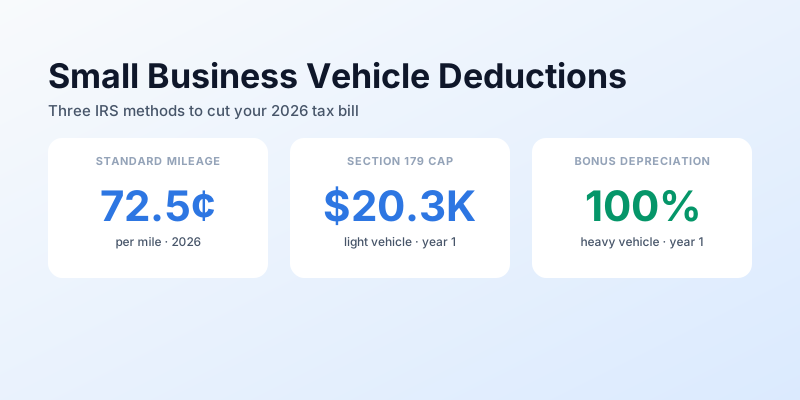
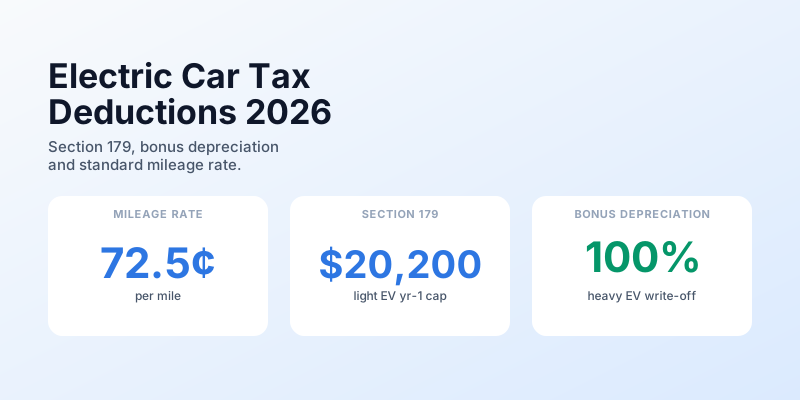
- Light vehicles (under 6,000 lbs GVWR): The Section 179 deduction is capped at $12,300 for 2026
- Heavy SUVs (6,001–14,000 lbs GVWR): The Section 179 deduction is capped at $32,000
- Trucks and vans over 14,000 lbs GVWR: Generally treated as equipment with no special vehicle cap
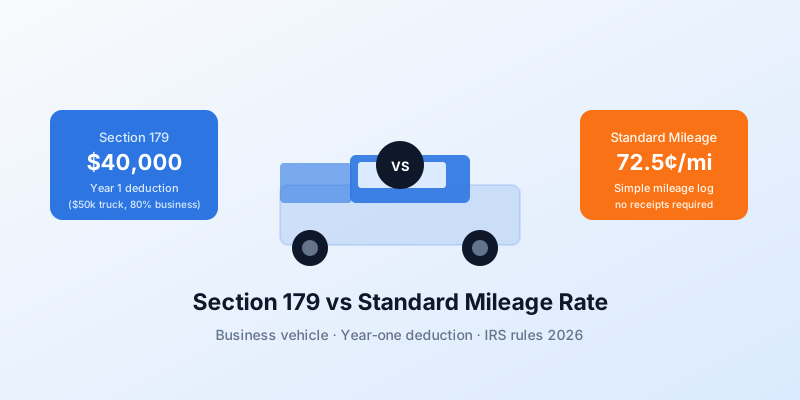
The Section 179 deduction cannot exceed your taxable business income for the year. Any unused amount carries forward to future tax years. If you are comparing this approach to the standard mileage rate of 72.5 cents per mile, see our guide on Section 179 deduction vs. mileage rate for a side-by-side breakdown.
Part II: Bonus Depreciation (Special Depreciation Allowance)
Bonus depreciation lets you deduct a percentage of a vehicle’s depreciable basis in the first year, on top of — or instead of — the Section 179 deduction. Under the One Big Beautiful Bill Act (OBBBA), 100% bonus depreciation is permanently available for qualified property acquired and placed in service after January 19, 2025.
This is a significant change. Under the prior TCJA phase-down schedule, bonus depreciation had dropped to 40% for 2025 and was set to fall to 20% for 2026 before disappearing entirely. The OBBBA reversed that decline and locked in the full 100% rate going forward.
For vehicles, bonus depreciation works differently depending on weight:
- Light passenger vehicles are still subject to the annual Section 280F caps (see below), so even with 100% bonus depreciation, your first-year deduction is limited
- Heavy SUVs and trucks over 6,000 lbs GVWR can apply 100% bonus depreciation to the cost remaining after the Section 179 deduction, often allowing a full write-off in year one
If you are considering a heavy vehicle purchase, our 6,000 lb vehicle tax deduction guide explains the weight thresholds and qualifying models in detail.
Section 280F Caps: Annual Depreciation Limits for Passenger Vehicles
Light passenger vehicles — those under 6,000 lbs GVWR — face annual depreciation ceilings regardless of which depreciation method you choose. These limits apply to the combined total of Section 179, bonus depreciation, and regular MACRS depreciation.
For vehicles placed in service in 2026:
| Tax Year | With Bonus Depreciation | Without Bonus Depreciation |
|---|---|---|
| 1st year | $20,300 | $12,300 |
| 2nd year | $19,800 | $19,800 |
| 3rd year | $11,900 | $11,900 |
| 4th year+ | $7,160 | $7,160 |
These caps mean a $50,000 sedan used 100% for business takes roughly five years to fully depreciate, even with bonus depreciation. A heavy SUV at the same price could be written off entirely in year one.
Part III: MACRS Depreciation
If you do not expense the full cost of a vehicle through Section 179 and bonus depreciation, the remaining basis is depreciated over time using the Modified Accelerated Cost Recovery System (MACRS). Vehicles fall under a 5-year recovery period using the 200% declining balance method and the half-year convention.
MACRS depreciation is reported in Part III of Form 4562. For most taxpayers claiming a vehicle, the combination of Section 179 plus bonus depreciation handles the bulk of the deduction, and MACRS picks up whatever cost basis remains.
If business use drops to 50% or less in any year after you claim Section 179 or bonus depreciation, you must switch to the Alternative Depreciation System (ADS) straight-line method and may owe recapture on the excess deduction you previously claimed.
Part V: Listed Property — The Vehicle-Specific Section
Part V is where you report the date placed in service, business-use percentage, total miles driven, depreciation method, and whether you have written evidence supporting your claim.
The IRS classifies passenger automobiles as “listed property,” which triggers stricter substantiation requirements. You must keep a contemporaneous mileage log recording the date, destination, business purpose, and miles for every trip. Without it, the IRS can disallow your entire depreciation deduction in an audit.
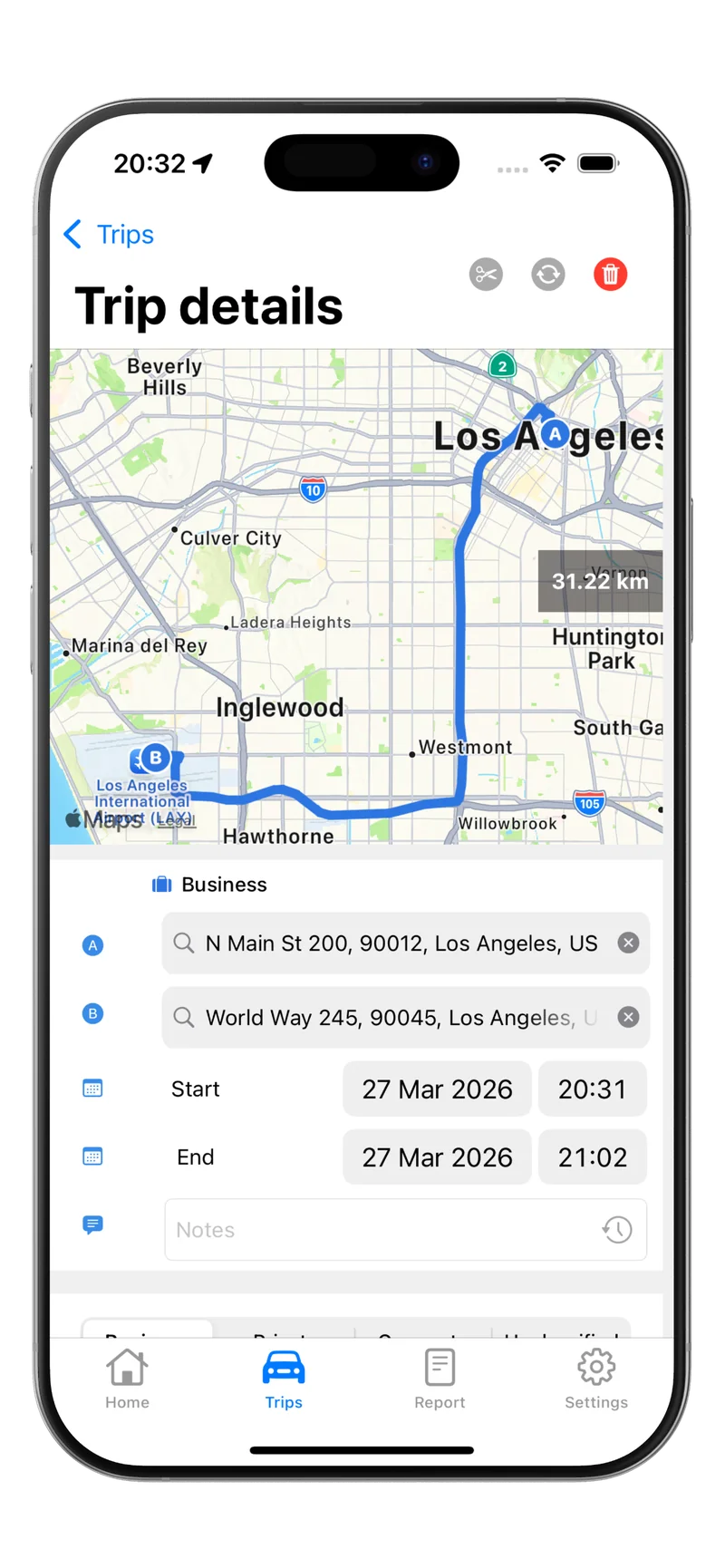
Tripbook automatically records every trip with GPS-verified distance, timestamps, and purpose tags — exactly the documentation Part V requires. Download Tripbook to build an audit-proof log that supports your Form 4562 filing.
Example: Heavy SUV Write-Off in Year One
Suppose you buy a $72,000 SUV with a GVWR of 7,200 lbs and use it 100% for business in 2026. Here is how the deduction stacks up:
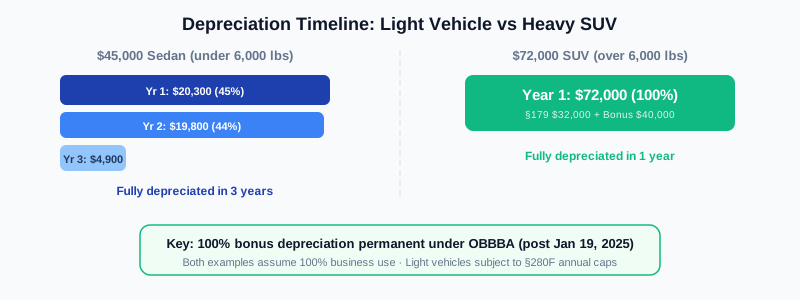
- Section 179 deduction: $32,000 (heavy SUV cap)
- Remaining basis: $72,000 − $32,000 = $40,000
- Bonus depreciation at 100%: $40,000
- Total first-year deduction: $72,000
The entire purchase price is deducted in year one.
Example: Light Vehicle Over Multiple Years
Now consider a $45,000 sedan under 6,000 lbs GVWR, also used 100% for business in 2026:
- First year (with bonus): $20,300
- Second year: $19,800
- Third year: $4,900 (remaining basis)
- Total recovered: $45,000 over three years
The accelerated caps still recover the cost faster than old straight-line schedules. For a detailed comparison, read our guide on tax write-offs for a new car.
Common Filing Mistakes to Avoid
Forgetting Part V. Many taxpayers fill out Parts I and II but skip the listed-property section. The IRS expects both the deduction and the supporting detail on the same form.
No mileage log. Claiming 90% business use without a contemporaneous log is an audit risk. The IRS can reduce your percentage to zero if you cannot produce records.
Mixing methods mid-stream. Once you elect Section 179 for a specific vehicle, you cannot switch to the standard mileage rate (72.5 cents per mile for 2026) for that vehicle in a later year. The actual-expense method, including depreciation, locks in for the life of the vehicle.
Ignoring the 1099-NEC threshold. If you receive $2,000 or more in nonemployee compensation reported on Form 1099-NEC, the IRS already knows you have income that may involve business driving. Make sure your depreciation claims are consistent with reported income.
Form 4562 Vehicle Depreciation: Key Takeaways
Form 4562 vehicle depreciation is the mechanism for turning a business vehicle purchase into a tax deduction. The form’s parts work together — Section 179 in Part I provides the immediate expense, bonus depreciation in Part II adds the accelerated write-off, MACRS in Part III handles any remaining basis, and Part V documents the vehicle details the IRS requires.
For 2026, the combination of a $32,000 Section 179 SUV cap and permanent 100% bonus depreciation under the OBBBA means heavy-vehicle buyers can often deduct the entire cost in year one. Light-vehicle owners face the $20,300 first-year ceiling but still recover costs faster than under prior law.
Whichever path you take, accurate mileage records are non-negotiable. Download Tripbook to automate your trip logging and keep your Form 4562 filing audit-ready.