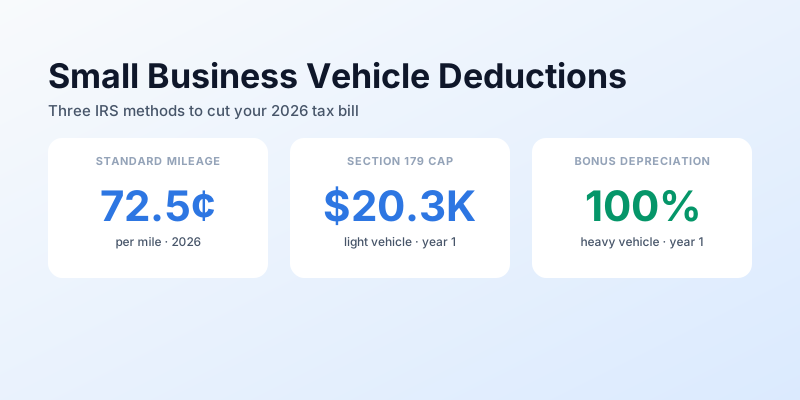
When you use a vehicle for business, the IRS gives you two fundamentally different ways to deduct the cost. The standard mileage rate is simple — 72.5 cents per mile driven in 2026. Section 179 is more powerful but more complex: it lets you deduct a large chunk of the vehicle’s purchase price in the first year instead of spreading depreciation across five years.
Choosing the wrong method can cost you thousands of dollars. Here’s how each one works and how to decide which fits your situation.
Two Ways to Deduct Business Vehicle Costs
Every business vehicle deduction method falls into one of two buckets:
Standard mileage rate: You track miles and multiply by the IRS rate. No need to track actual gas, oil, or repair receipts. The rate (72.5¢/mile in 2026) is designed to cover your average operating costs including depreciation.
Actual expenses method: You deduct real costs — gas, insurance, maintenance, repairs, registration — multiplied by your business-use percentage. Depreciation (including Section 179) is part of this method.
Section 179 is an accelerated depreciation election within the actual expenses method. Instead of depreciating your vehicle over five years at roughly 20% per year, you deduct a large amount upfront.
What Is Section 179 and How Does It Work for Vehicles?
Section 179 of the tax code lets businesses immediately expense the full cost of qualifying assets in the year of purchase rather than depreciating them over multiple years. For vehicles, the deduction depends heavily on what type of vehicle you’re buying.
The general 2026 Section 179 spending cap is $1,220,000 (phased out dollar-for-dollar above $3,050,000 in total equipment purchases). But vehicles have their own sub-limits:
Passenger cars (standard sedans, smaller crossovers): The IRS “luxury auto” rules cap your first-year deduction at approximately $12,400 — regardless of what the car cost. A $50,000 sedan doesn’t get you a $50,000 deduction.
SUVs with GVWR over 6,000 lbs: A separate Section 179 limit caps the deduction at $30,500 for vehicles classified as SUVs.
Heavy vehicles with GVWR over 6,000 lbs that are NOT SUVs (pickup trucks, cargo vans, heavy-duty work vehicles): These can be deducted up to the full $1,220,000 Section 179 cap — meaning you can potentially write off the entire purchase price in year one.
You must use the vehicle more than 50% for business to take any Section 179 deduction, and the deduction is proportional to your business-use percentage. A $60,000 pickup used 80% for business qualifies for up to $48,000 in Section 179.
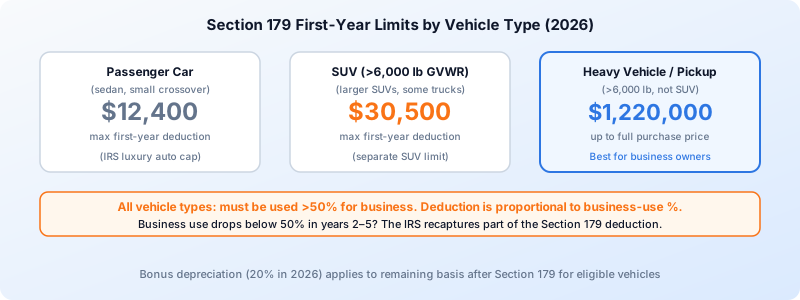
Bonus depreciation note: In addition to Section 179, bonus depreciation lets you deduct a percentage of the remaining cost after Section 179. For 2026, bonus depreciation is 20% (it was 100% through 2022 and has been phasing down). Combined with Section 179, heavy vehicles still get very favorable treatment.
The Standard Mileage Rate: Simpler, More Flexible
At 72.5 cents per mile, the standard mileage rate is straightforward. Drive 15,000 business miles in 2026 and you claim a $10,875 deduction. Drive 30,000 miles and you claim $21,750. No purchase price, no depreciation schedule, no business-use percentage calculations required.
The rate covers everything: fuel, oil changes, tires, repairs, insurance, and a depreciation component. You only need one record: a mileage log with date, miles, and business purpose for each trip.
The standard mileage method also lets you switch to actual expenses in future years (subject to some restrictions). This flexibility is valuable if your business-use percentage changes significantly from year to year.
For more on the mechanics of the standard mileage rate, see our standard mileage rate vs actual expenses comparison and our IRS mileage rate 2026 guide.
When Section 179 Makes Sense
Section 179 is worth considering when several conditions line up:
You’re buying a new or nearly new heavy vehicle. The largest Section 179 deductions are available for pickup trucks and cargo vans with GVWR over 6,000 lbs. A contractor buying a $55,000 pickup truck used 90% for business can deduct $49,500 in year one instead of depreciating it at roughly $10,000 per year.
Your business use is high and consistent. Section 179 requires more than 50% business use, and if business use drops below 50% in any of the first five years, the IRS recaptures part of your deduction. High, stable business use reduces this risk.
You need the tax break this year. If you had an unusually profitable year and want to reduce taxable income, front-loading a vehicle deduction through Section 179 can make more financial sense than spreading a smaller deduction over five years.
You have sufficient taxable income. Section 179 cannot create or increase a business loss. The deduction is limited to your business’s taxable income for the year, though any excess can be carried forward.
When the Standard Mileage Rate Makes Sense
For many business drivers, the standard mileage rate is the better choice:
You drive a passenger car. The luxury auto caps make Section 179 far less valuable for ordinary cars. A $40,000 sedan gets you only $12,400 in first-year Section 179 versus potentially more than that over five years using actual depreciation or the standard mileage rate.
Your mileage is high relative to vehicle value. A high-mileage driver in an older vehicle often comes out ahead with the standard mileage rate. At 72.5 cents per mile, 25,000 miles produces an $18,125 deduction — easily exceeding what you’d get from depreciating a $20,000 used car.
You want flexibility. If there’s any chance your business use will change, or you’re not sure whether actual expenses or standard mileage will be better in future years, starting with standard mileage preserves your options.
You don’t want to track every receipt. Section 179 and actual expenses require detailed documentation of all vehicle-related expenditures. Mileage tracking only requires a log.
The Critical Trap: Your Year-One Choice Is Permanent
This is the most important thing to know about choosing between these methods: if you use the standard mileage rate in the first year you use a vehicle for business, you cannot use Section 179 (or any actual expense depreciation method) for that vehicle in a later year.
The rule works in only one direction. If you start with actual expenses (including Section 179), you can switch to the standard mileage rate in a later year. But if you start with the standard mileage rate, you’re locked into it for that vehicle’s entire business life.
Example: You buy a qualifying pickup truck and use the standard mileage rate year one because it seemed simpler. Year two, your accountant tells you Section 179 would have saved you $30,000. Too late — that vehicle is locked into standard mileage for its entire business use period.
Before you file your first return after buying a business vehicle, run the numbers on both methods. This decision cannot be undone.
A Real-World Example
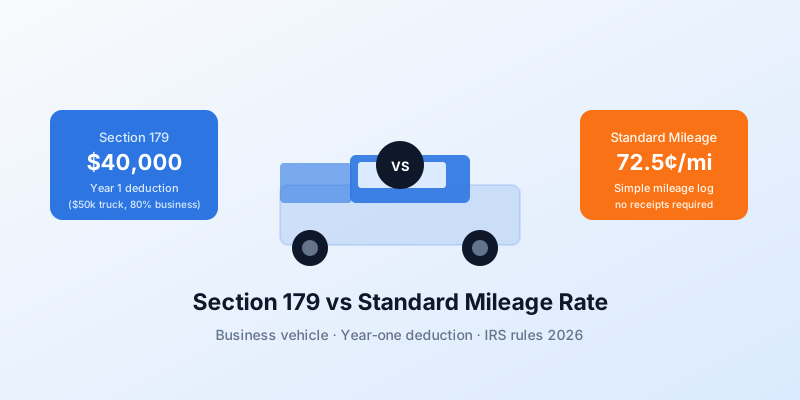
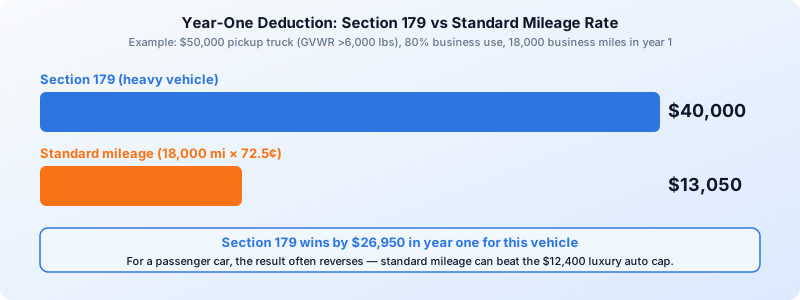
A general contractor buys a $50,000 pickup truck (GVWR 8,500 lbs — qualifies as a heavy vehicle, not an SUV). Business use is 80%.
Section 179 approach: 80% × $50,000 = $40,000 deduction in year one. The remaining $10,000 of purchase price (20% personal use) is not deductible.
Standard mileage approach: If the truck does 18,000 business miles in year one, the deduction is 18,000 × $0.725 = $13,050.
The Section 179 approach wins by $26,950 in year one. Over five years, the standard mileage rate will accumulate more if the truck stays active, but the time value of money strongly favors the upfront deduction.
For employees or self-employed drivers whose vehicle is a standard passenger car with moderate mileage, the comparison often flips — and the standard mileage rate wins.
Tracking Miles Regardless of Method
Even if you choose Section 179 and the actual expenses method, you still need to track your business miles. The IRS requires you to document your business-use percentage, and the only defensible way to do that is with a mileage log showing date, destination, and business purpose for every trip.
Tripbook tracks your miles automatically, so your business-use percentage is always current and documented. You can hand your tax preparer a clean mileage report at year end — whether you’re using the standard rate or actual expenses.
For a full guide on what the IRS requires in a mileage log, see our IRS mileage log requirements article. If you’re self-employed and filing Schedule C, our guide to claiming mileage on taxes covers the full filing process.
The Bottom Line
Section 179 can deliver a massive first-year deduction — particularly for heavy vehicles like pickup trucks used predominantly for business. For passenger cars or high-mileage drivers, the standard mileage rate often wins on simplicity and total value.
The most important step is to make the decision before you file your first return. You can move from Section 179 to standard mileage later, but not the other way around.
Download Tripbook and keep the mileage documentation you’ll need regardless of which deduction method you choose.