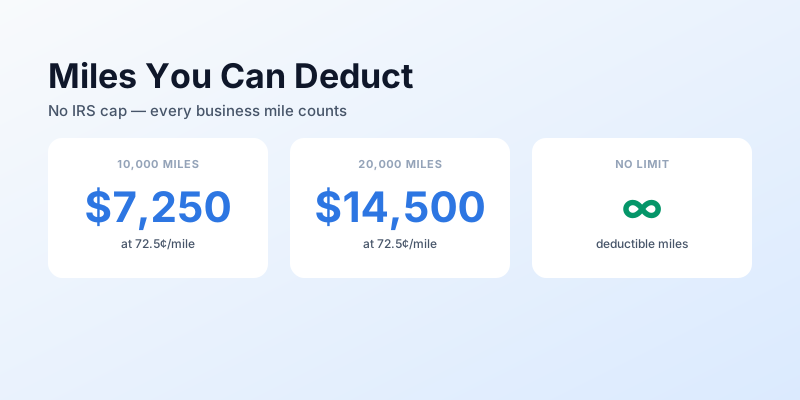
If you drive for work, you have probably asked: how many miles can you deduct on your tax return? The short answer is that there is no limit. The IRS does not cap the number of business miles you can write off. Whether you drive 2,000 miles or 50,000 miles in a year, every qualifying business mile is deductible.
What matters is not the quantity of miles but the quality of each trip. Every mile you claim must have a legitimate business purpose, and you must keep proper records to prove it. This guide breaks down the rules for 2026 so you know exactly which miles count, which do not, and how to calculate your deduction.
How Many Miles Can You Deduct? There Is No IRS Cap
The IRS publishes a standard mileage rate each year, but it does not publish a mileage ceiling. You can deduct all business miles you drive during the tax year, as long as each trip meets two conditions:
- The trip has a business purpose. You drove to meet a client, visit a job site, pick up supplies, travel between work locations, or perform some other business-related activity.
- You have documentation. Your records include the date, destination, total miles, and business purpose for each trip.
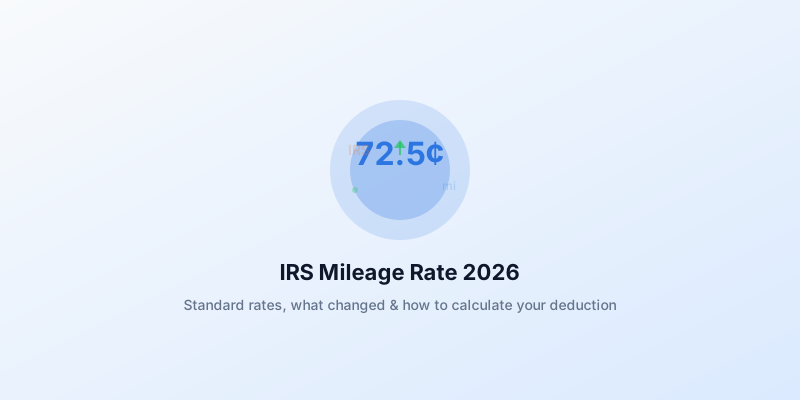
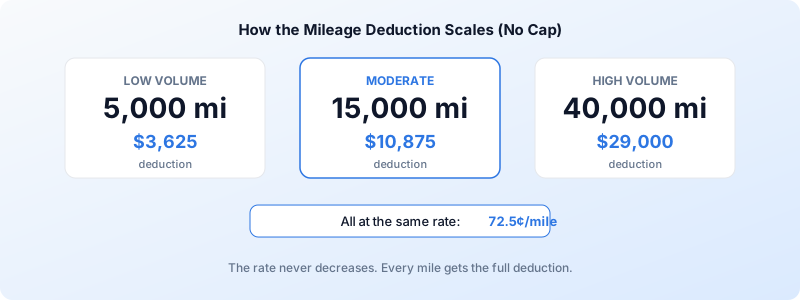
For 2026, the IRS mileage rate is 72.5 cents per mile for business driving. That means 10,000 business miles would produce a $7,250 deduction, and 30,000 miles would produce a $21,750 deduction. There is no point at which the rate drops or the deduction stops.
Who Can Actually Claim the Deduction?
Not everyone who drives for work is eligible. Since the Tax Cuts and Jobs Act took effect in 2018, and with the permanent extension under more recent legislation, W-2 employees can no longer deduct unreimbursed mileage as a miscellaneous itemized deduction.
The mileage deduction is now available to:
- Self-employed individuals and sole proprietors who report business income on Schedule C
- Independent contractors and freelancers (1099 workers, gig drivers, consultants)
- Single-member LLC owners filing as sole proprietors
- Armed Forces reservists and certain qualifying government officials
- Anyone deducting medical mileage (at a lower rate of 20.5 cents per mile)
- Volunteers driving for qualified charities (at a fixed rate of 14 cents per mile)
If you are self-employed, the mileage deduction is reported on your Schedule C. It reduces your taxable business income, which also reduces your self-employment tax.
Miles You Cannot Deduct: Commuting and Personal Driving
The IRS draws a hard line between business driving and commuting. Understanding this distinction is critical because it is the most common reason the IRS disallows mileage deductions.
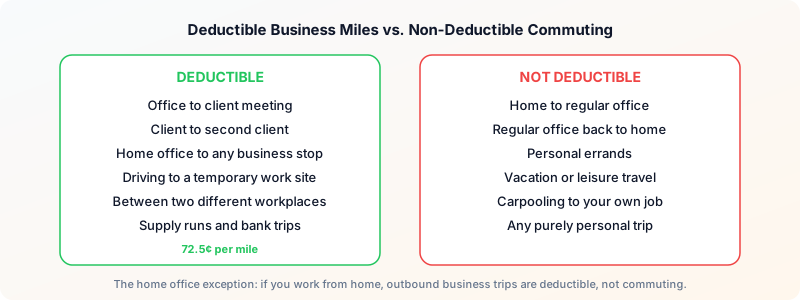
Commuting miles are never deductible. A commute is defined as the trip between your home and your regular place of work. It does not matter how far you drive or how inconvenient the commute is. The IRS treats it as a personal expense.
Here is how to tell the difference:
| Trip Type | Deductible? |
|---|---|
| Home to regular office | No (commute) |
| Office to client meeting | Yes |
| Client meeting to second client | Yes |
| Home office to client | Yes |
| Home to temporary work site | Yes |
| Personal errands during lunch | No |
| Driving between two jobs | Yes |
The home office exception is important. If your home qualifies as your principal place of business, then trips from your home to any business destination are deductible, not commuting. For most self-employed people who work from home, this means virtually every business trip starts from a deductible location.
For a deeper breakdown, see the full guide on business miles vs. commuting miles.
How to Calculate Your Mileage Deduction
You have two methods to choose from when deducting vehicle expenses. You can use both methods across different vehicles but not for the same vehicle in the same year.
Method 1: Standard Mileage Rate
Multiply your total business miles by the IRS rate for that year.
2026 rate: 72.5 cents per mile
This method is simpler and works well for most self-employed drivers. You still add tolls and parking fees on top of the standard rate.
Example calculation:
- 15,000 business miles x $0.725 = $10,875
- Plus $400 in tolls and $600 in parking = $11,875 total deduction
Method 2: Actual Expense Method
Track every cost related to your vehicle: gas, insurance, repairs, tires, registration, depreciation, and lease payments. Then multiply the total by the percentage of miles that were for business.
Example:
- Total vehicle expenses: $12,000
- Total miles driven: 20,000
- Business miles: 15,000 (75%)
- Deduction: $12,000 x 75% = $9,000
In this example, the standard mileage rate produces a larger deduction. That is common for newer, fuel-efficient vehicles. Older vehicles with high maintenance costs sometimes favor the actual expense method.
Important rule: If you want to use the standard mileage rate, you must choose it in the first year you use the vehicle for business. You can switch to actual expenses later, but you cannot go the other direction.
What Records Does the IRS Require?
The IRS requires a contemporaneous log, meaning you record each trip at or near the time it happens. For every business trip, your log must include:
- Date of the trip
- Destination (or route)
- Miles driven
- Business purpose (who you met, what you did)
You should also track your odometer reading at the start and end of each year to establish your total annual mileage. The IRS uses this to verify the ratio of business to personal miles.
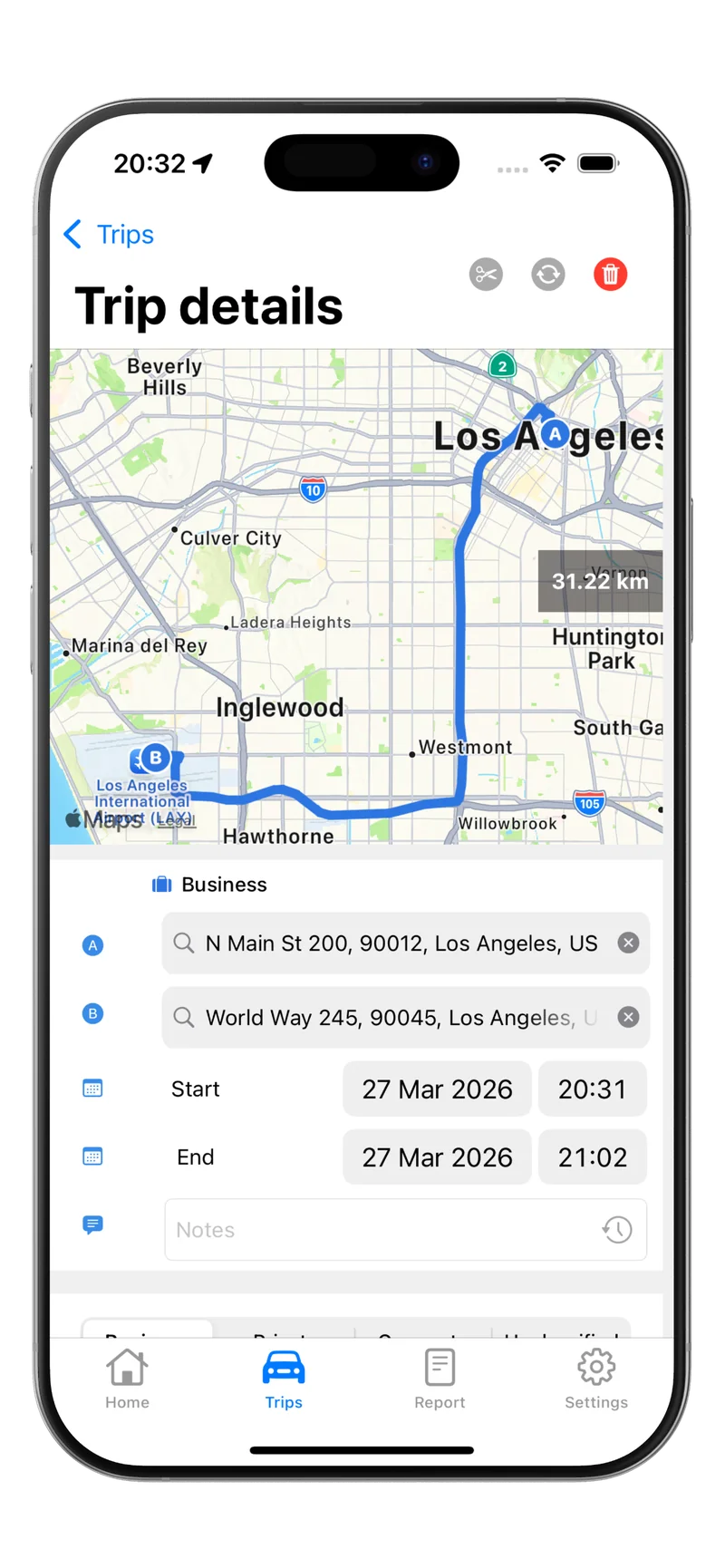
Paper logs still work, but they are time-consuming and easy to lose. A mileage tracking app records trips automatically with GPS and stores everything in the cloud, giving you an IRS-ready log without the manual effort.
Tips to Maximize Your Mileage Deduction
Since there is no cap on how many miles you can deduct, maximizing your write-off comes down to capturing every eligible mile:
- Set up a home office. If you work from home, qualifying for the home office deduction turns every outbound business trip into a deductible one.
- Track every trip. A forgotten trip is a lost deduction. Automatic GPS tracking eliminates this problem.
- Combine errands strategically. A trip that starts with a business stop and includes personal errands is partially deductible. Log the business portion accurately.
- Count trips between work locations. Driving from one client to another, or from a job site to a supply store, is fully deductible.
- Do not forget medical and charitable miles. These use lower rates (20.5 cents and 14 cents respectively) but still add up over a year.
Frequently Asked Questions
Is there a maximum number of miles I can deduct? No. The IRS does not set a limit on deductible business miles. You can deduct every qualifying mile at 72.5 cents for 2026.
Can W-2 employees deduct mileage? No. Since 2018, unreimbursed employee mileage is no longer deductible as an itemized deduction. This change is now permanent. Only self-employed individuals can claim the deduction.
What happens if I get audited? The IRS will ask to see your mileage log. If you cannot produce records with dates, destinations, miles, and business purposes, the deduction can be partially or fully disallowed.
Can I deduct mileage and gas? Not at the same time for the same vehicle. The standard mileage rate already accounts for fuel costs. If you use the actual expense method instead, you can deduct gas as part of your total vehicle expenses.
Start Tracking Every Mile Today
Now you know the answer to how many miles can you deduct: all of them, as long as they are for business and you have the records to prove it. The only miles you lose are the ones you forget to log.
Download Tripbook to automatically track your business miles with GPS. Every trip is recorded with the date, route, distance, and purpose, giving you an IRS-compliant mileage log without any manual work.