Knowing how to calculate mileage for taxes is one of the easiest ways to lower your tax bill if you drive for work. The IRS lets self-employed individuals, freelancers, and certain other taxpayers convert every qualified business mile into a dollar-amount deduction, yet many filers leave money on the table because they are unsure of the math. This guide breaks the calculation down into clear steps so you can claim every mile you deserve.
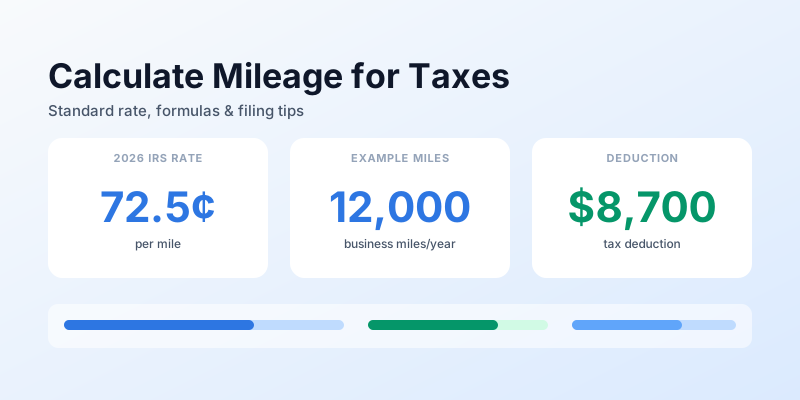
For the 2026 tax year the IRS standard mileage rate is 72.5 cents per mile, up from 70 cents in 2025. That single number is the foundation of the most popular calculation method, but it is not the only option. Below you will find both approaches, a side-by-side comparison, and the recordkeeping rules that hold everything together.
Two Ways to Calculate Mileage for Taxes
The IRS provides two recognized methods for turning vehicle costs into a deduction. You choose one method per vehicle per tax year.
Method 1: The Standard Mileage Rate
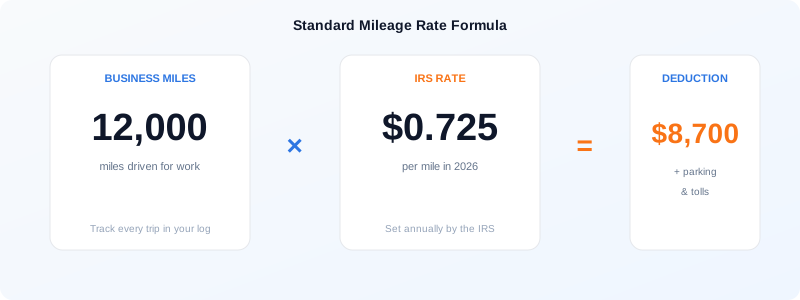
This is the simpler approach. Multiply the total number of business miles you drove during the year by the IRS rate for that year:
Business Miles x IRS Rate = Deduction
For example, if you drove 12,000 business miles in 2026:
12,000 x $0.725 = $8,700
You can also add business-related parking fees and tolls on top of the standard rate. Those costs stack with the per-mile amount rather than replacing it.
| Tax Year | Rate per Mile | 12,000-Mile Deduction |
|---|---|---|
| 2024 | $0.670 | $8,040 |
| 2025 | $0.700 | $8,400 |
| 2026 | $0.725 | $8,700 |
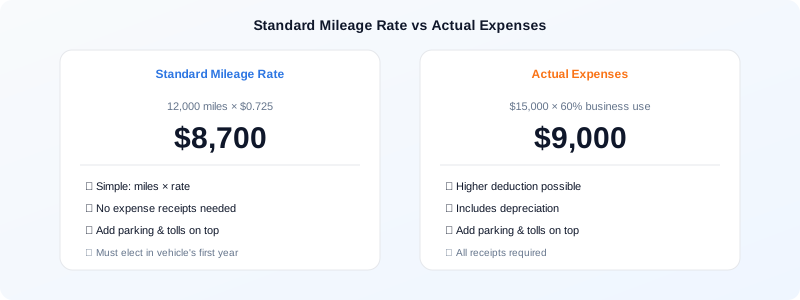
There is one important restriction: you must elect the standard mileage rate in the first year you place the vehicle in service for business. If you claimed actual expenses or a Section 179 deduction in year one, you are locked into the actual expense method for the life of that vehicle. For a deeper comparison of when each option saves more, see our guide on standard mileage rate vs. actual expenses.
Method 2: The Actual Expense Method
Instead of a flat per-mile number, you add up every cost of operating your vehicle for the year and multiply by the percentage of miles that were for business.
Total Vehicle Expenses x Business-Use Percentage = Deduction
Qualifying expenses include:
- Gas and oil
- Insurance premiums
- Repairs and maintenance
- Tires
- Registration fees
- Lease payments or depreciation
- Loan interest (business portion)
Suppose your total vehicle costs for the year are $15,000 and 60 percent of your miles were for business:
$15,000 x 0.60 = $9,000
The actual expense method can produce a larger deduction when your vehicle costs are high relative to the number of miles you drive, or when you own a newer vehicle with significant depreciation. The trade-off is more paperwork: you need receipts for every expense category.
Calculating Your Business-Use Percentage
Both methods rely on knowing what share of your total driving is for business. The formula is straightforward:
Business Miles / Total Miles = Business-Use Percentage
If you drove 18,000 total miles in a year and 12,000 were for business, your business-use percentage is 66.7 percent. That percentage feeds directly into the actual expense calculation and also determines how much of your parking, tolls, and other add-on costs are deductible.
Miles that do not count as business include:
- Your regular commute between home and your main office
- Personal errands and weekend trips
- Vacation travel
Miles that do count include trips between your office and a client site, travel between two work locations, trips to the bank or post office for business, and driving from a qualifying home office to any business destination. For a complete breakdown, check the IRS mileage rate 2026 overview.
What Records Does the IRS Require?
Regardless of which method you choose, the IRS expects a contemporaneous log, meaning you record each trip close to when it happens rather than reconstructing the data at year-end. Your log should capture five details for every business trip:
- Date of the trip
- Destination (name or address)
- Business purpose (e.g., client meeting, supply pickup)
- Miles driven
- Odometer reading at the start and end of the year (or when the vehicle is placed in service)
If you use the actual expense method, you also need receipts for every vehicle cost category. Keeping these organized throughout the year is critical because the IRS can disallow the entire deduction if your records are incomplete during an audit.
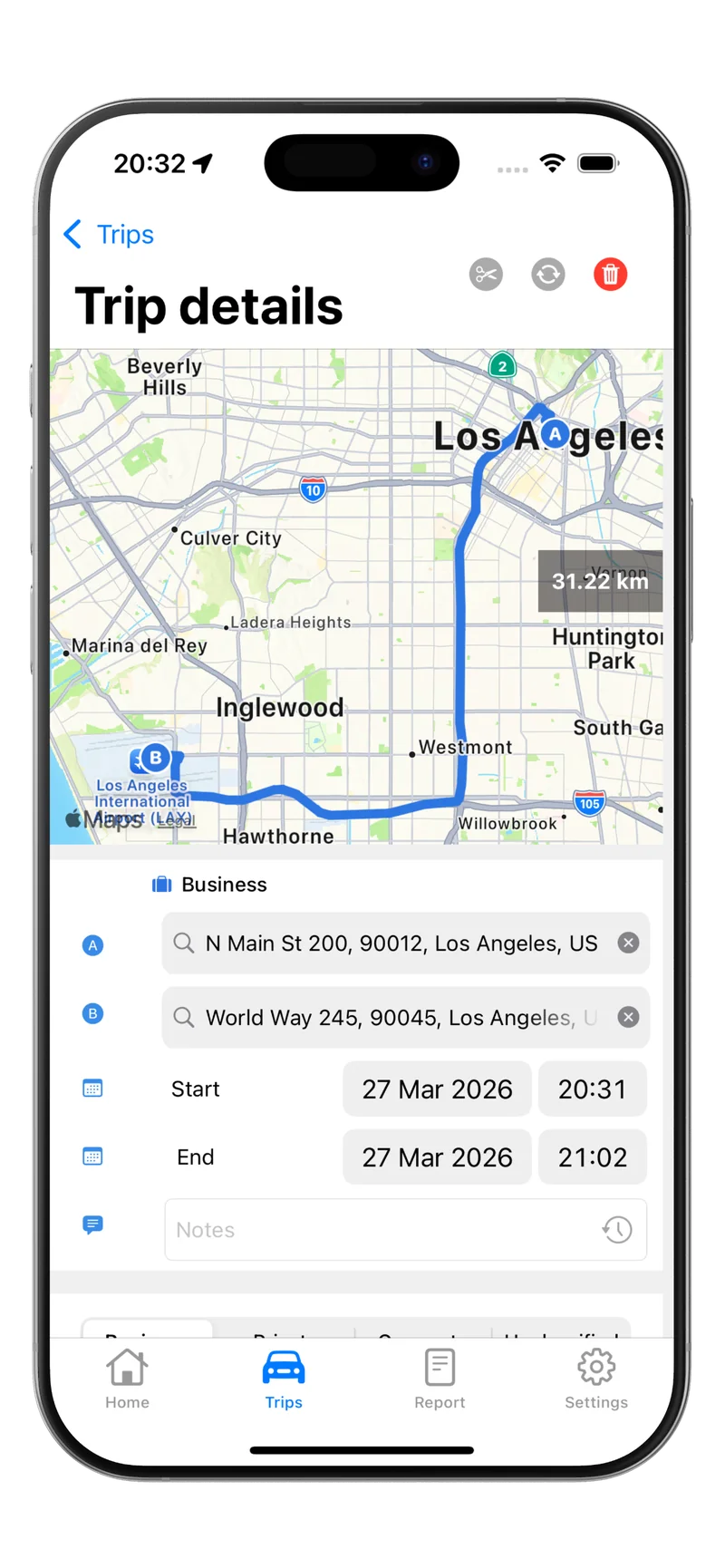
A mileage tracking app is the most reliable way to maintain a compliant log. It timestamps each trip automatically, captures GPS-verified distances, and exports IRS-ready reports when tax season arrives. Download Tripbook to start logging trips in seconds.
Where to Report Mileage on Your Tax Return
The form you use depends on your filing situation:
- Self-employed (sole proprietors, single-member LLCs, independent contractors): Report mileage on Schedule C (Form 1040), Line 9 — Car and truck expenses. You also complete Part IV of Schedule C with vehicle details. Our Schedule C mileage deduction guide walks through the form line by line.
- Medical mileage: Deductible at 20.5 cents per mile on Schedule A under medical expenses, subject to the 7.5 percent AGI threshold.
- Charity mileage: Deductible at 14 cents per mile on Schedule A under gifts to charity.
- Armed Forces reservists and qualified performing artists: Use Form 2106 and Schedule 1 (Form 1040).
Note that under current tax law, W-2 employees generally cannot claim unreimbursed mileage as an itemized deduction. The Tax Cuts and Jobs Act suspended the miscellaneous itemized deduction for most employees.
Step-by-Step Calculation Checklist
Follow these steps to calculate your mileage deduction from start to finish:
- Gather your mileage log. Confirm that every business trip includes a date, destination, purpose, and distance.
- Total your business miles. Add up all qualified business miles for the tax year.
- Total your overall miles. Include personal and commuting miles to determine your business-use percentage.
- Pick your method. If this is the vehicle’s first year in business service, compare both methods to find the larger deduction. If you already elected one method in a prior year, continue with it.
- Run the math. Standard rate: multiply business miles by $0.725. Actual expenses: multiply total vehicle costs by your business-use percentage.
- Add parking and tolls. Both methods allow business-related parking and toll expenses on top of the base calculation.
- Enter the number on the correct form. Schedule C Line 9 for self-employed filers, Schedule A for medical or charity, or Form 2106 for qualifying employees.
Common Mistakes to Avoid
- Counting your commute. Driving from home to a fixed office is personal, not business. It is one of the most common errors the IRS flags.
- Mixing personal and business miles. Always separate the two. If you forget to classify a trip, it defaults to personal.
- Switching methods mid-life. Once you use actual expenses in the first year, you cannot switch to the standard rate for that vehicle later.
- Reconstructing a log at tax time. Estimated mileage logs are a red flag in audits. Record trips as they happen.
- Forgetting parking and tolls. These are deductible on top of the standard rate and are easy to overlook.
How to Calculate Mileage for Taxes: Key Takeaways
Learning how to calculate mileage for taxes comes down to choosing between the standard rate and the actual expense method, keeping an accurate log, and reporting the deduction on the right form. At 72.5 cents per mile in 2026, even modest driving can produce a meaningful deduction. A freelancer logging 15,000 business miles would save $10,875 before accounting for parking, tolls, or the self-employment tax effect.
The best time to start tracking is today. The more complete your records, the larger and more defensible your deduction will be. Download Tripbook to automate your mileage log and generate tax-ready reports in one tap.