
If you drive for work, your business mileage for taxes could be one of the most valuable deductions available to you. The IRS allows self-employed individuals and business owners to deduct the cost of driving for business purposes, but the rules about what counts and what does not are strict. Getting them right means more money in your pocket. Getting them wrong could mean lost deductions or audit trouble.
This guide breaks down everything you need to know: what qualifies as business mileage, the current IRS rate, who can claim the deduction, and how to track your miles properly throughout the year.
What is business mileage for taxes?
Business mileage refers to the miles you drive for ordinary and necessary work-related purposes. The IRS allows you to deduct these miles from your taxable income using either a standard per-mile rate or by calculating your actual vehicle expenses.
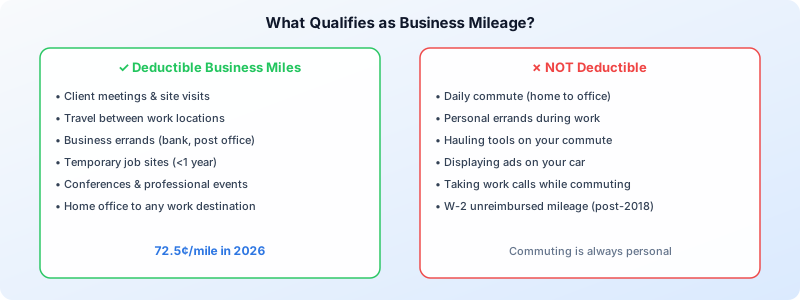
Common examples of deductible business mileage include:
- Client meetings and site visits — driving from your office to a client location
- Travel between work locations — going from one job site to another during the day
- Errands for your business — bank runs, supply pickups, post office trips
- Temporary work locations — driving to a job site where you expect to work for less than one year
- Conferences and professional events — travel to industry gatherings related to your work
The critical distinction is between business driving and commuting. Your daily commute from home to your regular workplace is never deductible, no matter how far it is. The IRS treats that as a personal expense. However, once you arrive at your workplace, any further driving for business purposes during the day counts as deductible business mileage.
For a deeper dive into that dividing line, see our guide on business miles vs commuting miles.
The 2026 IRS standard mileage rate
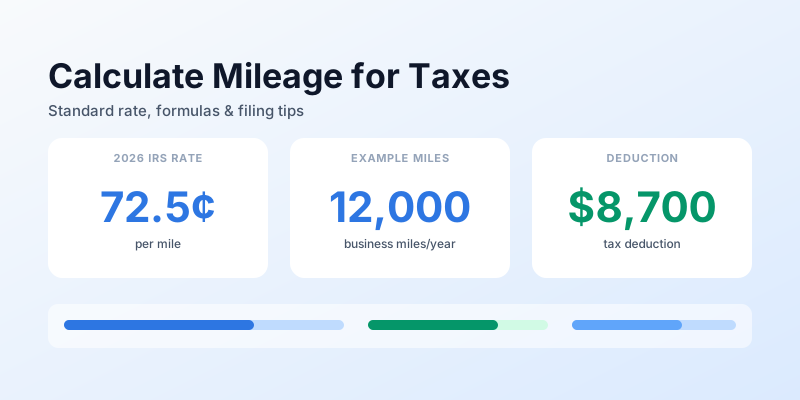
For the 2026 tax year, the IRS set the standard mileage rate at 72.5 cents per mile for business use. This is up 2.5 cents from 2025 and reflects the rising costs of fuel, insurance, maintenance, and depreciation.
Here is how the math works. If you drive 10,000 business miles in 2026, your deduction would be:
10,000 miles x $0.725 = $7,250
That is a significant reduction in taxable income. At a 22% tax bracket, it translates to roughly $1,595 in actual tax savings.
The standard mileage rate includes depreciation (35 cents per mile in 2026), fuel, insurance, repairs, and general wear and tear. You cannot deduct those expenses separately when using the standard rate.
For a full breakdown of the rate and how it compares to prior years, check our IRS mileage rate 2026 resource.
Standard mileage rate vs actual expenses
The IRS gives you two options for calculating your business mileage deduction:
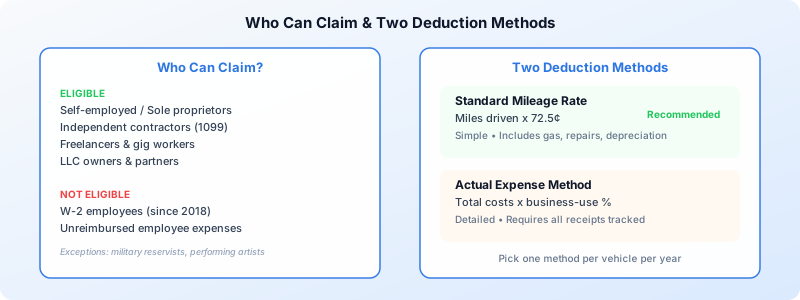
Standard mileage rate method: Multiply your total business miles by the IRS rate (72.5 cents for 2026). This approach is simple and works well for most people.
Actual expense method: Track every vehicle-related cost — gas, oil changes, tires, insurance, registration, depreciation, lease payments — and deduct the business-use percentage. If your car is used 60% for business, you deduct 60% of all costs.
You must choose one method per vehicle per tax year. If you own the vehicle, you can switch methods in later years, but you must use the standard mileage rate in the first year the vehicle is available for business. If you lease, you must stick with whichever method you pick for the entire lease period.
For most self-employed individuals, the standard mileage rate is the simpler and often more beneficial choice.
Who can claim business mileage for taxes?
Not everyone who drives for work can take this deduction:
Eligible:
- Self-employed individuals and sole proprietors
- Independent contractors (1099 workers)
- Freelancers
- Single-member LLC owners
- Gig workers (rideshare, delivery, etc.)
- Partners in a partnership
Not eligible (since 2018):
- W-2 employees claiming unreimbursed mileage as an itemized deduction
The Tax Cuts and Jobs Act eliminated the miscellaneous itemized deduction for unreimbursed employee expenses through the end of 2025, and the One Big Beautiful Bill Act made that change permanent. If you are a W-2 employee, you cannot deduct business mileage on your personal tax return, though your employer may reimburse you.
Limited exceptions exist for certain Armed Forces reservists, qualified performing artists, fee-basis state or local government officials, and eligible educators.
The home office exception
If you have a qualifying home office, every trip from your home to a business destination becomes deductible. Your home is treated as your principal place of business, so there is no commute to deduct from.
To qualify, you need a dedicated space used regularly and exclusively for business. A spare room works. A desk in a bedroom can work if that area is used only for work. A kitchen table does not qualify.
This exception is especially powerful for freelancers and contractors who work from home. A consultant who drives from their home office to three client sites in a day can deduct every single mile.
How to track business mileage for taxes
The IRS requires contemporaneous records, meaning you need to log your trips as they happen rather than trying to recreate them at tax time. Each entry should include:
- Date of the trip
- Starting location and destination
- Business purpose (e.g., “client meeting with ABC Corp”)
- Miles driven
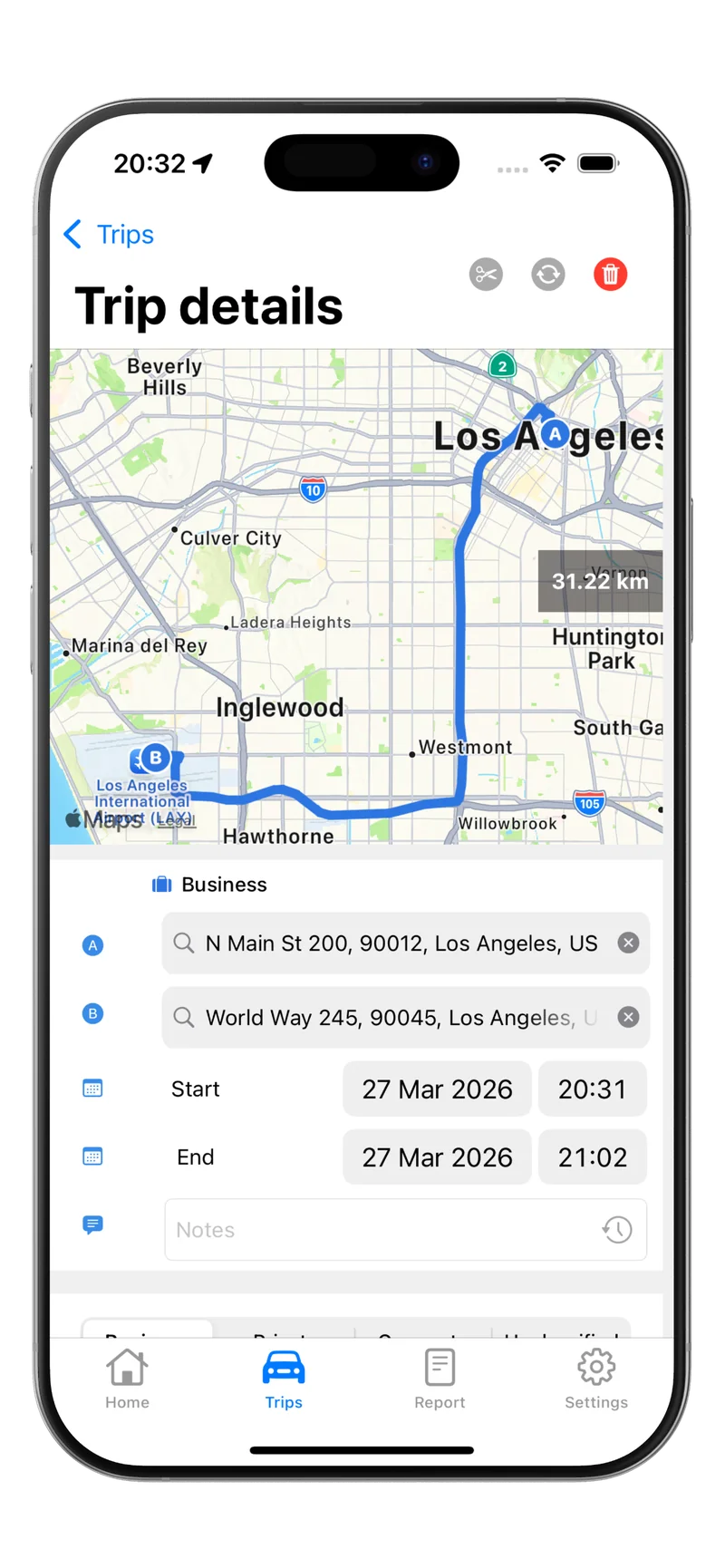
You can use a paper log, a spreadsheet, or a mileage tracking app. An app is the most reliable method because it records trips automatically and eliminates the risk of forgotten or incomplete entries.
If the IRS audits your mileage deduction and you cannot provide adequate documentation, the deduction gets disallowed. At 72.5 cents per mile, even a few thousand undocumented miles can cost you hundreds of dollars in lost deductions plus potential penalties.
How to report business mileage on your tax return
Where you report your business mileage depends on your business structure:
- Sole proprietors and single-member LLCs — Schedule C (Form 1040), Part II, Line 9
- Farmers — Schedule F
- Partners — Report on your individual return based on partnership allocations
- S-Corp owner-employees — The corporation reimburses you through an accountable plan rather than you taking a personal deduction
You will also need to complete Part IV of Schedule C or attach Form 4562 if claiming vehicle expenses for the first time or using the actual expense method. For a step-by-step walkthrough, visit our guide on how to claim mileage on taxes for the self-employed.
Common mistakes to avoid
Deducting your commute. Driving from home to your regular office is never deductible, even if you stop for a business errand along the way (only the detour portion counts).
Mixing personal and business miles. A trip to a client meeting is deductible. Stopping at the grocery store on the way back adds personal miles that must be excluded.
Reconstructing a mileage log after the fact. The IRS specifically requires contemporaneous records. A log created in April for the prior year is weak evidence in an audit.
Forgetting to log short trips. A five-mile run to the bank or post office adds up over the year. Those small trips can amount to hundreds of deductible miles.
Using both methods on the same vehicle. You cannot claim the standard mileage rate and also deduct gas, repairs, or depreciation separately for the same vehicle.
Make tracking easy with Tripbook
Keeping a compliant mileage log does not have to be a chore. Tripbook automatically records your business trips in the background, classifies them, and generates IRS-ready reports when you need them. No manual entry, no forgotten trips, no scrambling at tax time.
Download Tripbook and start turning every business mile into a tax deduction.