
If you lease a vehicle for business, you are entitled to a leased car mileage deduction that can save you thousands of dollars each year. The IRS lets you choose between two methods: the standard mileage rate (72.5 cents per mile for 2026) or actual expenses, which include your lease payments. Each method carries its own rules, and making the wrong pick at the start of a lease can lock you in for years.
This guide explains both options, highlights the critical lease lock-in rule, and helps you decide which approach puts more money back in your pocket.
Two Ways to Deduct a Leased Car
The IRS provides two methods for deducting vehicle expenses, and both apply to leased vehicles. You must choose one for each vehicle you use for business.
Standard Mileage Rate
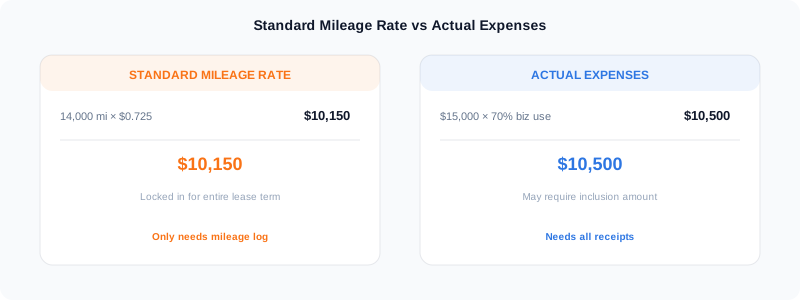
Multiply your business miles by the IRS rate for the year. For 2026 the rate is 72.5 cents per mile. This flat rate is designed to cover fuel, insurance, maintenance, depreciation, and general wear. On top of the standard rate you can still deduct parking fees and tolls tied to business trips, but you cannot add lease payments, gas, or insurance on top.
Example: You drive 14,000 business miles in your leased sedan. Your deduction is 14,000 x $0.725 = $10,150, plus any business parking and tolls.
Actual Expense Method
Track every cost of operating the vehicle and multiply the total by your business-use percentage. Deductible items include lease payments, gas, oil, tires, insurance, repairs, and registration fees. Because you do not own the car, depreciation does not apply, but the lease payment itself replaces that line item.
Example: Your annual lease costs total $9,600. Gas, insurance, maintenance, and registration add another $5,400, bringing total costs to $15,000. At 70% business use, you deduct $15,000 x 0.70 = $10,500.
For a deeper comparison of these two methods, see our standard mileage rate vs. actual expenses guide.
The Lease Lock-In Rule
This is the single most important rule for anyone leasing a vehicle for business. If you elect the standard mileage rate for a leased car, you must use it for the entire lease period, including renewals. You cannot switch to actual expenses partway through.
The rule does not work in reverse. If you start with actual expenses you are also expected to stay with that method for the lease term, but the IRS enforces the standard-rate lock-in most strictly.
For owned vehicles the rules are more flexible. You can choose the standard rate in year one and then switch to actual expenses in a later year (though you must use straight-line depreciation going forward). With a lease you have no such flexibility, so it pays to run the numbers before signing the first return.
Why the Lock-In Matters
Lease payments tend to be fixed, but mileage fluctuates. If your driving increases significantly in later years, the standard rate could outperform actual expenses. Conversely, if you drive fewer miles than expected, being stuck on the standard rate means a smaller deduction than actual expenses might have produced.
Before you file your first return with a leased vehicle, calculate the deduction both ways. Use your projected miles and estimated costs for the full lease term, not just year one.
Lease Inclusion Amount for Expensive Vehicles
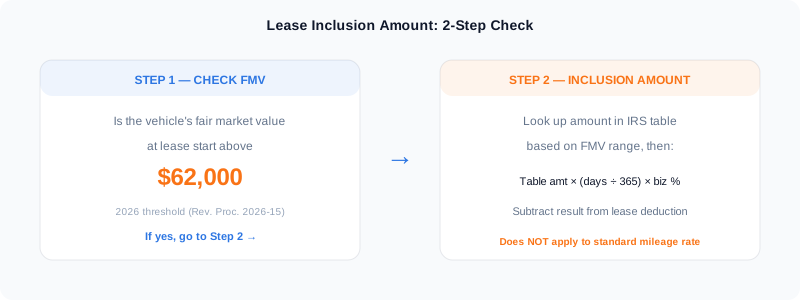
If you choose the actual expense method and your leased vehicle had a fair market value above $62,000 when the lease began (2026 threshold), the IRS requires you to reduce your lease-payment deduction by an inclusion amount each year. This rule prevents taxpayers from sidestepping the luxury-vehicle depreciation caps by leasing instead of buying.
The inclusion amount comes from tables published annually by the IRS (Revenue Procedure 2026-15 for vehicles first leased in 2026). The adjustment is based on the vehicle’s FMV when the lease started, the number of days you used it during the tax year, and your business-use percentage.
For most vehicles the inclusion amount is modest in the early years of the lease and increases slightly over time. If you lease a vehicle worth $65,000 at 80% business use, the first-year adjustment might only be a few dollars, but it compounds across a three- or four-year term.
The inclusion amount does not apply if you use the standard mileage rate.
What You Can Stack on Top of Each Method
Not every expense is exclusive to one method. Here is what you can add:
| Expense | Standard Rate | Actual Expenses |
|---|---|---|
| Parking (business) | Yes | Yes |
| Tolls (business) | Yes | Yes |
| Loan / lease interest | No | Yes (via lease payment) |
| Gas and oil | No | Yes |
| Insurance | No | Yes |
| Registration fees | No | Yes |
| Repairs and maintenance | No | Yes |
| Lease payments | No | Yes |
With the standard mileage rate, only parking and tolls stack. Everything else is baked into the per-mile figure.
Self-Employment Tax Impact
If you are self-employed, the leased car mileage deduction reduces your net profit on Schedule C. That lower profit flows through to your self-employment tax calculation. SE tax applies to 92.35% of net earnings (the deductible half of SE tax is removed first), so every dollar you deduct from vehicle expenses also trims your 15.3% SE tax bill.
For a detailed walkthrough of reporting mileage on Schedule C, read our Schedule C mileage deduction guide.
Who Qualifies for the Leased Car Deduction
- Self-employed individuals and sole proprietors who use a leased vehicle for business trips.
- Single-member LLC owners filing Schedule C.
- Partners and S-corp shareholders who use a personal lease for business and are not reimbursed under an accountable plan.
W-2 employees generally cannot deduct unreimbursed vehicle expenses. The OBBBA made the suspension of miscellaneous itemized deductions (subject to the 2% AGI floor) permanent, so employees should seek reimbursement from their employer instead.
If you financed the vehicle through a loan instead of a lease, the rules differ. Our car loan interest tax deduction guide covers those specifics.
Recordkeeping Tips for Leased Vehicles
The IRS expects the same documentation whether you own or lease. At a minimum, keep:
- A contemporaneous mileage log with the date, destination, business purpose, and miles for every trip.
- Lease agreement showing monthly payment, term, and vehicle FMV at inception.
- Receipts for parking, tolls, fuel, and maintenance if you use actual expenses.
- Business-use percentage calculated from total miles versus business miles each year.
A digital mileage tracker eliminates most of the manual work. Tripbook logs every trip automatically with GPS, stamps each entry with a date, and generates IRS-ready reports you can hand straight to your accountant.
Deciding Which Method to Use
Run the numbers for the full lease term. A quick checklist:
- High mileage + low lease payment — the standard rate often wins.
- Low mileage + high lease payment — actual expenses usually win.
- Expensive vehicle (FMV above $62,000) — factor in the inclusion amount before choosing actual expenses.
- Simplicity — the standard rate requires only a mileage log; actual expenses demand full receipt tracking.
Remember, your choice on a lease is essentially permanent for that vehicle. Take the time to project costs over the entire term.
Claim Every Mile on Your Leased Vehicle
Whether you use the standard mileage rate or actual expenses, accurate mileage records are the foundation of a leased car mileage deduction that holds up under scrutiny. Missing even a few trips per week adds up to hundreds of lost dollars by year-end.
Download Tripbook to track every business mile automatically and keep your lease deduction airtight.