
Understanding the mileage deduction for LLC owners is essential if you drive for business. The IRS does not have a special mileage rule for LLCs. Instead, how you deduct business miles depends entirely on how your LLC is classified for tax purposes. A single-member LLC, a multi-member partnership, and an LLC with an S-corp election each follow a different filing path, but every structure can claim the same 72.5 cents per mile for 2026.
This guide breaks down the rules for each LLC type so you know exactly where to report your mileage and how to maximize your deduction.
How the Mileage Deduction for LLC Works by Tax Classification
The IRS does not recognize “LLC” as a tax classification. When you form an LLC, the IRS assigns a default tax treatment based on how many members you have. You can also elect a different classification. Your tax classification determines which form carries your mileage deduction.
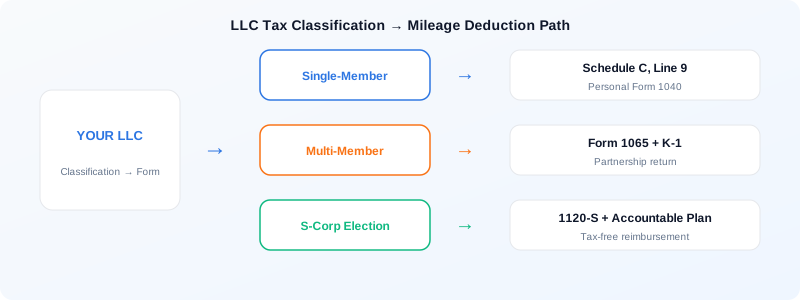
Here is the breakdown:
-
Single-member LLC — Treated as a disregarded entity. All income and expenses, including mileage, go on Schedule C (Form 1040). This is identical to a sole proprietorship. For the full process, see our Schedule C mileage deduction guide.
-
Multi-member LLC — Defaults to partnership taxation. The LLC files Form 1065 and issues a K-1 to each member. Vehicle expenses can be deducted at the entity level if the LLC owns or leases the vehicle. If members use personal vehicles, they may deduct unreimbursed partner expenses on their individual returns.
-
LLC with S-corp election — Files Form 1120-S. The LLC reimburses member-employees for mileage through an accountable plan. The reimbursement is a deductible business expense for the company and tax-free income for the recipient. Learn more in our S-corp mileage reimbursement guide.
Single-Member LLC: Schedule C Mileage Deduction
If you are the sole owner of your LLC and have not elected S-corp or C-corp treatment, your LLC is a disregarded entity. The IRS treats it as though the business does not exist separately from you. Every business mile you drive gets deducted on Schedule C, Line 9.
The Two Methods
You can choose between:
Standard mileage rate — Multiply your business miles by the IRS rate. For 2026, that rate is 72.5 cents per mile. If you drive 15,000 business miles, your deduction is $10,875.
Actual expense method — Track every vehicle cost (fuel, insurance, repairs, depreciation, registration) and multiply the total by your business-use percentage. If your total annual vehicle costs are $12,000 and you drive 70% for business, your deduction is $8,400.
| Method | 15,000 Business Miles | Best For |
|---|---|---|
| Standard rate | $10,875 | Low-cost vehicles, high mileage |
| Actual expenses | Varies by vehicle costs | Expensive vehicles, high costs |
Most single-member LLC owners choose the standard rate because it requires less paperwork and often produces a larger deduction, especially for drivers with older or fuel-efficient vehicles.
Tax Savings Beyond Income Tax
The Schedule C mileage deduction reduces your net self-employment income. That means it lowers both your income tax and your self-employment tax (15.3% for Social Security and Medicare). For an LLC owner in the 22% federal bracket, each 1,000 business miles saves roughly $270 in combined taxes.
Multi-Member LLC: Partnership Filing Rules
A multi-member LLC defaults to partnership status and files Form 1065. Mileage deductions work differently depending on who owns the vehicle.
LLC-owned vehicles — If the LLC owns or leases the vehicle, it claims the deduction directly on the partnership return. The deduction flows through to each member on their K-1, proportional to their ownership share.
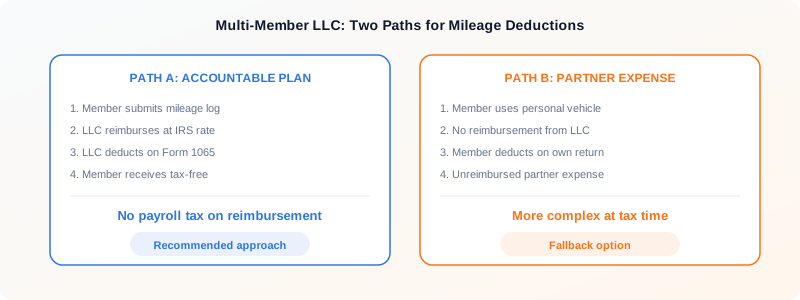
Member-owned vehicles — If a member uses a personal car for LLC business, the LLC has two options. It can reimburse the member under an accountable plan (the preferred approach), or the member can deduct unreimbursed partner expenses on their personal return. The reimbursement route is cleaner because it keeps the deduction at the entity level and avoids complexity on individual returns.
Setting Up a Reimbursement Policy
Multi-member LLCs should adopt a written accountable plan. Under this plan, members submit mileage logs showing the date, destination, business purpose, and miles driven for each trip. The LLC reimburses at or below the IRS standard rate. The reimbursement is tax-free to the member and deductible by the LLC. No payroll taxes apply.
S-Corp Election: How It Changes Mileage Deductions
Many LLC owners elect S-corp taxation once their net income exceeds $50,000 to $60,000 because it reduces self-employment tax. Under S-corp status, you become a W-2 employee of your own company and pay yourself a reasonable salary. This shift fundamentally changes how mileage deductions work.
With an S-corp, you cannot deduct mileage on your personal return. Instead, the S-corp reimburses you under an accountable plan at the IRS rate (72.5 cents per mile for 2026). The reimbursement is:
- Tax-free to you (it does not appear on your W-2)
- Deductible by the S-corp as a business expense
- Exempt from payroll taxes
This approach can produce meaningful tax savings. Say you drive 20,000 business miles. Your S-corp reimburses you $14,500 (20,000 x $0.725). That $14,500 is a business expense that reduces the S-corp’s taxable income, and you receive it without paying income tax or payroll tax on it.
For a detailed walkthrough of S-corp mileage rules, see our S-corp mileage reimbursement guide. To compare LLC structures for mileage purposes, read LLC vs sole proprietorship mileage deduction.
IRS Recordkeeping Requirements for LLC Mileage
Regardless of your LLC type, the IRS expects the same documentation for every business trip:
- Date of the trip
- Destination (or route)
- Business purpose — the specific reason for the trip
- Miles driven — odometer readings or GPS-verified distance
The IRS requires contemporaneous records, meaning you should log each trip at or near the time it happens. Reconstructing an entire year of trips at tax time is exactly the kind of documentation the IRS rejects during an audit.
What Counts as a Business Mile?
Business miles include trips between your office (or home office) and a client site, travel between two work locations, trips to the bank or post office for business, and driving to a business meeting or conference. Commuting from your home to a regular office does not qualify, even if you own the business.
Common Mistakes LLC Owners Make With Mileage
Mixing personal and business miles. The IRS only allows deductions for miles driven with a clear business purpose. Weekend errands do not count, even if you stop by a client’s office on the way.
Using the wrong form. A multi-member LLC filing as a partnership cannot deduct mileage on a member’s Schedule C. The deduction belongs on Form 1065 or through a reimbursement plan.
Skipping the first-year election. If you want to use the standard mileage rate for a vehicle you own, you must elect that method in the first year the vehicle is available for business. Switch to actual expenses in year one and you are locked out of the standard rate for that vehicle permanently.
No accountable plan for S-corps. If your S-corp reimburses mileage without a qualifying accountable plan, the reimbursement becomes taxable wages. The plan must require adequate documentation and return of excess reimbursements.
Making the Most of Your LLC Mileage Deduction
The mileage deduction for LLC owners follows the same IRS rules as any other business entity. The key variable is your tax classification: single-member LLCs use Schedule C, multi-member LLCs file Form 1065, and S-corp LLCs reimburse through an accountable plan. In every case, the foundation is the same — accurate, contemporaneous mileage records.
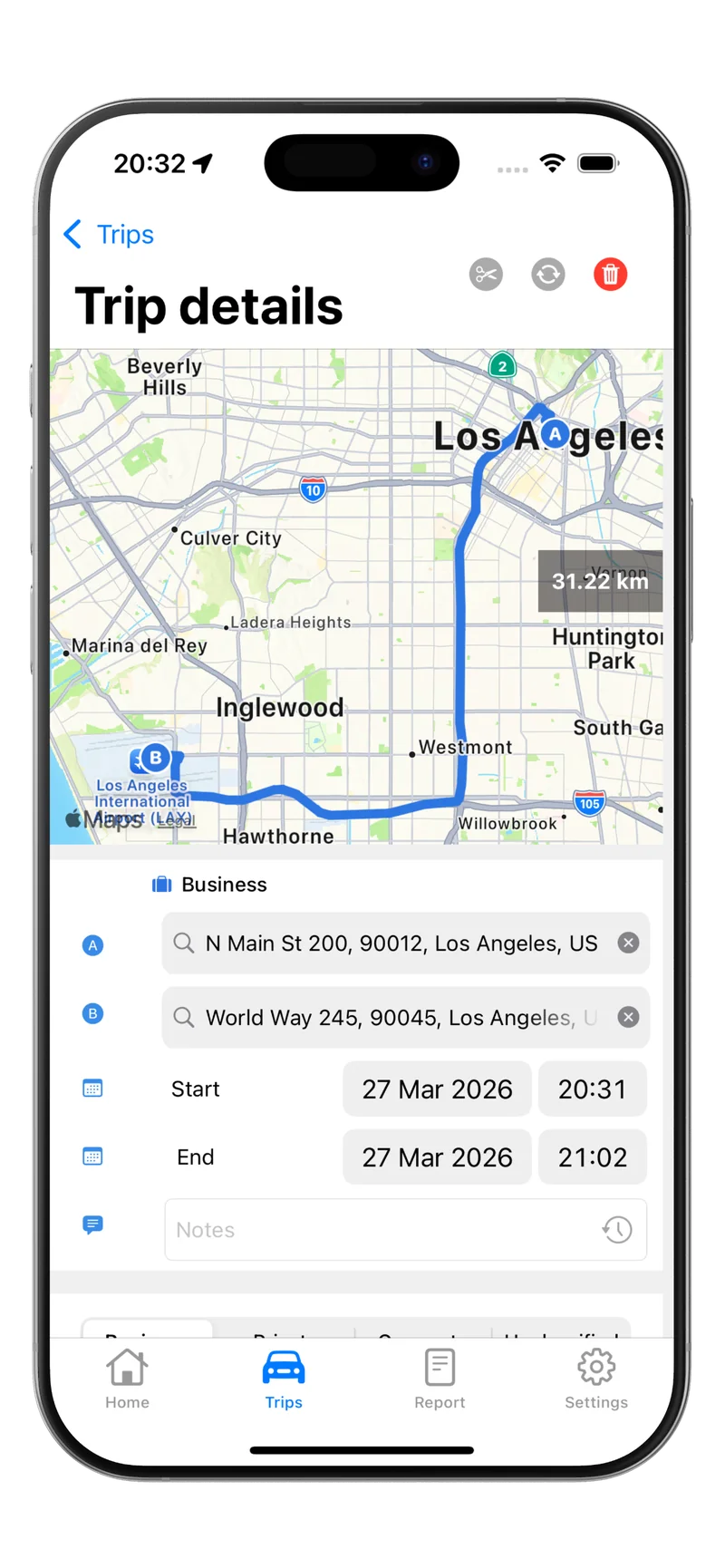
The easiest way to build an audit-proof log is to track every trip automatically as you drive. Download Tripbook to log your LLC business miles with GPS verification, categorize trips by purpose, and generate IRS-ready reports at tax time.