
The mileage deduction for part-time workers can be a significant tax saver, but only if you understand who actually qualifies. Millions of Americans earn income from side hustles, freelance gigs, and part-time self-employment. If that describes you, every business mile you drive could reduce both your income tax and your self-employment tax. The catch is that your tax status matters more than how many hours you work.
For 2026, the IRS standard mileage rate is 72.5 cents per mile. A part-time worker who logs 5,000 business miles in a year can deduct $3,625 from their taxable income. This guide covers who qualifies, how to claim the deduction, and the records you need to keep.
Who Qualifies for the Mileage Deduction for Part-Time Workers?
The short answer: it depends on whether your part-time work is self-employment (1099) or traditional employment (W-2).
Self-Employed Part-Time Workers (Eligible)
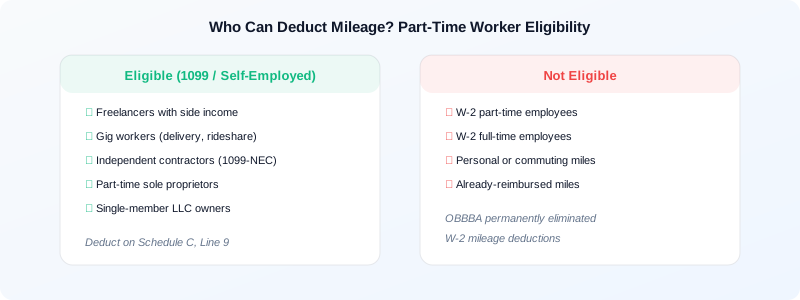
If you work part-time as an independent contractor, sole proprietor, or gig worker, you can deduct business miles on your federal tax return. This applies to:
- Side-hustle drivers (rideshare, delivery, courier services)
- Freelancers working part-time alongside a day job
- Independent contractors who receive Form 1099-NEC
- Part-time sole proprietors running a small business
- Single-member LLC owners with business vehicle use
You report the deduction on Schedule C (Profit or Loss from Business), which flows through to your Form 1040. For a deeper look at Schedule C reporting, see our Schedule C mileage deduction guide.
W-2 Part-Time Employees (Not Eligible)
If you work part-time as a W-2 employee, you cannot deduct mileage on your federal return. The Tax Cuts and Jobs Act originally suspended the unreimbursed employee expense deduction through 2025, and the One Big Beautiful Bill Act (OBBBA) made this elimination permanent. It does not matter whether you work full-time or part-time. If you receive a W-2, the mileage deduction is off the table at the federal level.
For more detail on this rule, read our guide on mileage deduction for W-2 employees in 2026.
The Hybrid Situation: W-2 Job Plus Side Hustle
Many part-time workers hold a traditional W-2 job during the week and run a side hustle on evenings or weekends. In this scenario, you can deduct mileage for the self-employed portion of your work but not for the W-2 portion.
For example, imagine you work as a part-time retail associate (W-2) and also do freelance graphic design (1099). You cannot deduct the miles you drive to the retail store. You can deduct every business mile driven for your freelance clients, including trips to meetings, supply stores, and the post office for shipping client work.
The key is to keep your W-2 miles and your 1099 miles completely separate in your records. Mixing them together is one of the fastest ways to trigger problems during an audit.
How to Calculate Your Mileage Deduction
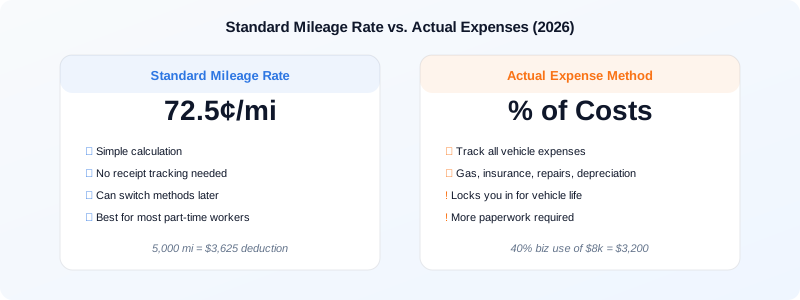
The IRS offers two methods. Most part-time workers benefit from the standard mileage rate because it is simpler and often yields a larger deduction.
Standard Mileage Rate
Multiply your total business miles by the IRS rate:
Business miles x $0.725 = Deduction
At 5,000 miles, your deduction is $3,625. At 8,000 miles, it grows to $5,800. There is no cap on the number of miles you can deduct, so even part-time drivers can accumulate a meaningful write-off over the course of a year.
Actual Expense Method
With this approach, you track every vehicle cost (gas, insurance, maintenance, depreciation, registration) and multiply the total by your business-use percentage. If your car costs $8,000 per year to operate and 40% of your driving is for business, you deduct $3,200.
Important: If you choose the actual expense method in the first year you use a vehicle for business, you are locked into that method for the life of the vehicle. The standard mileage rate preserves your flexibility to switch in future years.
For a more detailed comparison, our freelancer mileage deduction guide walks through both methods with additional examples.
What Counts as a Deductible Business Mile?
The IRS distinguishes between business miles and commuting miles. Commuting from your home to a regular workplace is never deductible, but most other business-related driving qualifies:
- Deductible: Driving from home to a client site, traveling between two client locations, picking up supplies for your business, going to the bank to deposit business income, driving to a co-working space if you have a qualifying home office.
- Not deductible: Your regular commute to a W-2 job, personal errands, driving to lunch unless it involves a business meeting.
Home office exception: If you have a dedicated home office that qualifies under IRS rules, your home becomes your principal place of business. Every trip from your home office to a business destination counts as a deductible mile rather than a commute.
1099-NEC Reporting Changes for 2026
The OBBBA raised the 1099-NEC reporting threshold from $600 to $2,000 starting with payments made in 2026. This means clients who pay you less than $2,000 in a calendar year are no longer required to send you a 1099-NEC form.
However, this change only affects paperwork. Your income is still fully taxable regardless of whether you receive a 1099. If a client pays you $1,500 and does not file a 1099, you must still report that income and you can still deduct the business miles you drove to earn it.
Recordkeeping: What the IRS Requires
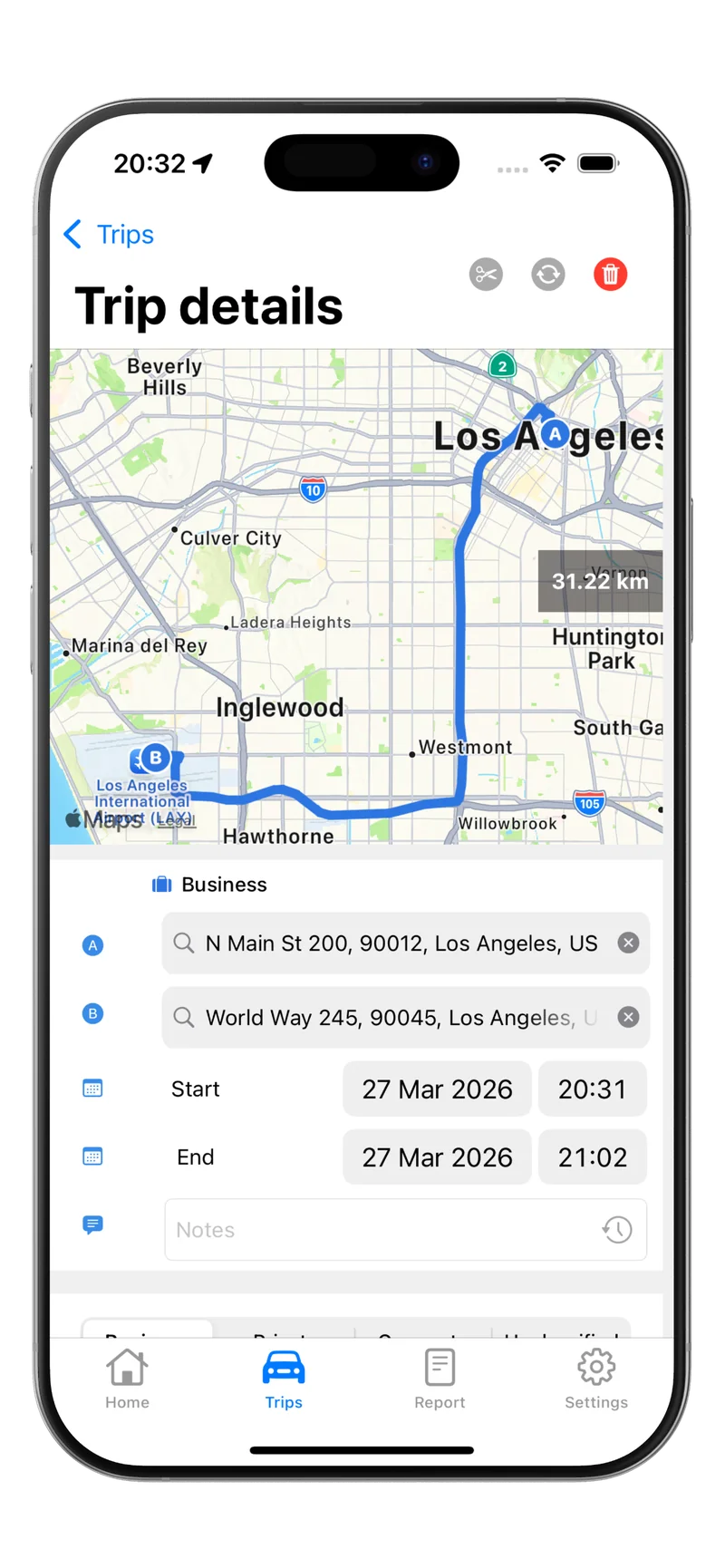
The IRS expects a contemporaneous mileage log, which means you record trips at or near the time they happen. For each business trip, note:
- Date of the trip
- Starting and ending location
- Business purpose (client meeting, supply run, delivery)
- Miles driven
Paper logs and spreadsheets are acceptable, but they are easy to forget and hard to maintain consistently. A mileage tracking app automates the process and produces reports that hold up if the IRS asks questions.
Quarterly Estimated Taxes for Side Hustlers
Because no one withholds taxes from your self-employment income, the IRS expects quarterly estimated tax payments. The deadlines fall in April, June, September, and January. Underpaying can result in penalties and interest.
A practical approach is to set aside 25 to 30 percent of every payment you receive into a dedicated savings account. Your mileage deduction reduces the amount you owe, so accurate tracking throughout the year also helps you estimate your quarterly payments more precisely.
How Much Can Part-Time Workers Save?
Even modest driving adds up. Here are a few examples at the 2026 rate of 72.5 cents per mile:
| Weekly Business Miles | Annual Miles | Annual Deduction |
|---|---|---|
| 50 | 2,600 | $1,885 |
| 100 | 5,200 | $3,770 |
| 150 | 7,800 | $5,655 |
| 200 | 10,400 | $7,540 |
If you are in the 22% tax bracket and also pay 15.3% self-employment tax, a $3,770 deduction saves you roughly $1,405 in combined taxes. That is real money for a part-time worker.
Start Tracking Your Miles Today
The mileage deduction for part-time workers is only valuable if you have the records to back it up. The IRS will not accept estimates or guesses, and retroactively reconstructing a mileage log is both stressful and unreliable.
The easiest approach is to start logging trips now so every qualifying mile is captured automatically. Whether you drive 50 miles a week or 200, consistent tracking turns ordinary driving into a meaningful tax deduction.
Download Tripbook to start recording your business miles and generate IRS-ready reports at tax time.