Mileage tracking for home health aides is one of the most overlooked ways to save money in home care. Whether you visit three patients a day or fifteen, you are racking up serious miles driving between homes, pharmacies, and medical supply stores. Those miles have real dollar value if you handle them correctly at tax time.
The challenge is that home health aides fall into two very different categories when it comes to mileage: W-2 employees and 1099 independent contractors. The rules are not the same for both, and a mistake here can cost you thousands. This guide covers exactly what you need to know for 2026.
How the IRS Mileage Rate Works for Home Health Aides
The IRS sets a standard mileage rate each year that determines how much each business mile is worth as a deduction or reimbursement. For 2026, the business mileage rate is 72.5 cents per mile, the highest it has ever been.
This is the rate that applies to home health aide travel. It is not the medical mileage rate (20.5 cents per mile), which only applies to patients driving to receive medical care. As a home health aide, your travel between patient homes is business travel, not medical travel.
At 72.5 cents per mile, even modest daily driving adds up fast. A home health aide who drives 80 miles per day across 250 working days logs 20,000 miles per year. That translates to $14,500 in potential deductions or reimbursements.
Which Miles Count as Deductible?
Not every mile you drive qualifies. The IRS draws a clear line between business miles and commuting miles.
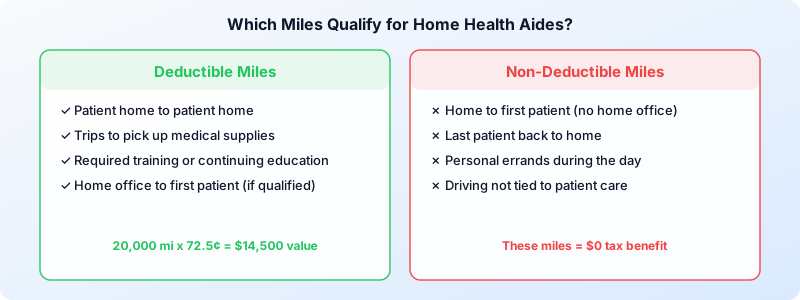
Miles that qualify
- Driving from one patient’s home to the next patient’s home
- Trips to pick up medical supplies or prescriptions for patients
- Travel to required training sessions or continuing education
- Driving between your home office and patient homes (if you have a qualifying home office)
Miles that do not qualify
- Your commute from home to your first patient of the day
- Your drive from your last patient back home
- Personal errands during the workday
- Any driving that is not directly tied to patient care
There is one important exception: if you maintain a dedicated home office that qualifies under IRS rules, your first and last trips of the day can count as business miles rather than commuting. For home health aides who do administrative work from a home office, this exception can add thousands of deductible miles per year.
W-2 vs 1099: Two Completely Different Tax Situations
Your employment status determines everything about how you handle mileage at tax time. This is the single most important distinction for home health aides.
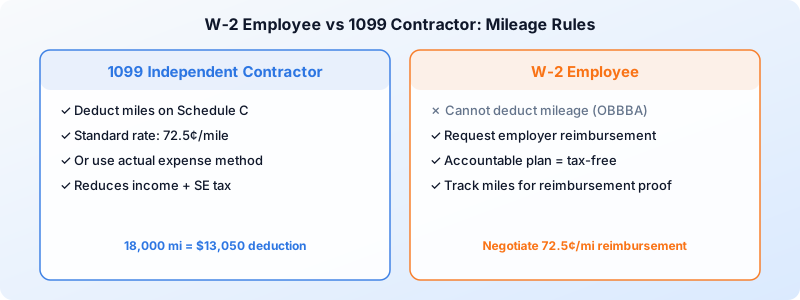
1099 Independent Contractor Home Health Aides
If you work as an independent contractor, you can deduct your business miles directly on your tax return using Schedule C. You have two options:
Standard mileage method: Multiply your business miles by 72.5 cents. This is simpler and works well for most aides.
Actual expense method: Track every vehicle expense (gas, insurance, maintenance, depreciation) and deduct the business-use percentage. This requires more record-keeping but can yield a larger deduction if you drive an expensive vehicle.
For example, a 1099 home health aide who drives 18,000 business miles in 2026 would get a $13,050 deduction using the standard mileage method. If you are in the 22% tax bracket, that saves you $2,871 in federal income tax alone, plus self-employment tax savings.
For a deeper look at filing with Schedule C, see our guide on how to claim mileage on taxes when self-employed.
W-2 Employee Home Health Aides
If you are classified as a W-2 employee of a home health agency, the situation is very different. The One Big Beautiful Bill Act (OBBBA) permanently eliminated the ability for W-2 employees to deduct unreimbursed business expenses, including mileage, on their personal tax returns.
This means you cannot claim a mileage deduction no matter how many miles you drive for work. The deduction that existed before 2018 under the old miscellaneous itemized deduction rules is gone for good.
However, you are not out of options. Here is what W-2 home health aides should do:
Negotiate mileage reimbursement. Ask your employer to reimburse you at or near the IRS rate of 72.5 cents per mile under an accountable plan. This reimbursement is tax-free to you and tax-deductible for your employer, making it a win for both sides.
Understand accountable plan rules. For reimbursements to be tax-free, your employer must use an accountable plan. This means you submit mileage logs with dates, destinations, and business purposes, and you return any excess reimbursement. If your employer reimburses without proper documentation, the payments become taxable income.
For more details on how the OBBBA affects employee mileage, see our mileage deduction for W-2 employees in 2026 guide.
What the IRS Requires in Your Mileage Log
The IRS requires contemporaneous records, meaning you need to log your trips at or near the time of travel. Reconstructing a mileage log at the end of the year from memory is not acceptable and will not hold up in an audit.
Each entry in your log must include:
- Date of the trip
- Starting and ending locations (patient names or addresses)
- Miles driven for each trip
- Business purpose (e.g., “patient visit - John D.” or “supply pickup for patient care”)
Home health aides face a higher audit risk for mileage claims because the driving patterns are complex. You may visit five or more locations per day with different routes each time. Paper logs become impractical fast, which is why most aides rely on a mileage tracking app.
How to Track Mileage Efficiently as a Home Health Aide
Between patient visits, documentation, and care tasks, the last thing you need is another administrative burden. The best approach is automated tracking that runs in the background while you focus on your patients.
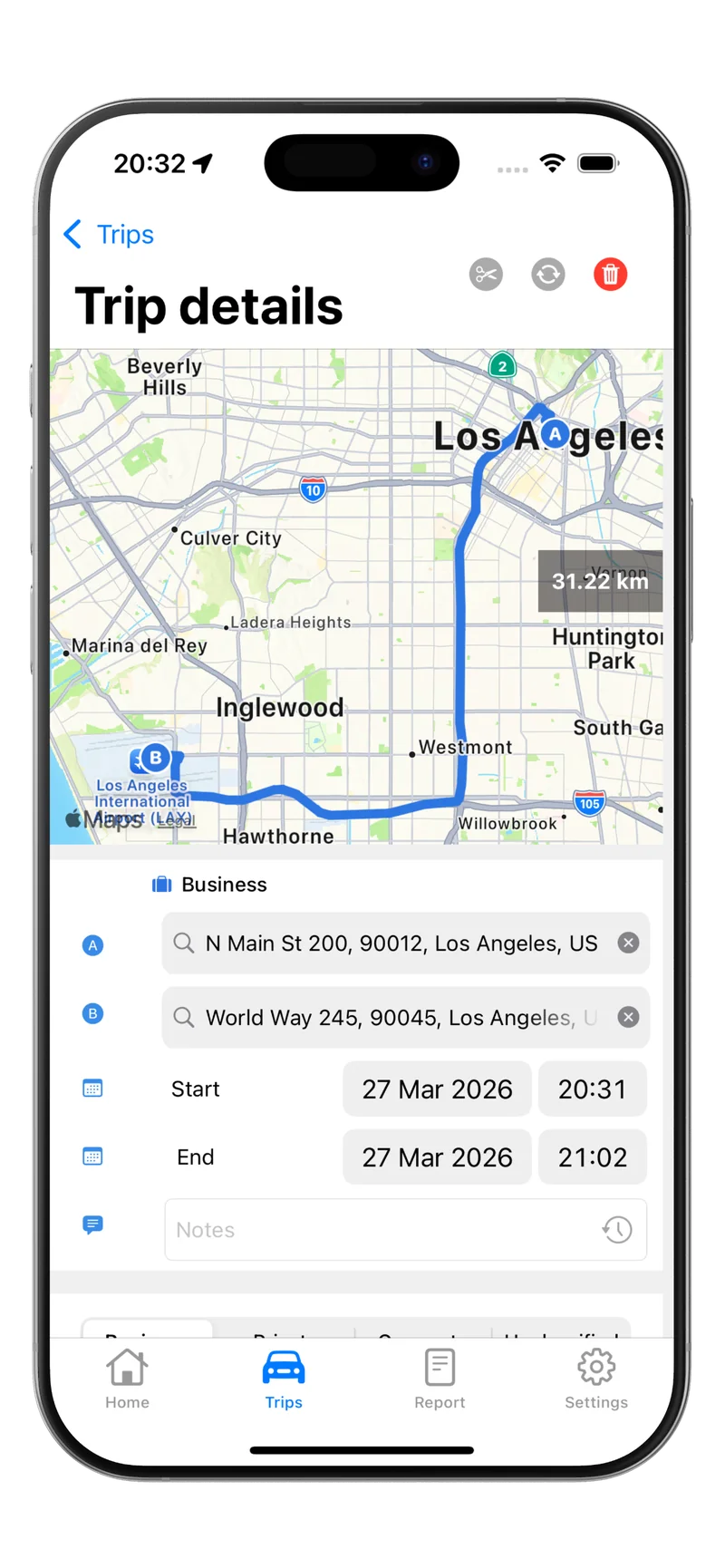
A mileage tracking app like Tripbook automatically records each trip using GPS, logs the date and distance, and lets you categorize trips with a single swipe. At tax time or reimbursement time, you export a clean IRS-compliant report.
Here are practical tips for home health aides:
- Start tracking on day one. Do not wait until tax season. The IRS requires real-time records, and trying to reconstruct a year of patient visits is nearly impossible.
- Categorize every trip immediately. Swipe each trip as business or personal right after it ends. Letting trips pile up leads to forgotten classifications.
- Keep separate logs for each employer. If you work for multiple agencies, track mileage separately so you can submit accurate reimbursement requests to each one.
- Save your reports monthly. Export and store your mileage reports every month as a backup. If your phone is lost or replaced, your records are safe.
For a broader look at mileage tracking in healthcare, check out our guide on mileage tracking for nurses and healthcare workers.
Mileage Reimbursement: What to Expect from Your Agency
Many home health agencies reimburse mileage, but rates vary widely. Some pay the full IRS rate of 72.5 cents per mile, while others offer a flat daily stipend or a lower per-mile rate.
If your agency reimburses below the IRS rate, you are essentially absorbing the difference out of pocket. For W-2 employees who cannot deduct the gap on their taxes, this makes negotiating a fair reimbursement rate critical.
When discussing mileage reimbursement with your employer, keep these points in mind:
- The IRS rate of 72.5 cents per mile reflects the true cost of operating a vehicle, including gas, maintenance, insurance, and depreciation
- Reimbursements under an accountable plan are tax-free, costing the employer less than equivalent wages
- Proper mileage tracking and reimbursement reduces turnover, since unreimbursed driving costs are a top reason aides leave agencies
Our mileage reimbursement for employees guide covers accountable plans and negotiation strategies in detail.
Start Tracking Your Miles Today
Whether you are a 1099 contractor claiming deductions on Schedule C or a W-2 employee seeking reimbursement, mileage tracking for home health aides starts with accurate, real-time records. At 72.5 cents per mile in 2026, every untracked trip is money left on the table.
Download Tripbook to start logging your miles automatically and generate IRS-compliant reports with zero manual effort.