
If you paid a car registration fee this year, part of it may qualify as a car registration tax deduction on your federal return. The catch is that only a specific portion of the fee is deductible, and the rules differ depending on whether you are an employee, self-employed, or claiming personal deductions. This guide breaks down what the IRS allows, how to identify the deductible amount, and where to report it.
What Makes a Car Registration Fee Deductible?
The IRS treats certain vehicle registration fees as personal property taxes. To qualify for a deduction, the fee must meet two conditions:
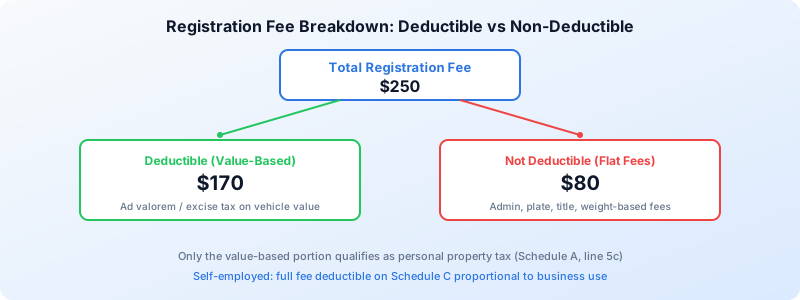
- Based on the vehicle’s value. Only the portion of your registration fee that is calculated using your car’s market value (often called an “ad valorem” tax) is deductible. Flat fees, weight-based charges, title fees, and plate fees do not qualify.
- Charged annually. The tax must be assessed on a yearly basis, even if you pay it on a different schedule.
Most states include a mix of flat charges and value-based taxes in a single registration bill. You need to isolate the value-based portion. Your registration notice or your state DMV website will typically break this out. Look for labels like “vehicle license fee,” “excise tax,” or “ad valorem tax.”
Example Breakdown
Suppose your total annual registration fee is $250. Of that, $80 is a flat administrative fee and $170 is based on your vehicle’s assessed value. Only the $170 qualifies as a deductible personal property tax.
Schedule A: Claiming the Car Registration Tax Deduction as an Individual
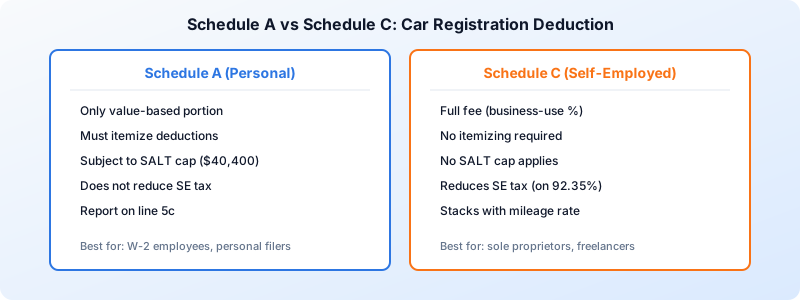
If you are not self-employed or do not use your vehicle for business, you can deduct the value-based portion of your registration fee by itemizing deductions on Schedule A (Form 1040). Report the amount on line 5c, which is designated for personal property taxes.
SALT Cap Considerations
The car registration deduction falls under the state and local tax (SALT) deduction. Under the One Big Beautiful Bill Act signed in 2025, the SALT cap increased from $10,000 to $40,000 for tax year 2025 ($40,400 for 2026). This cap covers your combined state income taxes, local property taxes, and personal property taxes including the deductible portion of your car registration.
For most filers, the higher $40,000 cap means the car registration amount fits comfortably within the limit. However, the cap phases down for taxpayers with modified adjusted gross income above $505,000, reducing by 30 cents for each dollar over that threshold.
Standard Deduction vs. Itemizing
You can only claim this deduction if you itemize. For tax year 2026, the standard deduction is $16,100 for single filers and $32,200 for married couples filing jointly. If your total itemized deductions, including the registration fee, do not exceed the standard deduction, itemizing provides no benefit.
Schedule C: Self-Employed and Business Use
Self-employed individuals who use a vehicle for business have a more favorable path. You can deduct car registration fees as a business expense on Schedule C, regardless of whether the fee is based on vehicle value. This is a significant advantage because:
- No value-based requirement. The entire registration fee is deductible for the business-use percentage of the vehicle, not just the ad valorem portion.
- No SALT cap. Business deductions on Schedule C are not subject to the $40,000 SALT limit.
- Reduces self-employment tax. Schedule C deductions lower your net self-employment income, which reduces the 15.3 percent self-employment tax (calculated on 92.35 percent of net earnings).
- No need to itemize. You claim this deduction whether you take the standard deduction or itemize.
Actual Expense Method
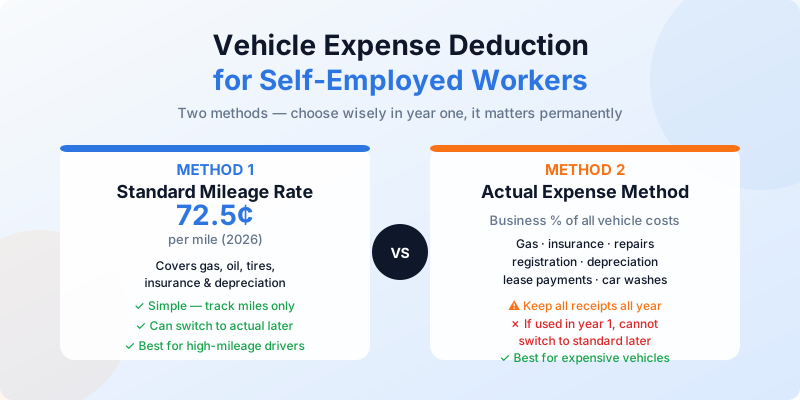
If you use the actual expense method to deduct vehicle costs, registration fees are included in your total actual expenses. You multiply the full fee by your business-use percentage. For example, if your registration costs $250 and you use the car 75 percent for business, you deduct $187.50 on Schedule C. For a full comparison of the two methods, see our guide on the standard mileage rate vs actual expenses.
Standard Mileage Rate Method
If you use the standard mileage rate (72.5 cents per mile for 2026), registration fees are already factored into the per-mile rate. You cannot separately deduct registration as a business expense on Schedule C when using this method. The only costs that stack on top of the standard mileage rate are parking fees, tolls, and auto loan interest (per IRS Publication 463).
However, the ad valorem (value-based) portion of your registration fee can still be claimed on Schedule A as a personal property tax, subject to the SALT cap. This applies to the personal-use share of the vehicle, just as it would for any non-business taxpayer who itemizes.
For a full breakdown of deductible vehicle expenses when you work for yourself, see our guide on vehicle expense deductions for the self-employed.
Splitting the Deduction: Mixed Business and Personal Use
If you use your vehicle for both business and personal purposes, you can split the registration deduction across both schedules:
- Business portion on Schedule C. Multiply the full registration fee by your business-use percentage.
- Personal portion on Schedule A. Take the remaining personal-use percentage, but only of the value-based portion. You must itemize to claim this.
For example, with a $250 fee ($170 value-based) and 60 percent business use:
- Schedule C: $250 x 60% = $150 (entire fee, proportional to business use)
- Schedule A: $170 x 40% = $68 (only the value-based portion of personal use)
States Where Registration Fees Are Deductible
Not every state charges a value-based component in its registration fee. States like California, Arizona, Colorado, Massachusetts, Minnesota, and Virginia include an ad valorem or excise tax based on vehicle value. In these states, the deductible portion is clearly identifiable.
However, approximately 21 states charge only flat fees with no value-based component. If you live in Texas, Florida, or New York, your registration fees are generally not deductible as personal property tax on Schedule A because the charges are not calculated based on vehicle value.
Self-employed taxpayers in any state can still deduct the business-use portion of registration fees on Schedule C under the actual expense method.
What You Cannot Deduct
Several registration-related costs never qualify for a deduction:
- Late payment penalties. Fines for overdue registration are not deductible.
- Title and transfer fees. One-time title charges when you buy or sell a vehicle are not deductible personal property taxes.
- Driver’s license fees. These are not vehicle-related taxes.
- Emissions testing fees. While required for registration in some states, these are not taxes based on vehicle value.
- Plate fees. Flat charges for license plates do not qualify.
How to Find the Deductible Amount
Follow these steps to identify what you can claim:
- Review your registration renewal notice. Most states itemize the charges and label the value-based tax.
- Check your state DMV website. Many states publish guides explaining which fees qualify as personal property tax.
- Look for specific terms. Search for “ad valorem,” “vehicle license fee,” “excise tax,” or “property tax” on your bill.
- Keep your records. Save the registration notice as documentation. If the IRS questions the deduction, you need proof of the value-based amount.
If you also track business mileage, consider pairing your registration records with an automatic mileage log. Accurate records of both expenses and miles driven protect your deductions during an audit. You can learn more about deductible insurance costs in our guide on car insurance tax deductions for the self-employed.
Car Registration Tax Deduction: Key Takeaways
The car registration tax deduction is straightforward once you understand the rules. For personal filers, only the value-based portion counts and it goes on Schedule A line 5c within the SALT cap. For self-employed taxpayers using the actual expense method, the business-use share of the full registration fee is deductible on Schedule C. Under the standard mileage rate, registration is included in the per-mile rate and cannot be separately deducted as a business expense, though the ad valorem portion may still be claimed on Schedule A. Either way, the key step is reading your registration bill and identifying the right amount.
If you drive for business, tracking your mileage accurately ensures you claim every deduction available to you. Download Tripbook to automatically log your trips and keep your vehicle expense records organized at tax time.