
If you are self-employed and drive for work, the car insurance tax deduction for self-employed filers can save you hundreds of dollars every year. Whether you freelance, run a small business, or take on 1099 gig work, the IRS allows you to write off the business portion of your auto insurance premiums — but only if you use the right method. This guide breaks down exactly how the deduction works, which method to choose, and what records to keep.
Who Qualifies for the Car Insurance Tax Deduction?
Only taxpayers who use their vehicle for business purposes can deduct car insurance. That includes:
- Sole proprietors and single-member LLCs (Schedule C filers)
- Independent contractors and 1099 workers
- Gig workers (rideshare, delivery, courier services)
- Partners in a partnership (unreimbursed partner expenses)
W-2 employees cannot deduct car insurance or any unreimbursed vehicle expenses. The Tax Cuts and Jobs Act (TCJA) suspended that deduction in 2018, and the One Big Beautiful Bill Act (OBBBA) made the suspension permanent. If you receive a W-2, this deduction is not available to you.
Two Ways to Deduct Vehicle Expenses (Including Insurance)
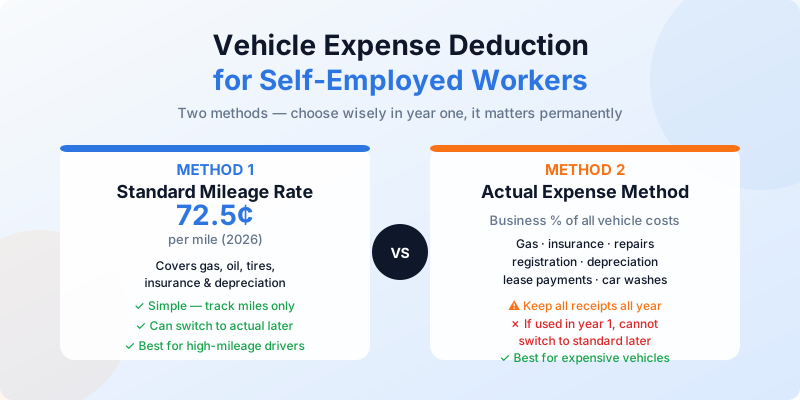
The IRS offers two methods for deducting vehicle costs on Schedule C, Line 9. Your choice of method determines whether you deduct car insurance separately or not.
Method 1: Actual Expense Method
With the actual expense method, you add up every vehicle-related cost for the year, then multiply the total by your business-use percentage. Deductible expenses include:
- Car insurance premiums
- Gas and oil
- Repairs and maintenance
- Tires
- Registration and license fees
- Depreciation (or lease payments)
- Parking and tolls
If your total vehicle costs for the year are $10,000 and you drove 70% of your miles for business, you can deduct $7,000. Your car insurance premium is included in that $10,000 total at its full amount before the business percentage is applied.
This method requires saving every receipt and tracking every expense category throughout the year.
Method 2: Standard Mileage Rate
The standard mileage rate for 2026 is 72.5 cents per mile. You simply multiply your business miles by the rate to get your deduction. The 72.5-cent rate already includes the cost of gas, oil, repairs, insurance, and depreciation — all rolled into one number.
That means if you use the standard mileage rate, you cannot deduct car insurance separately. It is already baked into the per-mile rate. You can still deduct parking fees and tolls on top of the standard rate.
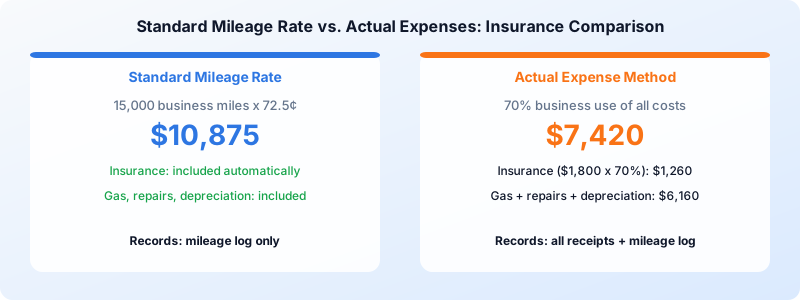
For most self-employed drivers, the standard mileage rate is simpler and often produces a larger deduction. At 15,000 business miles, it yields a $10,875 deduction with no receipts required beyond a mileage log.
Car Insurance Tax Deduction: Standard Rate vs. Actual Expenses
The table below shows how the two methods compare for a driver who pays $1,800 per year in car insurance with 70% business use.
| Detail | Standard Mileage Rate | Actual Expense Method |
|---|---|---|
| Insurance deduction | Included in 72.5¢/mile | $1,260 (70% of $1,800) |
| Other costs included | Gas, repairs, depreciation | Must total individually |
| Records needed | Mileage log only | All receipts + mileage log |
| Separate insurance deduction | No | Yes |
Under the standard rate, those 15,000 business miles produce $10,875 in total vehicle deductions. Under the actual expense method, you would need more than $15,535 in total annual vehicle costs at 70% business use to match that figure.
The key insight: if you use the standard mileage rate, your car insurance is already deducted. You do not need to track or report it separately. For a deeper comparison, see our guide on standard mileage rate vs. actual expenses.
How to Calculate Your Business-Use Percentage
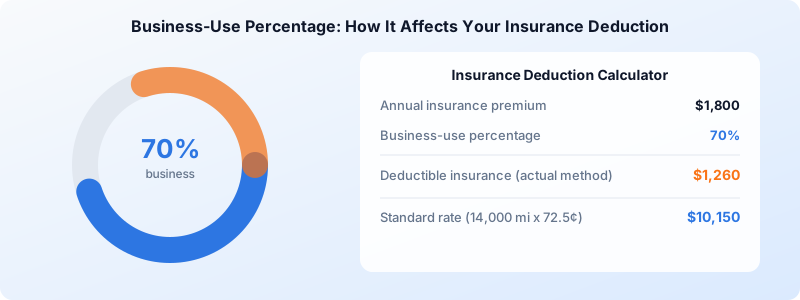
Both methods require you to know your business-use percentage. The formula is straightforward:
Business-use % = Business miles / Total miles driven
If you drove 20,000 total miles in a year and 14,000 were for business, your business-use percentage is 70%. That percentage applies to every expense under the actual method, including car insurance.
Commuting miles — driving from your home to a regular workplace — do not count as business miles. Trips between job sites, client visits, supply runs, and travel between your home office and a temporary work location all qualify.
What Records Do You Need?
The IRS requires adequate records to substantiate your deduction regardless of which method you choose. At minimum, keep a mileage log that records:
- Date of each trip
- Destination and business purpose
- Starting and ending odometer readings (or total miles)
- Business vs. personal classification
If you use the actual expense method, you also need receipts or statements for every vehicle cost, including your insurance premium payments.
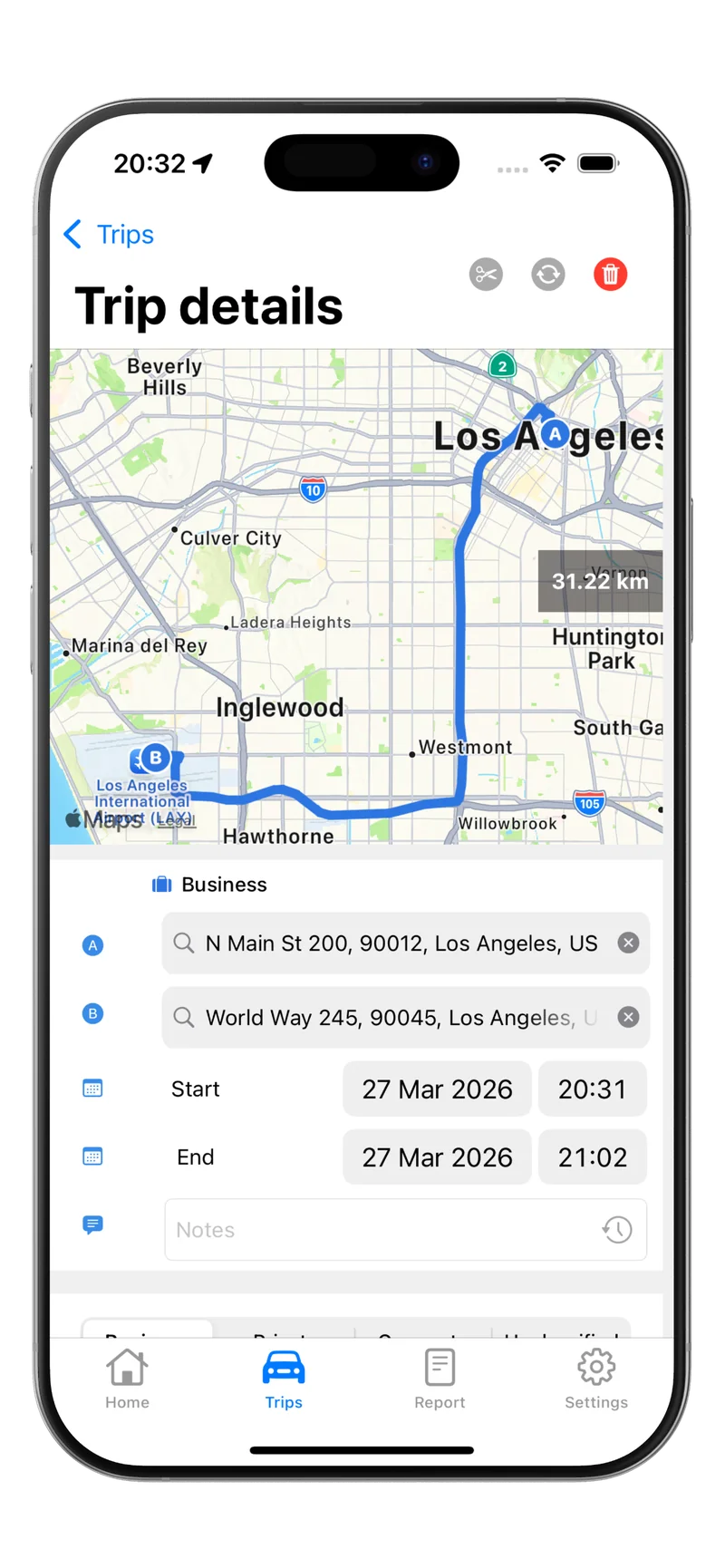
A mileage tracking app like Tripbook records trips automatically with GPS, timestamps, and purpose tags. This creates an IRS-ready log without manual data entry — important because the IRS can disallow your entire vehicle deduction if your records are incomplete.
Choosing the Right Method in Year One
The IRS has a critical timing rule: if you want to use the standard mileage rate for a vehicle you own, you must elect it in the first year the vehicle is available for business use. If you start with the actual expense method, you are locked into it for the life of that vehicle.
The reverse is not true. If you start with the standard mileage rate, you can switch to actual expenses in a later year. This one-way flexibility makes the standard rate the safer default choice for most self-employed filers.
For full details on deducting all vehicle costs on Schedule C, read our vehicle expense deduction guide for self-employed workers.
How Much Can You Save?
The mileage deduction reduces your net self-employment income on Schedule C. That lowers both your income tax and your self-employment tax (15.3% for Social Security and Medicare). Note that SE tax applies to 92.35% of net earnings (the employer-equivalent portion), so the effective SE tax saving is deduction × 0.9235 × 0.153. Here is how the savings add up at various mileage levels:
| Business Miles | Deduction (72.5¢/mile) | SE Tax Savings (× 0.9235 × 15.3%) | Income Tax Savings (22% bracket) |
|---|---|---|---|
| 10,000 | $7,250 | $1,024 | $1,595 |
| 15,000 | $10,875 | $1,536 | $2,393 |
| 20,000 | $14,500 | $2,049 | $3,190 |
| 25,000 | $18,125 | $2,561 | $3,988 |
At 20,000 business miles, the combined savings from income tax and self-employment tax can exceed $5,200. Learn exactly how to report these deductions in our Schedule C mileage deduction guide.
Bottom Line: Is Car Insurance Tax-Deductible for Self-Employed Workers?
Yes. The car insurance tax deduction for self-employed workers is available through either method:
- Standard mileage rate (72.5¢/mile in 2026): Insurance is included automatically. No separate deduction needed.
- Actual expense method: Deduct the business-use percentage of your annual premium.
For most self-employed drivers, the standard mileage rate is easier, often larger, and requires less paperwork. Whichever method you choose, accurate mileage records are required.
Start tracking every business mile today with Tripbook so your car insurance deduction — and every other vehicle write-off — is backed by an IRS-compliant log when tax season arrives.