If you drive an electric vehicle for work, you might wonder whether the IRS mileage rules apply to you the same way they do for gas cars. The short answer is yes — and electric vehicle mileage tracking often works in your favor. You can claim the same standard mileage rate as any other business driver, and because EVs cost less to operate, the standard rate typically gives you a bigger deduction than tracking actual costs would.
Here is everything you need to know about the 2026 rules for EV business mileage, including when to use the standard rate, how to handle home charging, and what the EV tax credit has to do with any of this.
Can You Use the Standard Mileage Rate for an Electric Vehicle?
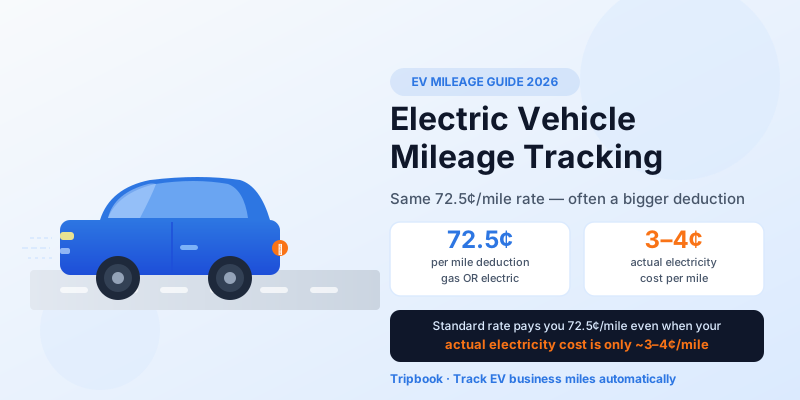
Yes, without restriction. The IRS standard mileage rate for 2026 — 72.5 cents per mile — applies to electric vehicles exactly as it does to gasoline or diesel cars. The rate is the same regardless of your fuel source.
This is good news for EV drivers. The standard mileage rate was set with average operating costs in mind, including fuel. Since electricity costs considerably less per mile than gasoline, EV owners who use the standard rate are effectively being compensated at a rate that exceeds their actual fuel costs — leaving more money in their pocket.
Standard Mileage Rate vs Actual Expenses for EVs
There are two ways to deduct vehicle costs for business use. Understanding which works better for an EV is worth a few minutes of your time.
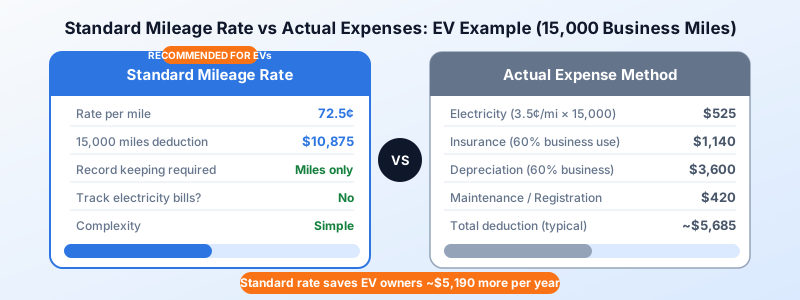
Standard mileage rate: Multiply business miles by 72.5 cents. Simple, and you do not need to track fuel receipts, insurance bills, or repair records — just miles.
Actual expense method: Deduct the business-use percentage of your actual vehicle costs: electricity, insurance, registration, depreciation, and repairs. For example, if 60% of your miles are business miles, you deduct 60% of each expense.
For most electric vehicle drivers, the standard mileage rate wins. Here is why: electricity costs roughly 3 to 4 cents per mile for an average EV, compared to 10 to 15 cents per mile for a gasoline vehicle. Under the actual expense method, your “fuel” cost is much lower — which makes the total deduction smaller. The standard rate does not make that distinction. It pays 72.5 cents per mile regardless.
The one scenario where actual expenses might win: a very expensive EV with high depreciation and high insurance, where you use it almost exclusively for business. In most cases though, the standard rate is the better and simpler choice.
How the EV Federal Tax Credit Interacts With Your Mileage Deduction
If you received the federal EV tax credit (up to $7,500 for qualifying vehicles under the Inflation Reduction Act), it does not affect your mileage deduction eligibility. You can still claim the full standard mileage rate on business miles regardless of whether you received the credit.
The credit matters only if you use the actual expense method. Under that method, you must reduce the vehicle’s cost basis by the amount of the credit before calculating depreciation. Under the standard rate, there is nothing to adjust — the credit and the mileage deduction simply coexist.
Tracking Home Charging Costs (If You Use Actual Expenses)
If you decide the actual expense method is right for your situation, tracking home EV charging becomes relevant. Unlike a gas fill-up, home charging does not generate a separate receipt — it just shows up mixed into your electricity bill.
To isolate the business portion of your home charging costs, you need to calculate how much electricity your vehicle consumed on business trips. The process looks like this:
- Find your EV’s energy consumption rate (typically listed in kWh per 100 miles in your owner’s manual or the manufacturer’s app)
- Multiply by your business miles to get total business kWh consumed
- Divide by your total kWh used for the month to find the percentage of your electricity bill attributable to the vehicle
- Multiply your electricity bill by that percentage — that is your deductible home charging cost
For example: an EV using 3.5 kWh per 10 miles, driven 500 business miles, consumes 175 kWh for business. If your household used 1,000 kWh that month, 17.5% of your electricity bill is a deductible vehicle expense.
Public charging is simpler. Any receipt from a public charging station (Electrify America, Tesla Supercharger, ChargePoint, etc.) that you can tie to a business trip is fully deductible as a vehicle operating expense under the actual method.
Why GPS Tracking Matters More for EVs
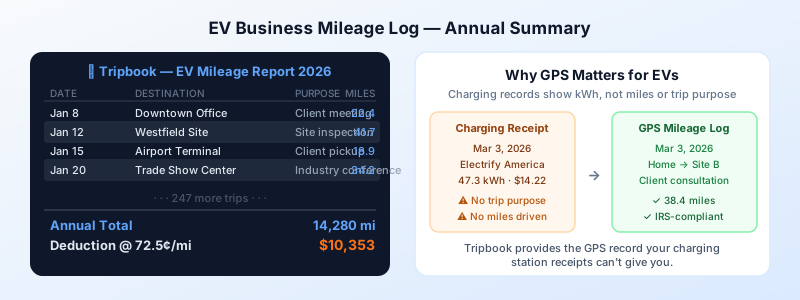
For gas vehicles, the odometer reading at the start and end of the year tells a straightforward story. EVs introduce a complication: your charging records show energy consumed, not miles driven — and your total range can vary with temperature, driving speed, and climate use.
This makes GPS-based mileage tracking particularly valuable for EV owners. An odometer is still your authoritative record of miles, but apps that log trip start and end points with GPS coordinates give you a clean, auditable log that is independent of charging data. If the IRS ever questions whether a specific trip happened or how far it was, your GPS log is your best evidence.
The IRS log requirements are the same for EVs as for any other vehicle: date, destination, business purpose, and miles driven. The fuel source does not change those requirements.
Best Practices for EV Mileage Logs in 2026
A few habits make EV mileage tracking cleaner and more defensible:
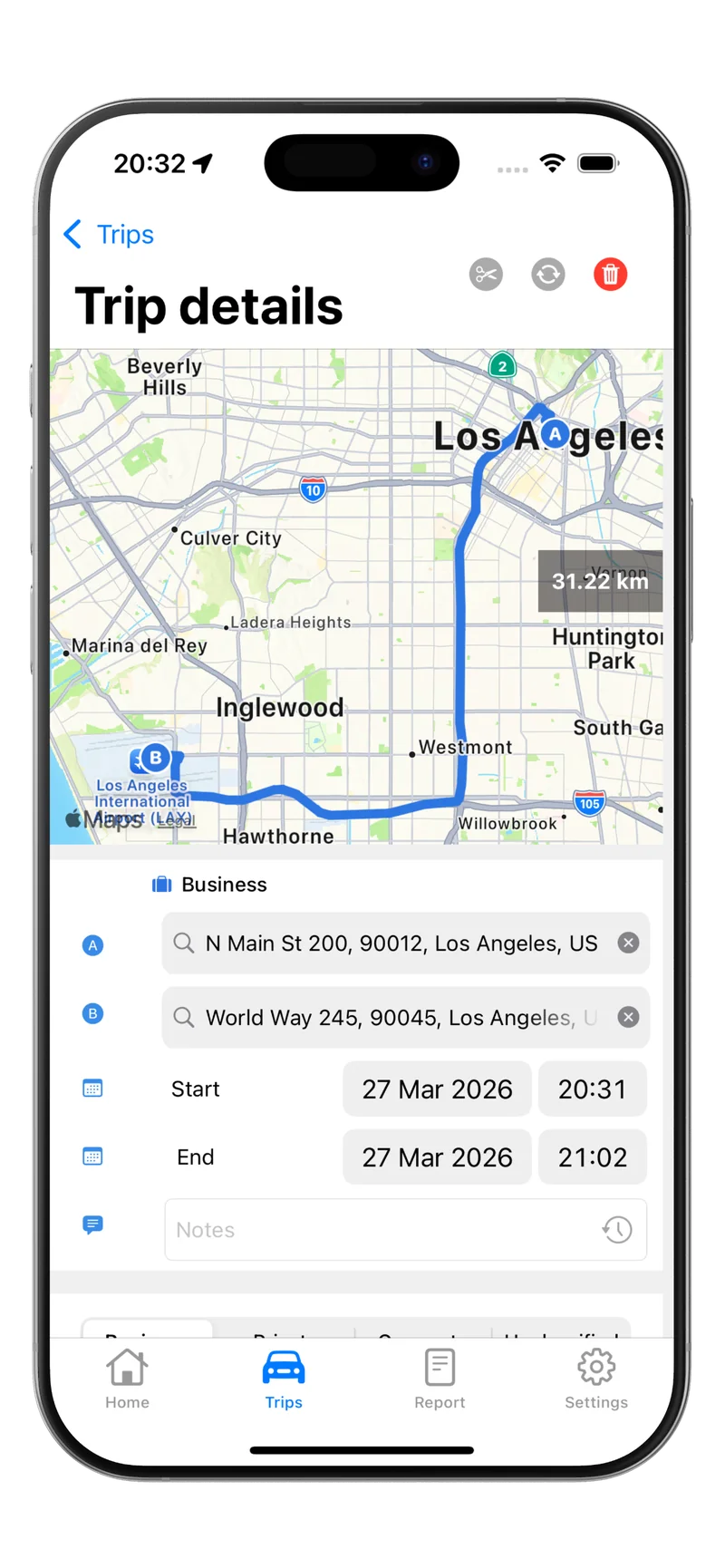
Log trips at the time they happen. Do not rely on charging history to reconstruct business trips later. Your charging records show energy use, not trip purpose — and the IRS requires contemporaneous records. An app like Tripbook captures each trip automatically in the background as you drive, so there is nothing to remember.
Record odometer readings at year start and year end. This gives you a total-miles anchor for the year. Your deductible business miles divided by total miles equals your business-use percentage — useful for any method.
Keep charging receipts separately from mileage data. If you ever decide to switch to actual expenses, you will need them. Even under the standard rate, having documentation of what you actually spent is useful for your own records.
Export your mileage report before filing. A sorted annual report showing every business trip, date, destination, and miles is what your accountant needs — and what you would hand over in an audit. Tripbook generates this in one tap.
For a full breakdown of what the IRS requires in a valid log, see our guide to IRS mileage log requirements. And to understand how mileage fits into the broader picture of vehicle deductions, the standard mileage rate vs actual expenses article walks through the decision in detail.
EV Mileage Tracking: The Simple Version
If you drive an electric vehicle for business, the path of least resistance is to:
- Use the standard mileage rate (72.5 cents per mile for 2026)
- Track every business trip with an automatic mileage app
- Skip tracking charging costs — the standard rate covers them
You get the same per-mile deduction as gas car drivers, without the complexity of itemizing electricity bills. For most EV owners, that is a better outcome with less work.
Ready to build a clean, IRS-ready mileage log for your EV? Download Tripbook on the App Store and start tracking your business miles today.