Home inspectors are road warriors by definition. Your entire business model revolves around driving to properties, and those miles between inspections are worth real money at tax time. Mileage tracking for home inspectors at the 2026 IRS rate of 72.5 cents per mile can easily produce a deduction worth $10,000 to $20,000 per year.
A home inspector performing three inspections per day, five days a week, with an average of 15 miles between stops, logs roughly 225 business miles per week. That is 11,700 miles per year, translating to an $8,483 deduction. Inspectors covering larger territories can double that figure.
What Miles Can Home Inspectors Deduct
Most home inspectors are self-employed or operate as independent contractors. That means you report income and expenses on Schedule C and can deduct business mileage directly.
Deductible business miles include driving from your home office to an inspection site, travel between inspection properties during the day, trips to pick up equipment or supplies, driving to continuing education classes and certification exams, and trips to meet real estate agents or clients for pre-inspection consultations.
The home office rule works strongly in your favor. Since most home inspectors operate from a home office without a separate commercial space, your home qualifies as your principal place of business. Every drive from home to an inspection is a deductible business mile, not a commute.
If you have not set up a home office deduction yet, read our guide on the home office mileage deduction to understand the requirements.
Choosing Your Deduction Method
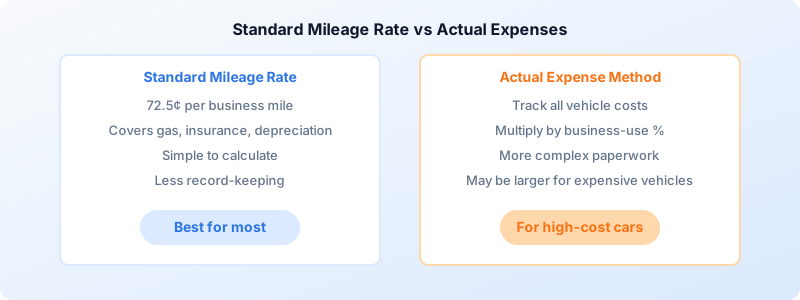
You have two options for deducting vehicle expenses.
Standard mileage rate. Multiply your total business miles by 72.5 cents (2026 rate). This covers gas, oil, maintenance, insurance, depreciation, and all other vehicle costs. You can still add parking and tolls on top.
Actual expense method. Track every vehicle cost, then multiply the total by your business-use percentage. If your truck costs $12,000 per year to operate and 80 percent of your miles are for business, you deduct $9,600.
For most home inspectors, the standard mileage rate is the better choice. Your vehicle likely accumulates high mileage, and the per-mile rate accounts for depreciation that would be complex to calculate separately. See our full comparison of the standard mileage rate vs actual expenses to determine which method suits your situation.
Important: you must choose the standard mileage rate in the first year you use a vehicle for business. If you start with actual expenses, you cannot switch to the standard rate for that vehicle later.
How to Track Inspection Miles Efficiently
Home inspectors face a unique tracking challenge. You often visit three to five properties per day, sometimes with short detours for personal errands in between. Manually logging every trip segment is tedious and error-prone.
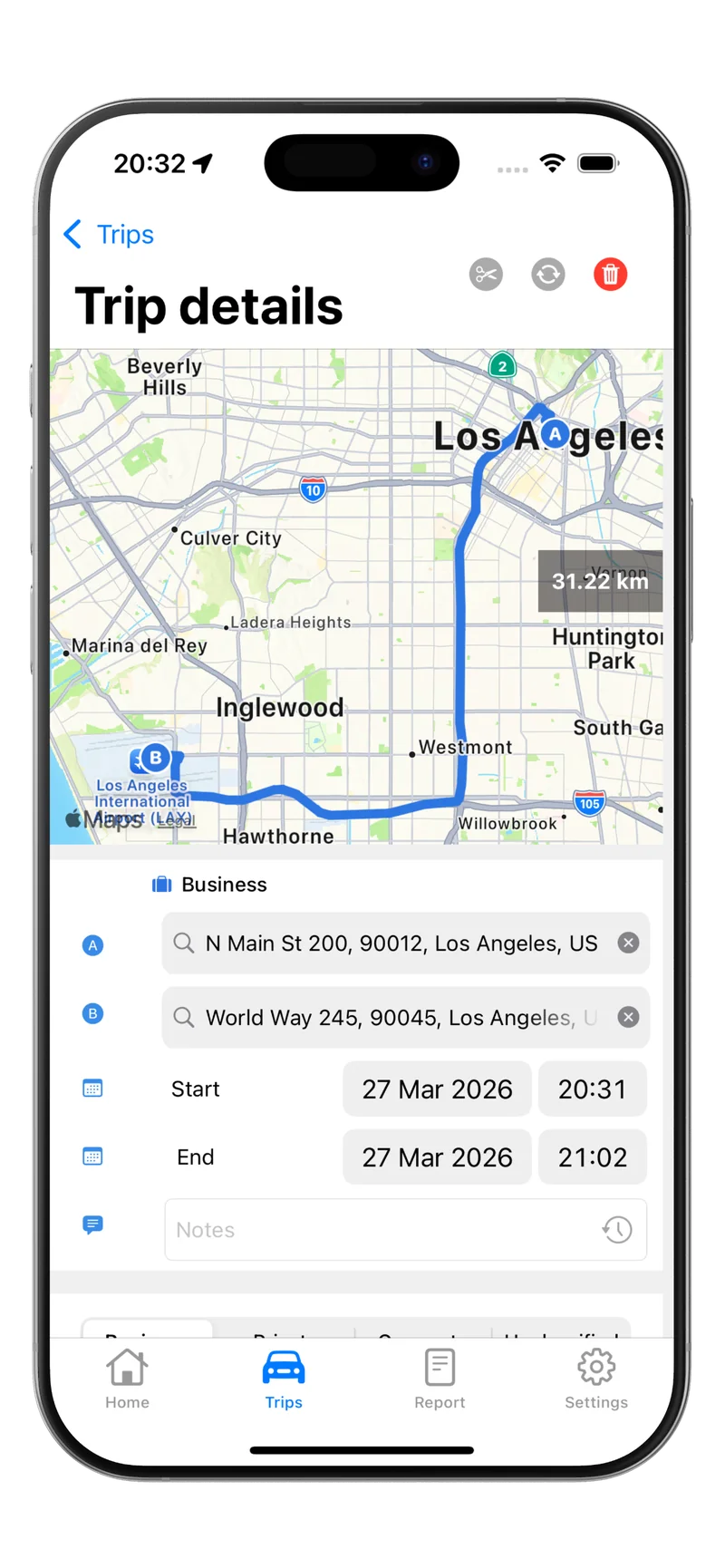
Automatic GPS tracking solves this problem. Tripbook runs in the background on your iPhone, recording every trip with timestamps, routes, and distances. Between inspections, you swipe to classify each trip as business or personal. At the end of the week, your log is complete without any manual entry.
For each trip, add a brief note with the inspection address or client name. This satisfies the IRS requirement for documenting business purpose. Your log should include the date, destination, business purpose, and miles for each trip.
Deducting Vehicle Costs Beyond Mileage
The standard mileage rate covers most vehicle costs, but some expenses are deductible separately.
Parking fees. Paid parking at inspection sites, downtown lots, or airport garages for out-of-town inspections is deductible on top of the mileage rate.
Tolls. Highway and bridge tolls during business travel are fully deductible in addition to mileage.
Equipment storage. If you install permanent storage racks, toolboxes, or equipment mounts in your vehicle specifically for inspection gear, those modifications may qualify as a separate business deduction under Section 179.
Loan interest. If you use the standard mileage rate, you can deduct the business percentage of your auto loan interest separately. Track this amount with your mileage.
Handling Peak Season Mileage
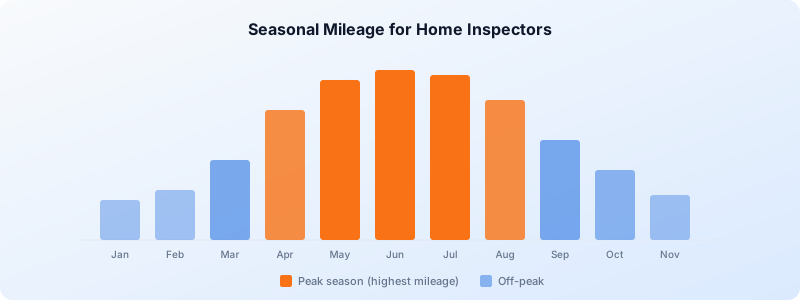
Home inspection volume spikes in spring and summer when the real estate market is most active. During peak months, you may perform five or six inspections daily and log 50 to 70 business miles per day.
This is exactly when tracking discipline matters most. Missing even 10 miles per day during a busy season costs you $7.25 in deductions per day, $145 per month, and over $500 across a three-month peak period.
Set up automatic tracking before peak season hits so you are not scrambling to build a manual log during your busiest weeks.
Quarterly Tax Planning for Inspectors
As a self-employed home inspector, you make quarterly estimated tax payments. Your mileage deduction directly reduces those payments.
Calculate your mileage deduction each quarter and factor it into your estimated tax. If you earned $80,000 in the first quarter and drove 5,000 business miles, your mileage deduction of $3,625 reduces your taxable income to $76,375. At a combined tax rate of roughly 30 percent, that saves you about $1,088 in estimated taxes for the quarter.
Tripbook lets you export reports by date range, making it easy to pull quarterly mileage totals for your accountant or tax software. Learn more about managing quarterly taxes as a self-employed professional.
Audit-Proofing Your Mileage Records
The IRS audits mileage deductions more frequently than many other business expenses because they are easy to inflate. Protect yourself with these practices.
Keep your mileage log updated weekly at minimum. The IRS requires contemporaneous records, and a log reconstructed from memory months later will not hold up. Track your total vehicle miles (business plus personal) to support your business-use percentage. Save fuel receipts as secondary documentation, even though they are not required under the standard mileage rate. Store digital copies of your logs in a separate location from your phone.
Start Capturing Every Inspection Mile
Your vehicle is one of your biggest business assets as a home inspector. Tracking every business mile at 72.5 cents per mile is one of the simplest ways to reduce your tax bill and keep more of your inspection revenue. Mileage tracking for home inspectors does not have to be complicated when the right tools handle the work automatically.
Download Tripbook and let automatic GPS tracking capture every drive between inspections.