
The EV mileage rate vs gas car question trips up a lot of business owners and self-employed drivers. They assume the IRS assigns a different cents-per-mile rate to electric vehicles. It does not. In 2026, every car, van, pickup, and panel truck qualifies for the same 72.5 cents per mile, whether it runs on gasoline, diesel, or a battery pack. That single fact has a surprisingly large impact on how much you keep at tax time.
This guide breaks down why the identical rate creates a hidden advantage for EV drivers, how the numbers compare on a cost-per-mile basis, and when you should skip the standard rate entirely and deduct actual expenses instead.
The 2026 IRS Standard Mileage Rate Applies to All Vehicles
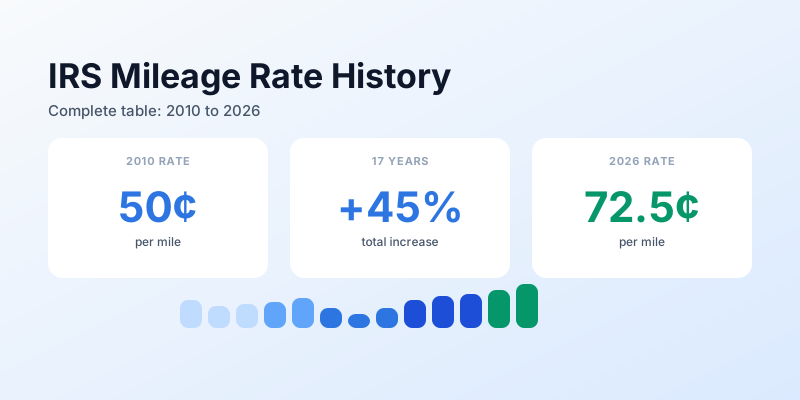
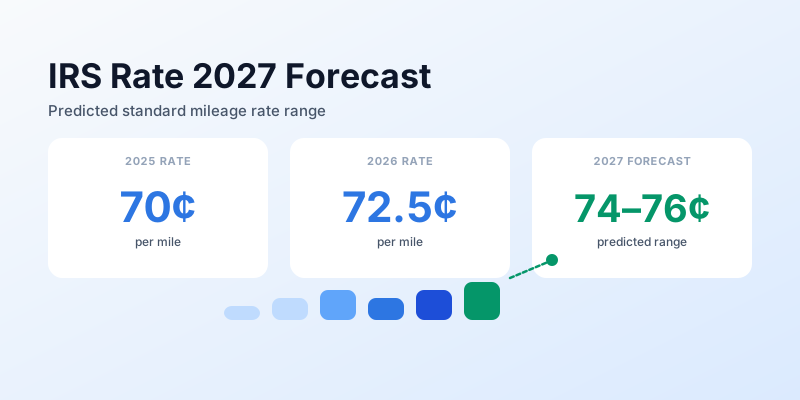
The IRS raised its business mileage rate to 72.5 cents per mile for 2026, up from 70 cents in 2025. The rate covers fuel, depreciation, insurance, maintenance, and repairs in one flat figure.
Here is the part that matters: this rate applies identically to gasoline, diesel, hybrid, and fully electric automobiles. The IRS does not publish a separate EV mileage rate. If you drive 15,000 business miles in 2026, your deduction is $10,875 regardless of what powers your vehicle.
Additional IRS rates for 2026:
- Medical or moving miles (qualified active-duty military): 20.5 cents per mile
- Charitable miles: 14 cents per mile (set by statute, unchanged)
You must choose one method per vehicle per year. You cannot claim the standard mileage rate and also deduct individual expenses like charging costs or gas receipts for the same car.
Why the Same Rate Favors EV Drivers
The 72.5-cent rate is calculated from average vehicle operating costs across the entire U.S. fleet, which is still dominated by gas-powered cars. Average fuel costs, average maintenance bills, and average depreciation all get baked into that single number.
Electric vehicles beat those averages on nearly every line item:
| Cost category | Gas car (avg) | EV (avg) |
|---|---|---|
| Fuel / energy per mile | ~10 cents | ~5 cents |
| Maintenance per mile | ~6 cents | ~3.5 cents |
| Total operating cost per mile | ~55-65 cents | ~35-45 cents |
The gap between 72.5 cents (what you deduct) and your actual cost (often 35 to 45 cents for an EV) is wider than for a gas car. That difference is not taxable income. It is simply money you keep.
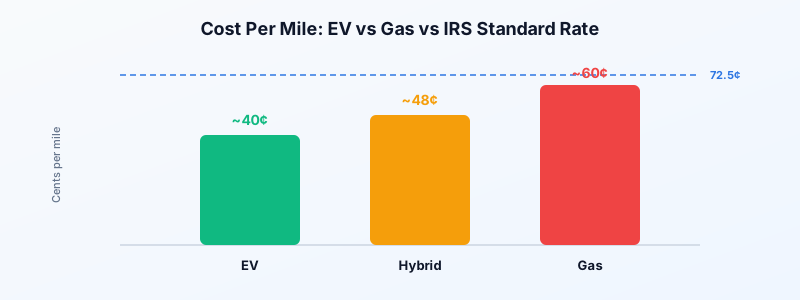
A self-employed consultant driving a Tesla Model 3 for 20,000 business miles would deduct $14,500 at the standard rate. Their actual electricity and maintenance costs might total around $8,000 to $9,000. A comparable gas sedan driver deducting the same $14,500 might actually spend $11,000 to $13,000 on fuel and upkeep. Both get the same write-off, but the EV driver pockets a wider margin.
Actual Cost Per Mile: EV vs Gas in 2026
Let’s put real numbers on the comparison. Fuel costs vary by state, but national averages paint a clear picture.
Electric vehicle fuel cost:
- Average U.S. electricity rate: roughly 17 cents per kWh
- Typical EV efficiency: 3 to 3.5 miles per kWh
- Cost per mile: approximately 5 cents (home charging)
Gas car fuel cost:
- Average U.S. gasoline price: approximately $3.10 per gallon
- Average fuel economy: 30 mpg
- Cost per mile: approximately 10 cents
Hybrid fuel cost:
- Typical hybrid economy: 45 to 50 mpg at $3.10 per gallon
- Cost per mile: approximately 6 to 7 cents
Off-peak home charging rates in many states drop to 10 to 12 cents per kWh, pushing EV fuel costs below 4 cents per mile. On the other hand, drivers who rely exclusively on DC fast charging at 40 to 55 cents per kWh may pay 12 to 18 cents per mile, which undercuts much of the EV advantage.
When Actual Expenses Beat the Standard Rate for EVs
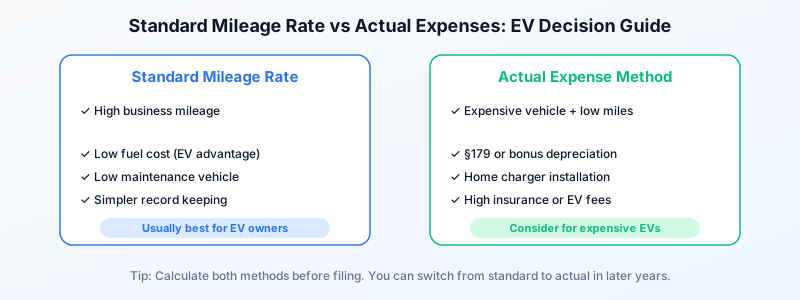
For most EV drivers, the standard mileage rate produces a larger deduction because operating costs sit well below 72.5 cents per mile. But there are situations where actual expenses come out ahead:
You drive relatively few business miles on an expensive vehicle. If you bought a $55,000 EV and only drive 8,000 business miles per year, the standard rate gives you $5,800. Section 179 depreciation alone could exceed that in year one.
You installed a home charging station. The charger hardware and installation cost (often $500 to $2,000) is deductible proportionally to business use. The standard rate does not capture this separately.
Your car insurance or registration fees are unusually high. Some states charge $200 to $300 in annual EV registration fees. High insurance premiums (EV policies can run 15 to 25 percent more than comparable gas cars) also tilt the math.
You qualify for 100% bonus depreciation. Under the One Big Beautiful Bill Act, 100 percent bonus depreciation returned for qualified property placed in service after January 20, 2025. Heavy SUVs and trucks over 6,000 lbs GVWR can be written off entirely in year one with no per-vehicle cap.
Remember: if you choose the standard mileage rate in the first year you use a car for business, you can switch to actual expenses in later years. But if you start with actual expenses and claim accelerated depreciation, you cannot switch back.
EV Tax Credits Are Gone — But Mileage Deductions Are Not
The federal EV tax credits under Sections 30D, 25E, and 45W of the Inflation Reduction Act were repealed for vehicles acquired after September 30, 2025. That means no more $7,500 new vehicle credit and no more $4,000 used EV credit.
This makes the mileage deduction even more important for EV owners. It is now the primary ongoing tax benefit for driving electric. For a deeper look at what deductions remain, see our guide on electric car tax deductions for business.
Hybrid Vehicles: Where Do They Fit?
Plug-in hybrids and traditional hybrids also qualify for the same 72.5 cents per mile. Their fuel costs typically land between EVs and gas cars at roughly 6 to 7 cents per mile for a 45 to 50 mpg hybrid.
The standard mileage rate still produces a net benefit for hybrid drivers, though the margin is narrower than for pure EVs. If you are comparing vehicle options, our hybrid vehicle mileage deduction guide walks through the specifics.
How to Track EV Mileage for the IRS
The IRS requires the same documentation for electric and gas vehicles. For each business trip you need:
- Date of the trip
- Destination and business purpose
- Miles driven (odometer start and end, or GPS tracking)
A paper log works, but it is easy to miss trips and hard to maintain consistently. Automated GPS tracking captures every drive, classifies trips, and generates IRS-ready reports.
Download Tripbook to track your EV business miles automatically. The app works with any vehicle type and calculates your deduction at the current IRS rate in real time.
EV Mileage Rate vs Gas Car: Key Takeaways
The EV mileage rate vs gas car comparison comes down to one core fact: the IRS treats them the same, but your wallet does not.
- The 2026 IRS standard mileage rate is 72.5 cents per mile for every vehicle type
- EV operating costs average roughly 35 to 45 cents per mile, while gas cars average 55 to 65 cents
- The standard rate usually produces a larger net benefit for EV drivers because the gap between the deduction and actual cost is wider
- Actual expenses may win when you have high depreciation, low mileage, or expensive add-ons like a home charger
- Federal EV tax credits are repealed for vehicles acquired after September 30, 2025 — the mileage deduction is now the main ongoing benefit
Whether you drive electric, hybrid, or gas, accurate mileage tracking is the foundation of your deduction. Every unlogged business mile is money left on the table.