
Mental health professionals drive more than most people expect. If you run a private practice, do home visits, or work across multiple clinic locations, mileage tracking for therapists is one of the most valuable tax habits you can build. At 72.5 cents per mile in 2026, the deduction adds up quickly — and many therapists leave thousands of dollars on the table simply because they never logged their trips.
This guide covers which miles count, how employment status changes your options, and how to make tracking effortless starting today.
Why Therapists and Social Workers Drive More Than You Think
It is easy to assume a therapy practice means sitting in one office all day. The reality is often very different. In-home therapists, school-based counselors, and home-visiting social workers routinely drive 10,000 to 25,000 miles per year for work. Even a therapist in a traditional outpatient practice can accumulate significant mileage through:
- Driving to clinical supervision sessions
- Attending CEU trainings and professional conferences
- Making bank runs, buying office supplies, or visiting a professional association
- Consulting with other providers or specialists
- Traveling between a primary office and a satellite location
Each of those trips can be deductible — if you are self-employed. The key word is self-employed.
Which Miles Are Deductible for Mental Health Professionals?
For private practice therapists and 1099 contractors, the IRS allows you to deduct the full business mileage rate on Schedule C. In 2026, that rate is 72.5 cents per mile.
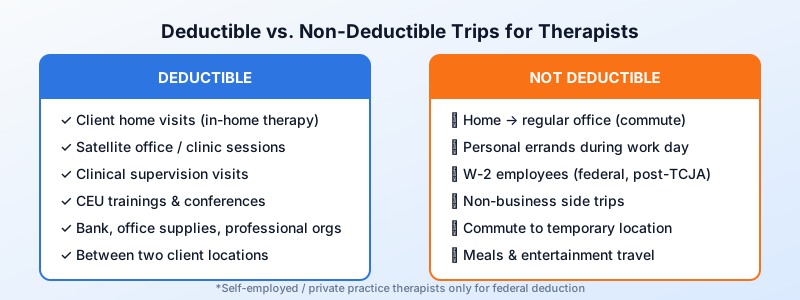
Deductible trips include:
- Client sessions at locations other than your regular office (home visits, school visits, hospital consults)
- Travel between two client locations on the same day
- Trips to your bank, office supply store, or printer for business purposes
- Driving to and from clinical supervision when you are working toward licensure
- Travel to professional development events, CEU courses, and conferences
What is NOT deductible: your daily commute from home to your regular office. Even if you run a private practice, the IRS treats that drive as a personal commute unless you qualify for a home office deduction (more on that below).
For a deeper look at how the IRS defines business mileage, see our guide to IRS mileage log requirements.
Private Practice vs. Employed Therapist: The TCJA Difference
Here is the rule that catches many therapists off guard. Under the Tax Cuts and Jobs Act (TCJA) of 2018, W-2 employees can no longer deduct unreimbursed business mileage on their federal tax return. That suspension remains in effect through at least the 2026 tax year.
If you are a W-2 employee working for a hospital, school district, community mental health center, or group practice, you cannot deduct your mileage on your federal return — even if your employer never reimburses you for it.
If you are self-employed (sole proprietor, LLC, or S-corp), filing Schedule C, you can deduct every qualifying business mile at the full rate.
How Much Can Therapists Actually Save?
The savings are real and specific. Using the 2026 rate of 72.5 cents per mile:
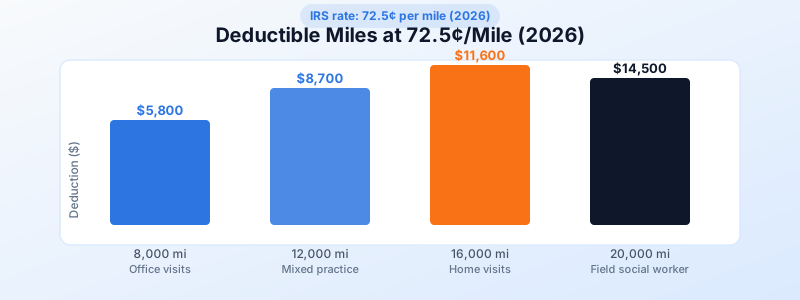
- 8,000 miles/year → $5,800 deduction (typical private practice with local clients)
- 12,000 miles/year → $8,700 deduction (mixed practice with some home visits)
- 20,000 miles/year → $14,500 deduction (field-based social worker or in-home therapist)
These are deductions, not credits. Your actual tax savings depend on your marginal rate. If you are in the 22% bracket, an $8,700 deduction saves you roughly $1,914 in federal taxes. Add self-employment tax savings and state tax benefits, and the number grows further.
If you are unsure whether the standard mileage method or actual vehicle expenses gives you a better result, see our comparison of the standard mileage rate vs. actual expenses.
Telehealth and Mileage: Do You Still Drive?
The growth of telehealth reduced driving for many therapists — but it did not eliminate it. If you see clients on a video platform from a home office, you may drive less to client sessions, but you likely still drive to:
- Supervision meetings
- Trainings and conferences
- Satellite clinic locations for in-person days
- Your accountant, bank, or professional association events
There is also an important home office angle. If you use a dedicated space in your home exclusively for telehealth sessions — and you meet the IRS home office requirements — that can make your trips from home to other business locations deductible, because your home becomes your principal place of business. This is a meaningful shift that removes the commute classification from many of your drives.
Read more about this in our home office mileage deduction guide.
Deductible vs. Non-Deductible at a Glance
Building a Mileage Tracking Habit for Therapists
The IRS requires a contemporaneous log — meaning you need to record each trip close to when it happened, not reconstruct months of driving at tax time. Your log needs to include the date, starting location, destination, miles driven, and business purpose.
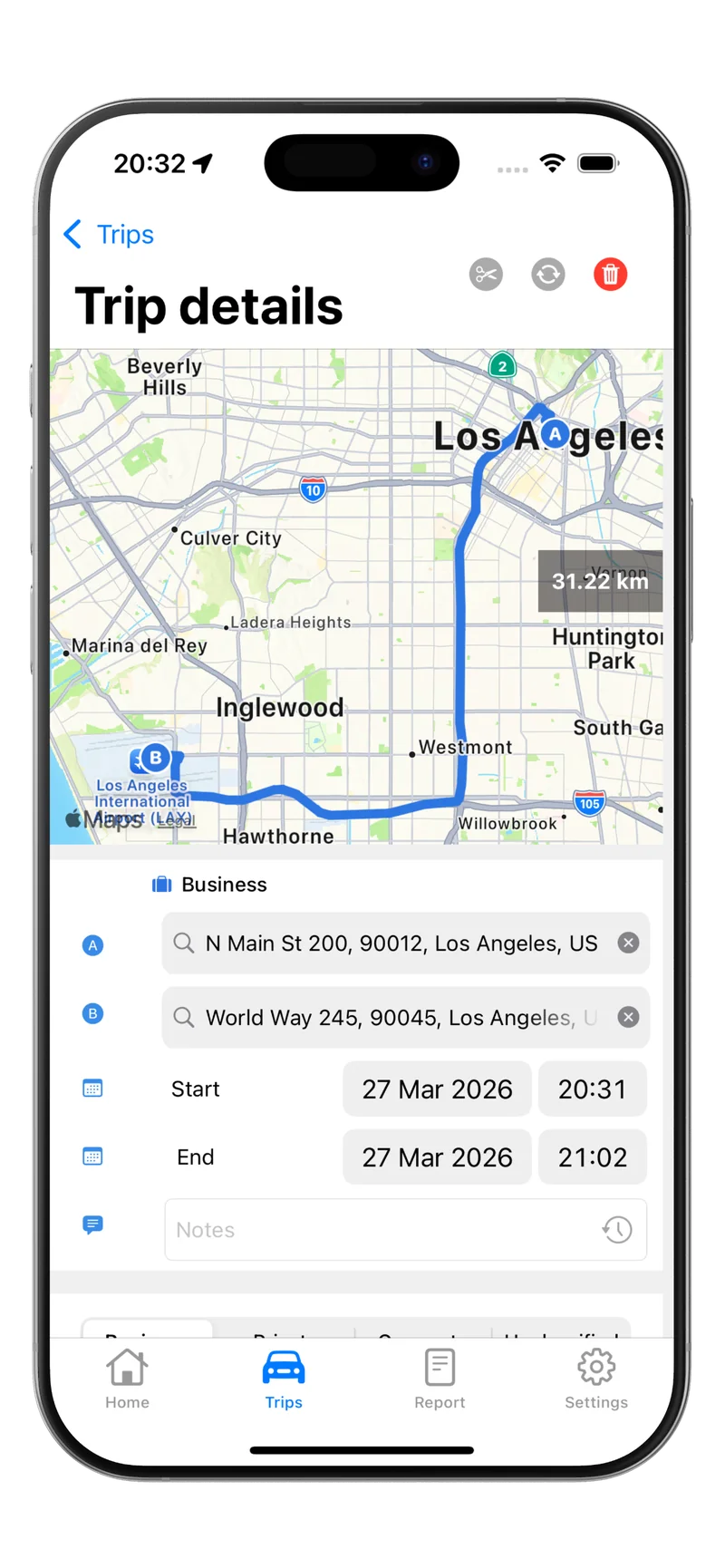
The simplest way to build this habit is to use an automatic mileage tracking app. Tripbook runs in the background on your iPhone, detects when you start driving, and logs each trip automatically. You can add the client name or trip purpose with a tap, and your entire mileage log is organized and ready for tax time with no manual entry required.
A few habits that help therapists stay consistent:
- Start the app when you leave for any work-related trip, not just client sessions. Supervision, trainings, and errands all count.
- Label trips immediately — it takes five seconds while you are still in the parking lot.
- Review your log monthly, not just at year-end. Catching missing trips is much easier when the context is fresh.
- Keep your log backed up. The IRS can audit returns up to three years back (six years in some cases), so cloud backup matters.
Start Tracking Before Your Next Drive
Mileage tracking for therapists is straightforward once you make it automatic. You do your best work helping clients — the last thing you want is to spend hours reconstructing a mileage log in April. Starting today, every qualifying trip you take becomes a documented deduction.
Download Tripbook on the App Store and let it handle the tracking while you focus on your practice.