
If you received a 1099-NEC this year, you are an independent contractor — and the IRS taxes you differently than an employee. You pay self-employment tax (15.3%) on top of regular income tax, which means your effective tax rate on that income can exceed 35%. Every dollar you deduct is worth more than it would be for a W-2 employee.
The 1099 mileage deduction is one of the most powerful tools you have. This guide explains exactly how it works, how to claim it, and the mistakes that cost contractors money.
How the 1099 Mileage Deduction Works
When you drive for business as an independent contractor, the IRS allows you to deduct the cost of that driving. You’re not deducting gas directly — you’re deducting a per-mile rate that the IRS updates annually to reflect the average cost of operating a vehicle.
For 2026, the rate is 72.5 cents per mile. You multiply your deductible business miles by 72.5¢ and subtract that total from your self-employment income on Schedule C.
This deduction reduces both your income tax and your self-employment tax — which is why it’s so valuable. See the full 2026 IRS mileage rate breakdown.
Who Qualifies for the 1099 Mileage Deduction
You qualify for the 1099 mileage deduction if you drive to perform any work for which you receive 1099 income. The vehicle can be personal — you don’t need a dedicated business car. What matters is that you track and separate the business miles.
Common independent contractor categories where mileage adds up fast:
- Delivery drivers (DoorDash, Instacart, Amazon Flex, UPS contract)
- Rideshare drivers (Uber, Lyft)
- Real estate agents showing properties and attending closings
- Sales representatives driving a territory
- Consultants and coaches traveling to client sites
- Tradespeople (plumbers, electricians, HVAC technicians)
- Healthcare workers (home health aides, nurses doing home visits)
- Tutors and instructors traveling between students
If you drive to earn 1099 income, those miles are almost certainly deductible.
Two Methods: Standard Mileage vs. Actual Expenses
You choose between two IRS-approved methods for deducting vehicle costs. You cannot mix and match within a single year, and you must make the right choice early.
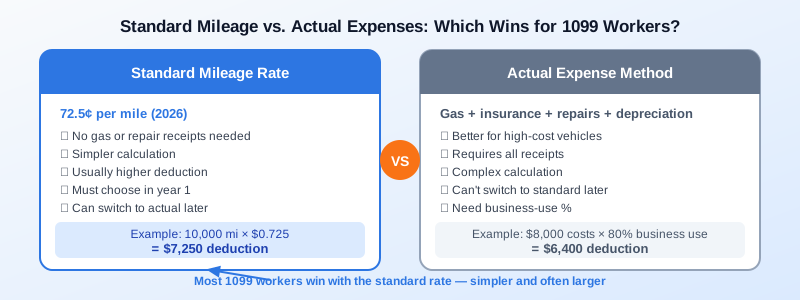
Standard mileage rate: Multiply your business miles by 72.5¢. That’s your deduction. No need to save fuel receipts or track repair costs. This method is simpler and typically produces a higher deduction for most contractors driving average or older vehicles.
Actual expense method: Add up every dollar you spent on your vehicle — gas, oil, tires, insurance, registration, interest on a car loan, and depreciation. Multiply that total by your business-use percentage. If you drove 15,000 miles total and 12,000 were for business, your business-use percentage is 80%.
Critical rule: If you want to use the standard mileage rate, you must elect it in the first year the vehicle is placed in service for business. You can switch from standard to actual in a later year, but you can never switch from actual to standard. This makes the standard rate the safer default choice for new contractors.
For most 1099 workers, the standard rate wins. Read the detailed comparison in our standard mileage rate vs. actual expenses guide.
How to Calculate and Claim on Schedule C
The 1099 mileage deduction lives on Schedule C, Part II, Line 9 (Car and Truck Expenses). Here’s the process:
- Total your deductible business miles for the year
- Multiply by 0.725 (the 2026 standard rate)
- Enter the result on Schedule C, Part II
You also need to fill out Form 4562 or answer the vehicle questions on Schedule C Part IV (total miles, personal miles, business miles, commuting miles). The IRS asks whether you have written evidence supporting your deduction. Your answer should be yes — and you need the log to back it up.
For a full walkthrough of Schedule C, see our guide on how to claim mileage on taxes as self-employed.
The Real Dollar Impact
Here’s what the 1099 mileage deduction actually saves someone earning $40,000 in self-employment income who drove 10,000 business miles:
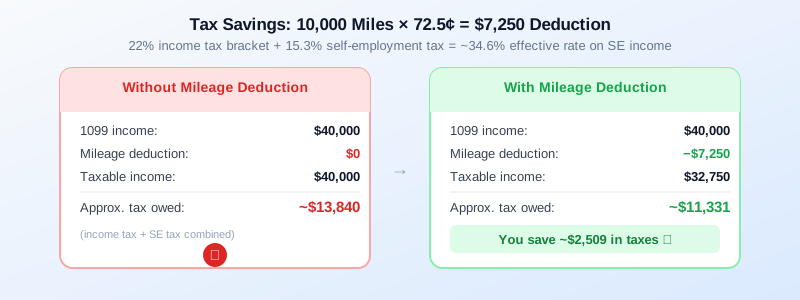
The $7,250 deduction (10,000 miles × 72.5¢) reduces taxable income from $40,000 to $32,750. For someone in the 22% federal bracket, accounting for self-employment tax, that’s roughly $2,500 in tax savings. At 15,000 miles, the savings exceed $3,700. The higher your mileage, the more dramatic the impact.
Record-Keeping Requirements
The IRS requires a contemporaneous mileage log. “Contemporaneous” means you record each trip at or near the time it occurs — not at year end from memory. Your log must contain:
- Date of each trip
- Starting location (address or general description)
- Destination (address or general description)
- Business purpose of the trip
- Miles driven (GPS distance or odometer start and end)
You also need to record your vehicle’s odometer reading at the start of January and end of December to establish your total annual mileage. The IRS can ask for this in an audit.
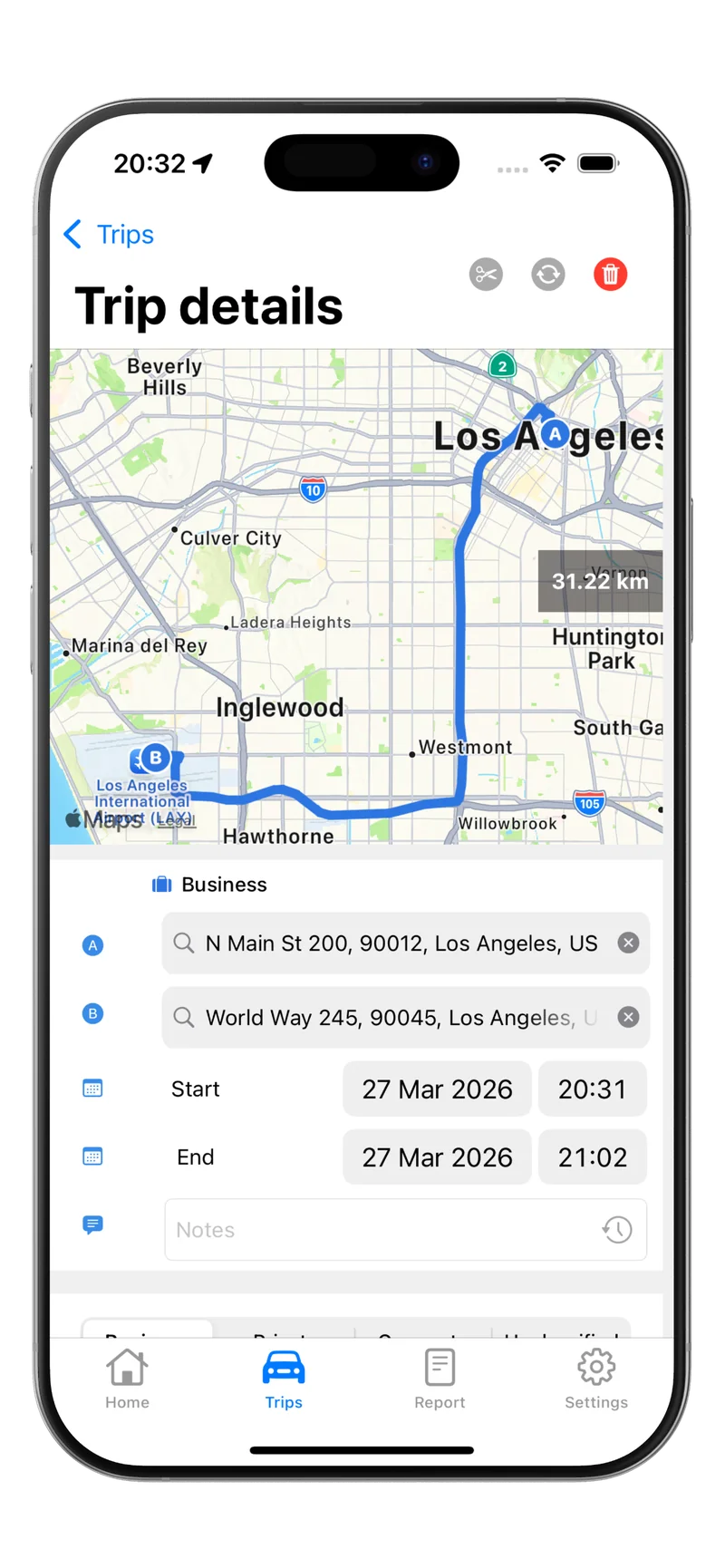
Paper logs are technically acceptable, but most 1099 workers use a mileage tracking app because manually logging each trip is error-prone and time-consuming. Tripbook runs in the background on your iPhone and logs every trip automatically, storing all the required fields in an IRS-compliant format.
Mistakes 1099 Workers Make with Mileage
1. Not tracking at all. The most common and costly mistake. If you don’t have records, you can’t claim the deduction — even if you actually drove those miles.
2. Trying to reconstruct mileage at year end. Going back through Google Maps history or calendar entries to estimate mileage doesn’t meet the contemporaneous requirement. The IRS can disallow reconstructed logs entirely.
3. Forgetting the year-1 election. Using actual expenses in year 1 permanently locks you out of the standard rate for that vehicle. New contractors should almost always start with the standard rate.
4. Mixing personal and business miles. You must track total miles and business miles separately. The IRS will ask for both on Schedule C.
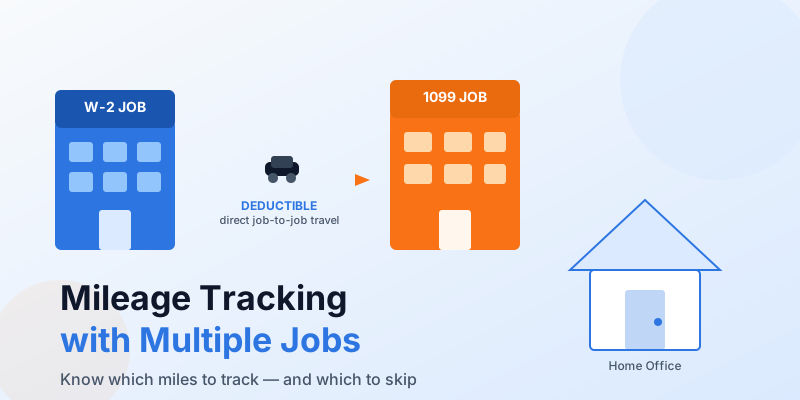
5. Claiming commuting miles. Driving from home to a regular office or job site is not deductible. Only trips from one work location to another — or from a qualified home office to any work location — count.
For more on what 1099 workers can deduct beyond mileage, see our full self-employed tax deductions list.
The Bottom Line on 1099 Mileage
Every business mile you drive as an independent contractor puts 72.5 cents back in your pocket — but only if you track it. A year of 10,000 to 20,000 miles represents $7,250 to $14,500 in deductions. That translates to real money: $2,500 to $5,000 in combined income and self-employment tax savings.
The IRS requires contemporaneous records. The only practical way to keep them without disrupting your workday is automated mileage tracking.
Download Tripbook and start capturing every deductible business mile from your very next trip.