If you are self-employed, you make estimated tax payments four times per year — and your mileage deduction directly reduces how much you owe each quarter. Most freelancers and independent contractors understand that mileage is a deduction at filing time, but fewer realize that tracking it consistently throughout the year gives you a more accurate quarterly estimate right now. That means less money out of your account each quarter and no nasty surprise at April filing.
This guide walks through how quarterly taxes self-employed workers owe are calculated, how mileage fits into that calculation, and what it takes to use your mileage log to optimize each quarterly payment.
Why Quarterly Taxes and Mileage Are Directly Connected
When you are an employee, your employer withholds income tax and Social Security/Medicare from every paycheck. When you are self-employed, no one does that for you. Instead, the IRS expects you to estimate your annual tax bill and pay it in four installments using Form 1040-ES.
Your quarterly payment is based on your expected taxable income for the year. Every deduction that reduces your taxable income — including mileage — reduces both your income tax and your self-employment tax. That means a mileage deduction does not just help at filing time. It reduces the number you use to calculate your quarterly payments right now.
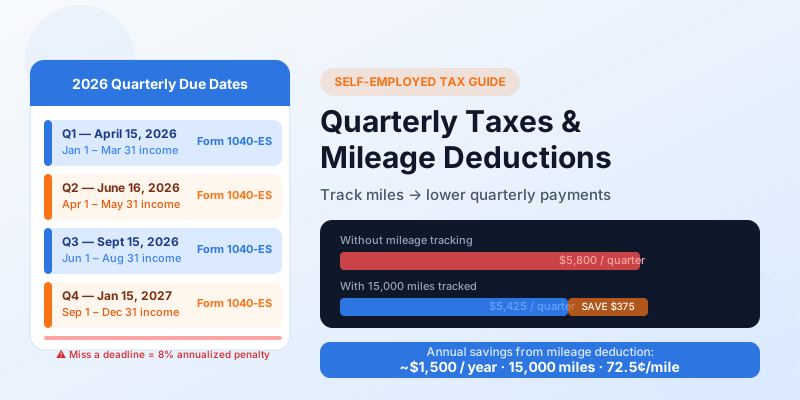
At 72.5 cents per mile, 15,000 business miles produces a $10,875 deduction. On a combined federal income and self-employment tax rate of roughly 30%, that deduction saves approximately $3,262 in taxes — spread across all four quarterly payments.
The Quarterly Estimated Tax Schedule
The IRS quarterly payment deadlines do not fall evenly across the calendar year. Here are the four due dates for 2026:
| Quarter | Covers | Due Date |
|---|---|---|
| Q1 | Jan 1 – Mar 31 | April 15, 2026 |
| Q2 | Apr 1 – May 31 | June 16, 2026 |
| Q3 | Jun 1 – Aug 31 | September 15, 2026 |
| Q4 | Sep 1 – Dec 31 | January 15, 2027 |
Missing or underpaying these deadlines triggers an underpayment penalty. The IRS annualized rate for 2026 is 8% — meaning a $5,000 underpayment over two quarters costs you roughly $200 in penalties on top of what you owe.
How Mileage Reduces Your Quarterly Payment — With Real Numbers
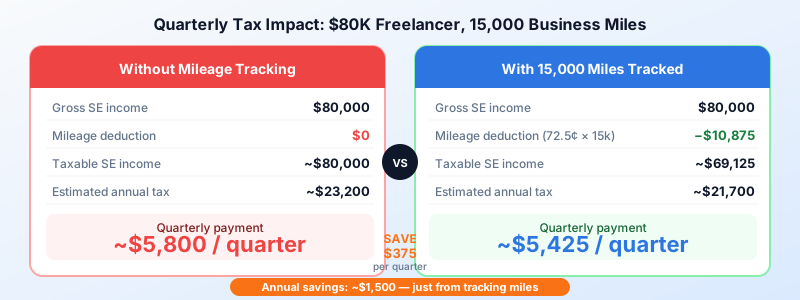
Let us walk through a concrete example. A freelance consultant earns $80,000 in gross self-employment income and drives 15,000 business miles during the year.
Without tracking mileage:
- Taxable SE income: ~$80,000 (before other deductions)
- Estimated quarterly payment: approximately $5,800 per quarter
- Annual total: ~$23,200
With 15,000 miles tracked at 72.5¢/mile:
- Mileage deduction: $10,875
- Reduced taxable SE income: ~$69,125
- Estimated quarterly payment: approximately $5,425 per quarter
- Annual total: ~$21,700
- Annual savings: ~$1,500
The $1,500 in savings comes from the same miles the consultant was already driving. The only variable is whether they were logged.
The Safe Harbor Rule: How to Avoid Underpayment Penalties
Even if you are not sure exactly how much you will earn this year, there is a way to pay quarterly taxes without risking the underpayment penalty: the safe harbor rule.
Under safe harbor, you avoid the underpayment penalty if you pay at least 100% of your prior year’s total tax — even if your income this year ends up higher. If your adjusted gross income last year exceeded $150,000, the threshold goes up to 110%.
This matters for mileage tracking in a specific way. Your prior year’s tax was already reduced by whatever mileage you deducted last year. If you tracked more miles last year, your safe harbor baseline is lower. If you tracked fewer, it is higher than it needs to be.
The practical strategy:
- Use last year’s tax as your safe harbor floor
- Track mileage throughout the current year in real time
- Adjust your Q3 or Q4 payment upward or downward once you have an accurate mileage count for the year
The Common Mistake: Undercounting Mileage All Year
Here is how most self-employed workers leave money on the table: they drive all year, track nothing or almost nothing, then scramble to reconstruct their mileage log in February before filing. They remember the obvious trips but forget the dozens of smaller ones — client check-ins, bank runs, post office trips, supply pickups.
The result is that they both overpay each quarter and underclaim at filing. The IRS will not penalize you for overpaying quarterly taxes, but you lose the time value of that money sitting with the Treasury rather than in your account.
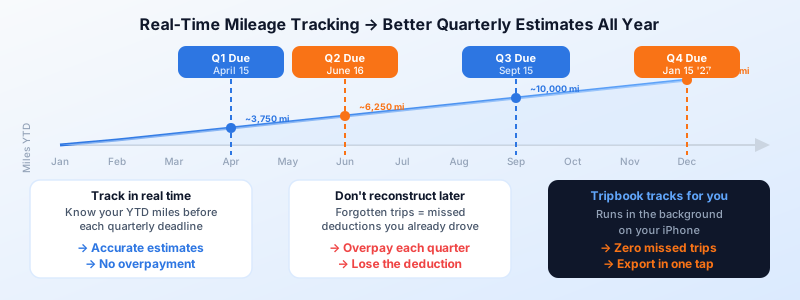
Real-time tracking fixes both problems. When you log every business trip as it happens, you know your running mileage total at any point in the year. Before you calculate your Q2 or Q3 payment, you can look at your running total, project the rest of the year, and adjust your estimate accordingly. You do not overpay and you do not underpay.
For a full picture of what counts as deductible mileage, see our guide to mileage tracking for self-employed workers and the IRS mileage log requirements to make sure your records hold up.
How to Calculate Each Quarterly Payment With Mileage
Here is the step-by-step process most self-employed workers should follow for each quarter:
Step 1 — Tally your year-to-date income. Add up all payments received so far this year.
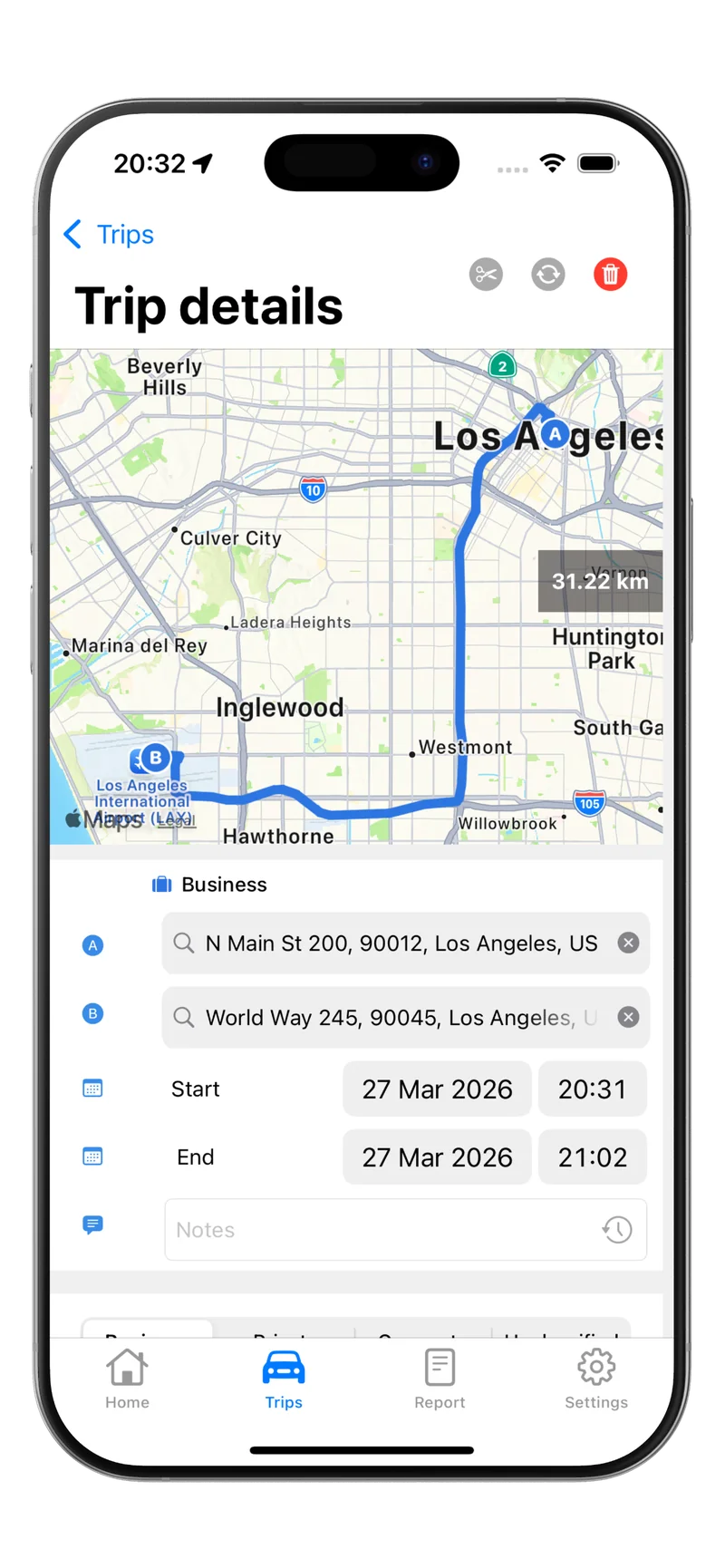
Step 2 — Pull your year-to-date mileage. Open Tripbook and check your running total for the year. If you are estimating for Q1, your full-year projection is based on the first quarter pace. By Q3, you have a much more accurate number.
Step 3 — Project your full-year deductions. Annualize your mileage total and add other known deductions (home office, equipment, health insurance, etc.).
Step 4 — Estimate full-year taxable income. Subtract total projected deductions from projected gross income.
Step 5 — Apply the SE tax and income tax rates. A rough combined rate of 28–35% for most freelancers gives you a working estimate.
Step 6 — Subtract what you have already paid. Divide remaining tax by remaining quarters.
This process sounds like work, but if you have already done the record keeping — specifically the mileage log — your accountant or tax software handles most of the math. The bottleneck is almost always the mileage number.
The Connection Between Mileage Tracking and Cash Flow
Quarterly taxes are a cash flow issue as much as a tax issue. If you overpay because you forgot to include your mileage deduction in your quarterly estimate, you are handing the IRS an interest-free loan until you file and claim the refund. Most self-employed workers would rather keep that cash in their business account.
If you underpay — which often happens when income spikes or a deductible expense is missed — you pay 8% in annualized penalties. Neither outcome is good.
The solution is accurate, real-time mileage tracking. Tripbook runs in the background on your iPhone, captures every drive automatically, and gives you an always-current mileage total you can use when you sit down to calculate your next quarterly payment. Your IRS mileage reimbursement and self-employment deductions are only as good as the log behind them.
Put Your Mileage to Work Before the Next Quarterly Deadline
If a quarterly payment deadline is coming up and you have not been tracking your miles, now is the time to start. Even partial-year tracking is better than nothing — you can use whatever you have to reduce the current quarter’s estimate.
For next year, set up a system on day one. The best mileage log is one you never have to think about. Download Tripbook on the App Store, run it in the background, and walk into every quarterly payment deadline knowing your mileage total is accurate.