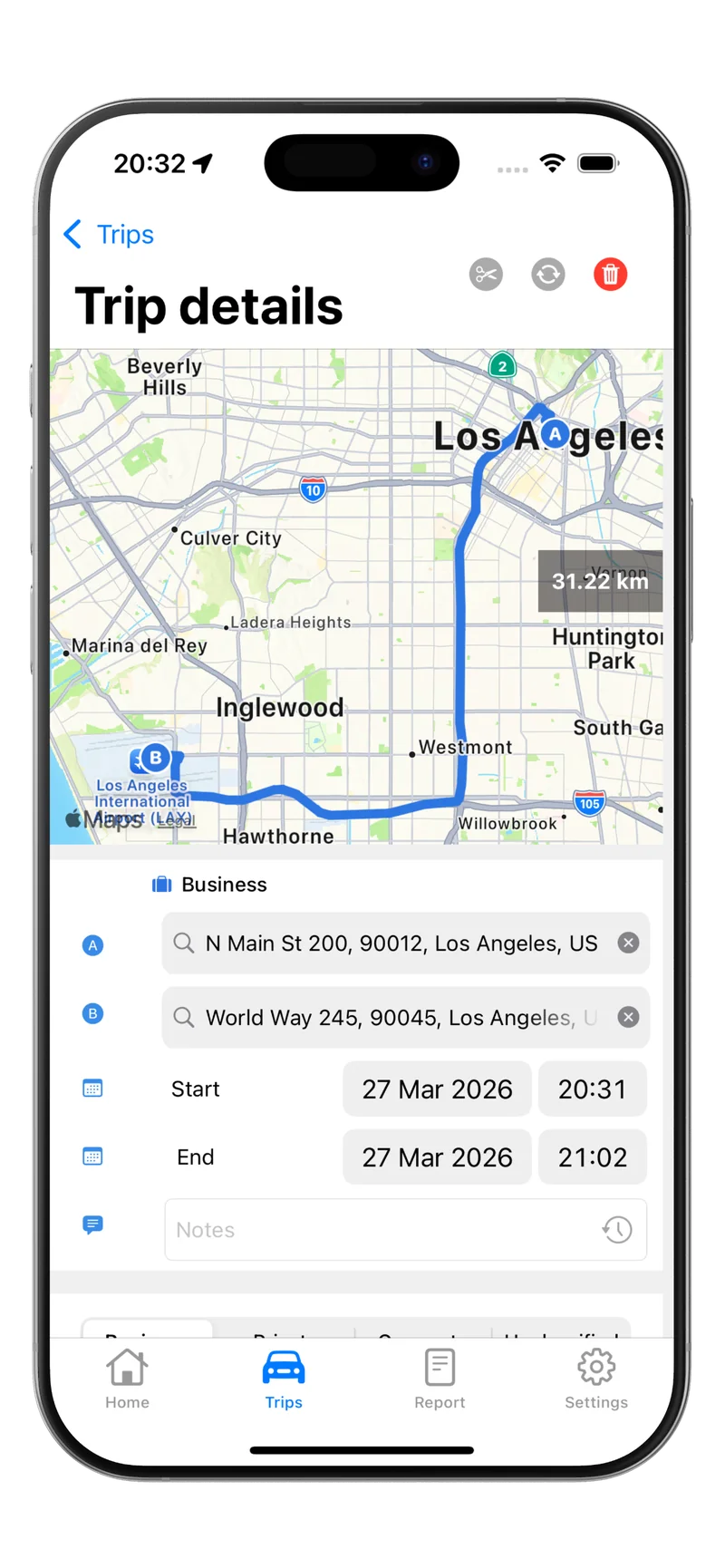

If you drive to job sites, client offices, or project locations that change throughout the year, you may be leaving money on the table. Understanding temporary work location mileage rules is one of the fastest ways to increase your tax deductions, and the IRS has clear guidelines on what qualifies.
This guide breaks down the one-year rule, explains which trips are deductible, and shows you how to stay compliant while maximizing every eligible mile.
What is a temporary work location?
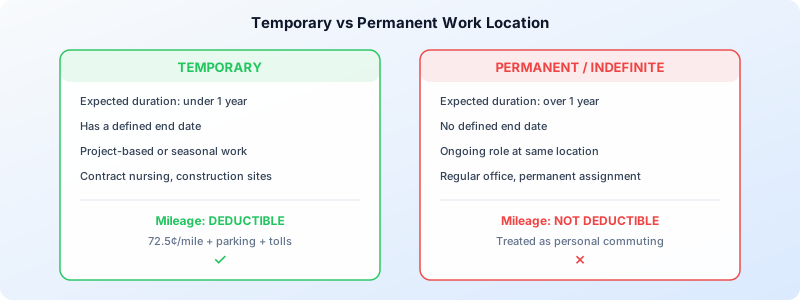
The IRS defines a temporary work location as any place where you realistically expect to work for one year or less. This is the foundation of the so-called “one-year rule.” If the assignment is expected to last longer than 12 months, or if there is no defined end date, the IRS considers that location indefinite, and travel to it becomes a non-deductible commute.
The one-year clock starts on your first day at the location. What matters is your realistic expectation at the time work begins, not what actually happens later. If you initially expect a project to last eight months but it extends to 14, the location was temporary for the first year and becomes indefinite once expectations change.
Key points about the one-year rule:
- Under one year expected: The location is temporary. Mileage may be deductible.
- Over one year expected: The location is indefinite. Mileage is a non-deductible commute.
- No defined end date: Treated as indefinite from day one.
- Expectation changes midway: The location becomes indefinite on the date your expectation changes, not retroactively.
Which trips to a temporary work location are deductible?
Not every trip to a temporary site automatically qualifies. The rules depend on whether you have a regular office and where the temporary location sits relative to your metropolitan area.
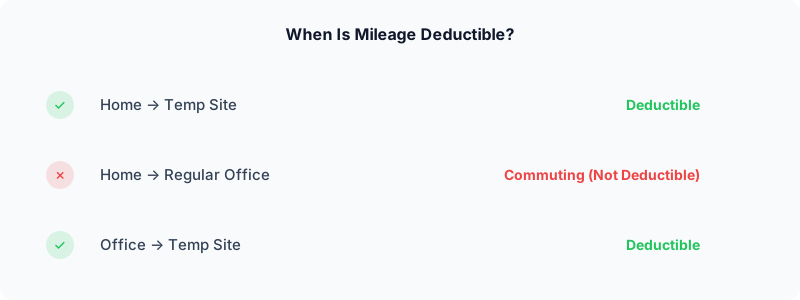
If you have a regular office away from home
When you have a fixed workplace (an office, store, or other location you report to regularly), trips from your home to a temporary work location are deductible regardless of whether the temporary site is inside or outside your metropolitan area. Trips between your regular office and the temporary site are also deductible.
If you work from home without a regular office
If you do not have a regular workplace outside the home and you do not have a qualifying home office, the metropolitan area rule kicks in. You can only deduct mileage to temporary locations that are outside your metropolitan area. Trips to temporary sites within your city and suburbs are treated as commuting.
If you have a qualifying home office
A home office that meets the IRS requirements for regular and exclusive business use turns your home into your principal place of business. Every trip from home to any business destination becomes deductible, including trips to temporary work locations both inside and outside your metro area. This is the most favorable scenario for maximizing business mileage deductions.
Temporary vs. permanent: common scenarios
Understanding the distinction between temporary and permanent work locations is easier with real-world examples.
Construction contractor. You take a six-month project at a new building site across town. Because the assignment is expected to last less than one year, the site is temporary. Your daily drive from home to the site is deductible (assuming you have a regular office or qualifying home office).
Traveling nurse. You accept a 13-week contract at a hospital in another city. The assignment is well under one year, so the hospital is a temporary work location. All mileage between your home (or lodging) and the hospital is deductible.
Consultant on a long-term engagement. A client brings you on for a project expected to last 18 months. From day one, this location is indefinite. Your daily travel there is a non-deductible commute, the same as driving to a permanent office.
Freelancer rotating between client sites. You visit three different clients each week, none for more than a few months at a time. Each site is temporary. If you have a home office, every trip is deductible. If not, only sites outside your metro area qualify.
How much can you deduct?
For 2026, the IRS standard mileage rate is 72.5 cents per mile for business driving. You can also deduct parking fees and tolls paid at or traveling to temporary work locations on top of the mileage rate. No other vehicle costs (fuel, insurance, maintenance) can be stacked with the standard rate.
A quick example: if you drive 30 miles each way to a temporary job site, 200 days per year, that is 12,000 deductible miles. At 72.5 cents per mile, the deduction is $8,700.
Alternatively, you can use the actual expense method, which tracks real costs like gas, insurance, repairs, and depreciation. You must choose one method for each vehicle and stick with it for the year. Most people find the standard mileage rate simpler and often more generous. For more on the difference between business miles and commuting miles, see our detailed guide.
Documentation the IRS expects
The IRS requires a contemporaneous mileage log for every business trip you deduct. That means recording your miles close to the time you drive them, not reconstructing the numbers at tax time. Each entry should include:
- Date of the trip
- Starting and ending locations
- Business purpose (e.g., “client meeting at temporary project site”)
- Miles driven
If your temporary work location deduction is questioned during an audit, the IRS will want to see that the assignment was genuinely expected to last under one year. Keep offer letters, contracts, or project timelines that document the expected duration.
A mileage tracking app removes the guesswork. Instead of scribbling notes on paper or filling in a spreadsheet after the fact, you get an automatic, GPS-verified log that satisfies IRS requirements.
Who can claim this deduction?
Under current tax law, the ability to deduct temporary work location mileage depends on your employment status.
Self-employed, freelancers, and independent contractors can deduct business mileage on Schedule C. This includes all eligible trips to temporary work locations.
W-2 employees cannot deduct unreimbursed mileage on their federal tax return. The One Big Beautiful Bill Act (OBBBA) made the suspension of miscellaneous itemized deductions permanent. However, employees can ask their employer to reimburse mileage through an accountable plan, which is tax-free to the employee and deductible for the employer.
If you are unsure whether your daily drive counts as a deductible commute, the key question is always: is the destination temporary or permanent?
Tips to maximize your temporary work location mileage
- Establish a home office. If you are self-employed and work from home regularly, setting up a qualifying home office makes every business trip deductible, even to temporary sites within your metro area.
- Track from day one. Start logging miles the moment you begin a new assignment. Gaps in your records weaken your case during an audit.
- Keep contracts and project timelines. Documentation that proves the expected duration of an assignment is your best evidence that a location was truly temporary.
- Monitor the one-year mark. If a project looks like it will extend beyond 12 months, recognize that the location becomes indefinite and adjust your tracking accordingly.
- Use a mileage tracking app. Automatic GPS logging captures every trip accurately, so you never have to guess or estimate.
Start tracking your temporary work location mileage
Every mile to a temporary work location that goes untracked is money lost at tax time. Whether you are a contractor bouncing between job sites, a consultant visiting clients, or a freelancer working from home, accurate mileage records turn everyday driving into meaningful deductions.
Download Tripbook to automatically log every business trip with GPS precision. No manual entry, no forgotten miles, and an IRS-ready report whenever you need it.