

If you drive for work and pay for oil changes, brake jobs, or tire replacements out of pocket, those costs may be tax deductible. A car repairs tax deduction for business use can save self-employed workers hundreds of dollars each year, but only if you use the right IRS method and keep proper records.
This guide explains when car repairs are deductible, which method you need to choose, and how the IRS draws the line between a simple repair and a capital improvement.
Who can deduct car repairs for business?
Not everyone qualifies. Under current IRS rules, the following groups can claim vehicle expense deductions, including repairs:
- Self-employed individuals (sole proprietors, freelancers, independent contractors)
- Single-member and multi-member LLC owners
- Partners and S-corp shareholders using a personal vehicle for business
- Armed Forces reservists and fee-basis government officials
W-2 employees generally cannot deduct car repairs or any unreimbursed vehicle expenses. The Tax Cuts and Jobs Act suspended the miscellaneous itemized deduction for employees through at least 2025, and the One, Big, Beautiful Bill Act has made this permanent.
Actual expense method: where car repairs are deductible
The IRS gives you two ways to deduct business vehicle costs. Car repairs are only deductible as a separate line item when you choose the actual expense method.
Under this method, you add up every vehicle-related cost for the year, including:
- Gas and oil
- Repairs and maintenance
- Tires
- Insurance premiums
- Registration and license fees
- Depreciation (or lease payments)
- Parking and tolls
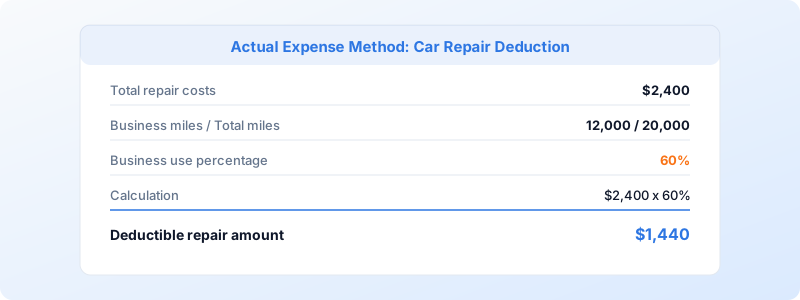
You then multiply the total by your business use percentage. That percentage comes from dividing your business miles by your total miles for the year.
Example: You spent $2,400 on repairs during the year and drove 60% of your miles for business. Your deductible repair amount is $2,400 x 60% = $1,440.
For a full comparison of both IRS methods, see our guide on standard mileage rate vs actual expenses.
Standard mileage rate: repairs are already included
If you choose the standard mileage rate instead, you cannot deduct car repairs separately. The 2026 IRS rate of 72.5 cents per mile already accounts for gas, oil, repairs, maintenance, insurance, depreciation, and general wear and tear.
This is the simpler option. You only need to track your business miles and multiply by the rate. You can still deduct parking fees and tolls on top of the standard rate.
Example: 10,000 business miles x $0.725 = $7,250 deduction. No repair receipts needed.
The standard mileage rate works well for drivers with lower overall vehicle costs. But if your car needs frequent or expensive repairs, the actual expense method may produce a larger deduction. Compare your totals under both methods before filing.
Car repairs tax deduction: what counts as a repair?
The IRS draws a clear line between a repair and a capital improvement. Getting this classification right matters because each is handled differently at tax time.
Deductible repairs (expense immediately)
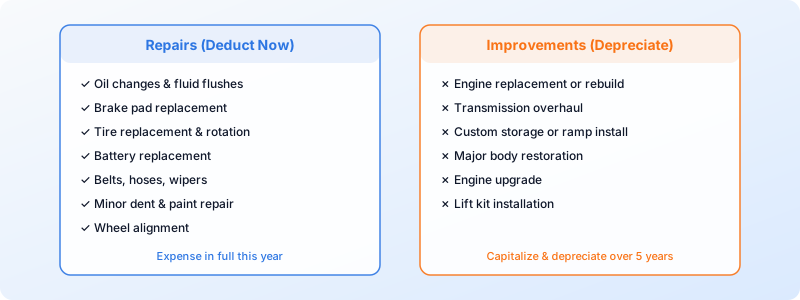
Repairs restore your vehicle to its normal operating condition without increasing its value or extending its useful life. Common examples include:
- Oil changes and fluid flushes
- Brake pad and rotor replacement
- Tire replacement and rotation
- Battery replacement
- Windshield wiper replacement
- Minor body work (dent repair, paint touch-ups)
- Wheel alignment
- Replacing belts and hoses
Capital improvements (must be depreciated)
Improvements materially better the vehicle, restore it to like-new condition, or adapt it for a different use. These costs must be capitalized and recovered through depreciation, typically over five years using MACRS. Examples include:
- Engine replacement or rebuild
- Transmission overhaul
- Adding a lift kit, wheelchair ramp, or custom storage
- Major body restoration
- Upgrading to a more powerful engine
The IRS applies a “betterment test.” If the work fixes a pre-existing defect, adds a major component, or materially increases capacity or output, it is an improvement, not a repair.
De minimis safe harbor: If you do not have audited financial statements, you can elect to expense individual items costing $2,500 or less per invoice, even if they might otherwise qualify as improvements.
How to calculate your business use percentage
Your business use percentage is the foundation of every actual expense deduction. Here is how to calculate it:
- Track every mile. Record your odometer at the start and end of the year to get total miles driven.
- Log each business trip. For every business drive, note the date, destination, purpose, and miles. The IRS requires this level of detail.
- Divide business miles by total miles. If you drove 20,000 total miles and 12,000 were for business, your business use percentage is 60%.
- Apply the percentage to each expense category. Multiply your total repair costs, insurance, gas, and every other actual expense by 60%.
Commuting miles (home to your regular office) do not count as business miles. However, trips from your home office to client sites, job sites, or business errands do qualify. Our guide on vehicle expense deductions for the self-employed covers this in more detail.
A mileage tracking app like Tripbook makes this step automatic. It logs each trip with GPS data, timestamps, and trip classification, giving you an IRS-ready log at tax time.
Self-employment tax and car repair deductions
If you are self-employed, your car repair deduction does more than reduce your income tax. It also lowers your self-employment tax bill.
Here is how it works:
- Your net business profit (Schedule C) minus half of SE tax feeds into the SE tax calculation.
- The IRS applies a 92.35% multiplier to your net earnings before calculating the 15.3% SE tax rate.
- Every dollar you deduct in car repairs reduces that base amount.
Example: A $1,440 car repair deduction reduces your SE tax by roughly $1,440 x 92.35% x 15.3% = $203. That is on top of the income tax savings.
For more on deductible vehicle costs for independent workers, see our guide on car insurance tax deductions for the self-employed.
Record-keeping requirements
The IRS can disallow your entire vehicle deduction if you lack proper documentation. Keep these records:
- Mileage log with date, destination, business purpose, and miles for every trip
- Receipts and invoices for every repair, including a description of the work performed
- Odometer readings at the start and end of the tax year
- Business use percentage calculation showing total miles vs. business miles
Paper receipts fade and get lost. A digital tracking system keeps everything organized and accessible. Download Tripbook to automatically log every business trip and store your records in one place.
Frequently asked questions
Can I deduct car repairs if I use the standard mileage rate? No. The standard mileage rate (72.5 cents per mile for 2026) already includes repairs, maintenance, gas, insurance, and depreciation. You cannot claim those separately.
What if I use my car for both business and personal driving? You deduct only the business use percentage of your repair costs. If 55% of your driving is for business, you can deduct 55% of your repair expenses under the actual expense method.
Are car washes deductible? Generally, routine car washes are not considered a deductible repair or maintenance expense. However, if you operate a vehicle that must be kept clean for business purposes (such as a rideshare or delivery vehicle), a portion may be deductible under actual expenses.
Can W-2 employees deduct car repairs? In most cases, no. The Tax Cuts and Jobs Act eliminated the unreimbursed employee expense deduction. This restriction is now permanent. Exceptions exist for Armed Forces reservists, fee-basis state or local government officials, and qualified performing artists.
Bottom line
A car repairs tax deduction for business use is available to self-employed workers and business owners who choose the actual expense method. If you use the standard mileage rate, repairs are already built into the per-mile amount. Either way, accurate mileage tracking is the key to maximizing your deduction and surviving an audit.
Start logging your miles today. Download Tripbook and keep every business trip on record automatically.