
If you drive two cars for business, you may wonder whether the IRS lets you deduct mileage on both. The short answer is yes. A two vehicle mileage deduction is perfectly legal as long as each vehicle meets the standard eligibility requirements and you keep separate logs for every car.
This guide covers the rules for claiming multiple vehicles, the fleet restriction, how to choose between the standard mileage rate and actual expenses for each car, and how to keep your records audit-ready.
Can you use the standard mileage rate on two vehicles?
Yes. The IRS allows you to apply the standard mileage rate to up to four vehicles used simultaneously for business. The restriction — commonly called the fleet rule — only kicks in when you operate five or more cars at the same time. As long as you have fewer than five vehicles in service, you can claim 72.5 cents per mile (the 2026 rate) on each one.
Each vehicle is treated independently. That means you can use the standard mileage rate on one car and actual expenses on the other, as long as each vehicle qualifies for its chosen method.
The fleet rule explained
The fleet rule is straightforward: if you operate five or more vehicles simultaneously for business, you cannot use the standard mileage rate on any of them. You must use the actual expense method for every vehicle in the fleet.
“Simultaneously” is the key word. You could own six cars total but only use four at the same time. In that scenario the fleet rule does not apply and you can still elect the standard rate.
For most self-employed workers and small business owners who drive two cars, the fleet rule is not a concern. It primarily affects delivery companies, sales organizations, and other businesses with large vehicle pools.

First-year election rule for each vehicle
One rule trips up many multi-vehicle owners: you must elect the standard mileage rate in the first year a car is available for business use. If you choose actual expenses in year one, you are locked into that method for the life of the vehicle.
The reverse is more flexible. If you start with the standard rate, you can switch to actual expenses in a later year. However, you must then use straight-line depreciation going forward.
This election applies to each vehicle separately. Adding a second car to your business next year does not affect the method you already chose for your first car.
What you can and cannot stack
When you use the standard mileage rate, the 72.5 cents per mile figure is designed to cover nearly all vehicle costs — gas, insurance, depreciation, maintenance, and repairs. You cannot add those expenses on top of the per-mile deduction.
There are three exceptions. You can still deduct:
- Parking fees related to business trips
- Tolls incurred during business driving
- Loan interest on a vehicle used for business (the business-use percentage)
Everything else is already baked into the rate. If your actual costs are significantly higher than what the standard rate yields, the actual expense method may save you more.
Keeping separate mileage logs
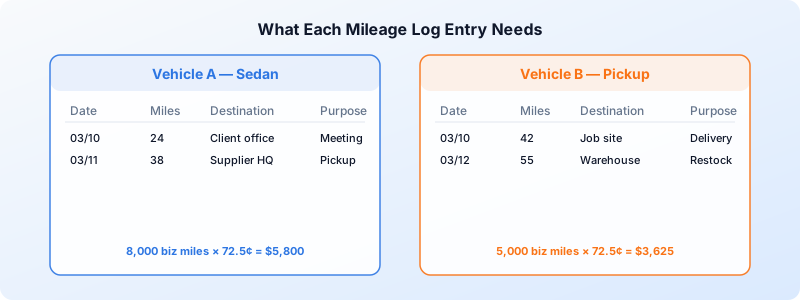
The IRS requires a contemporaneous mileage log for every vehicle you deduct. When you claim two cars, that means two independent logs. Each entry should include:
- Date of the trip
- Starting and ending odometer readings (or total trip miles)
- Business destination
- Business purpose
Mixing trips from two cars into a single notebook is a common audit trigger. Keep the records clearly separated, either in different sections or — better yet — with an automatic tracker that tags each trip to a specific vehicle.
For a full breakdown of what the IRS expects, see our guide on IRS mileage log requirements.
Two vehicle mileage deduction example
Let’s say you are a self-employed consultant who drives a sedan for client meetings and a pickup truck for job-site visits. Here is how the math works for 2026:
| Sedan | Pickup | |
|---|---|---|
| Business miles | 8,000 | 5,000 |
| Rate | 72.5 cents | 72.5 cents |
| Deduction | $5,800 | $3,625 |
Your combined mileage deduction is $9,425. You report this on Schedule C if you are a sole proprietor.
Remember that self-employment tax applies to your net profit at 92.35% of earnings, so reducing that profit with legitimate mileage deductions directly lowers both income tax and SE tax.
Choosing the right method for each car
Because each vehicle is evaluated independently, you can mix methods. A general rule of thumb:
- Standard mileage rate works best for vehicles with low operating costs, newer fuel-efficient cars, or situations where you simply want easy recordkeeping.
- Actual expenses tend to win for expensive vehicles with high depreciation, heavy maintenance costs, or a very high business-use percentage.
Run the numbers both ways for each car before you file. Once you lock in actual expenses in year one, you cannot switch back to the standard rate for that vehicle.
Also note the luxury vehicle inclusion threshold. For 2026, the maximum fair market value for the fleet-average and cents-per-mile employer valuation rules is $61,700. This mainly affects employer-provided vehicles, but it is worth knowing if your business provides cars to employees.
Tips for maximizing your two vehicle deduction
-
Track every trip in real time. Reconstructing a year’s worth of mileage at tax time is both stressful and risky. Use an app that records each trip automatically.
-
Assign vehicles by purpose. If one car handles mostly short city errands and the other covers long highway trips, tracking becomes cleaner and easier to explain under audit.
-
Review your method annually. If you started with the standard rate, compare it against actual expenses each year. Gas prices, repair bills, and depreciation all fluctuate.
-
Keep fuel and maintenance receipts anyway. Even if you use the standard rate, having backup documentation shows the IRS you are a diligent recordkeeper.
-
Separate personal and business use. The IRS only allows deductions for the business portion. Commuting from home to your regular office does not count.
Make tracking easy with Tripbook
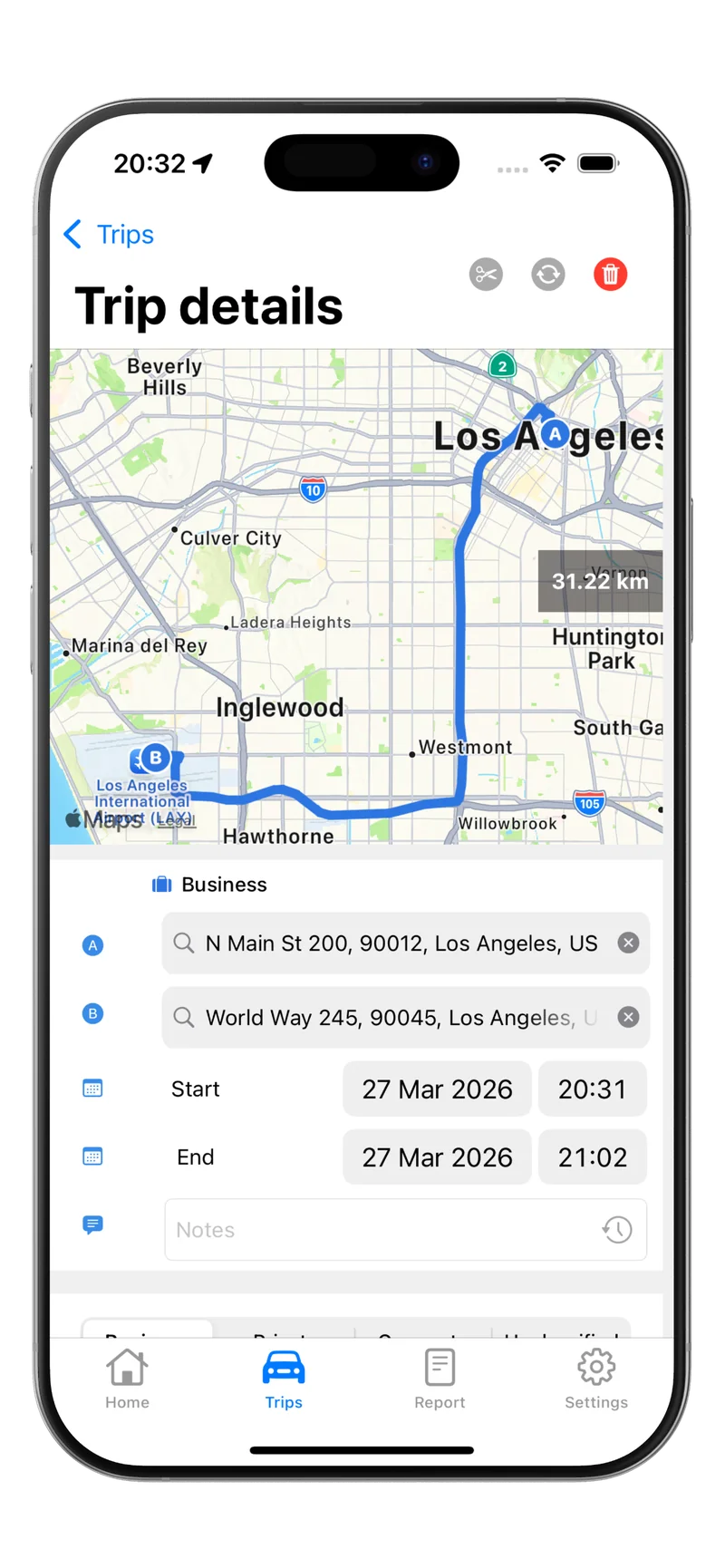
Managing mileage logs for two vehicles does not have to be complicated. Tripbook lets you set up multiple vehicles in one account and automatically records every business trip with GPS — no manual entries, no forgotten drives.
Each trip is tagged to the correct car, with date, distance, and purpose captured instantly. When tax season arrives you have a clean, IRS-ready report for each vehicle.
Download Tripbook and start building your two vehicle mileage log today.