
Mileage tracking for courier drivers is one of the most valuable habits you can build as a self-employed delivery professional. Whether you drive for Amazon Flex, FedEx Ground, UPS as an independent contractor, or a regional parcel service, every business mile you log becomes a direct reduction in your taxable income. At the 2026 IRS rate of 72.5 cents per mile, a full-time courier logging 25,000 miles per year earns a deduction worth over $18,000.
This guide explains exactly which miles qualify, how the IRS expects you to track them, and why your employment classification determines whether you can claim the deduction at all.
1099 vs. W-2: Who Can Actually Deduct Mileage?
Before you start tracking, you need to know where you stand. The IRS treats courier drivers very differently depending on whether you receive a 1099-NEC or a W-2 at the end of the year.
Independent Contractors (1099-NEC)
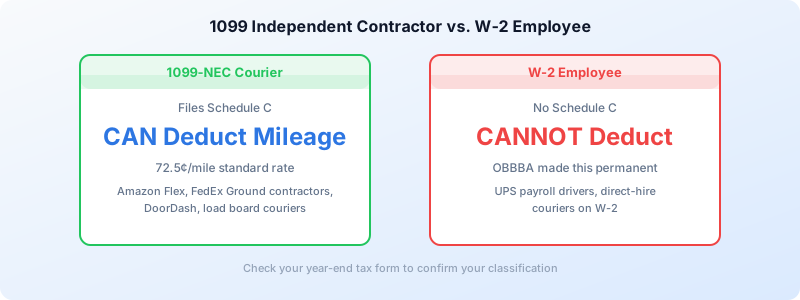
If you receive a 1099-NEC, you are self-employed. You report income and expenses on Schedule C, and you can deduct every qualified business mile. This applies to most Amazon Flex drivers, FedEx Ground route owners, couriers working through load boards, and last-mile delivery contractors.
Starting in 2026, companies only have to issue a 1099-NEC if they paid you $2,000 or more (up from $600). However, you must report all self-employment income even if you never receive a form. The IRS obligation to report starts at $400 in net self-employment earnings.
W-2 Employees
If you are a W-2 employee, such as a UPS driver on payroll or a direct-hire courier, you cannot deduct mileage on your personal tax return. The One Big Beautiful Bill Act (OBBBA) made the suspension of miscellaneous itemized deductions permanent. This means the pre-2018 rule that let employees write off unreimbursed expenses subject to a 2% AGI floor is gone for good.
If you are a W-2 courier, ask your employer about an accountable reimbursement plan. That is the only way to recoup vehicle costs tax-free.
What Miles Count for Courier Drivers
Not every mile behind the wheel is deductible. The IRS draws a clear line between business miles and personal commuting, and getting this wrong is one of the most common audit triggers for delivery driver tax deductions.
Deductible Business Miles
- Driving from your first pickup to your last drop-off during a shift
- Miles between deliveries, including return trips to a hub for your next load
- Trips to pick up supplies such as packing materials, hand trucks, or vehicle maintenance parts
- Driving to a post office or shipping facility for work purposes
- Travel between two different work locations in the same day
Not Deductible
- Driving from home to your first delivery location (commuting), unless your home qualifies as your principal place of business
- Personal errands during a shift
- Miles driven after your last delivery on the way home, unless your home is your tax home
The Home Office Exception
If you use a dedicated space in your home exclusively and regularly for courier administration (invoicing, route planning, scanning), your home may qualify as your principal place of business under IRS rules. In that case, the drive from your home to your first delivery zone becomes a deductible business trip rather than a commute. Without this qualification, home-to-zone mileage is personal.
How to Track Mileage the IRS Way
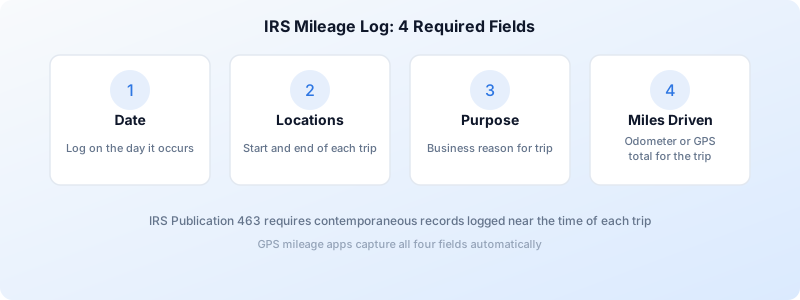
The IRS requires contemporaneous records. That means logging each trip close to the time it happens, not reconstructing a year of driving at tax time. For every business trip, your log must include:
- Date of the trip
- Starting and ending location
- Business purpose (e.g., “FedEx Ground route deliveries, Zone 4”)
- Miles driven
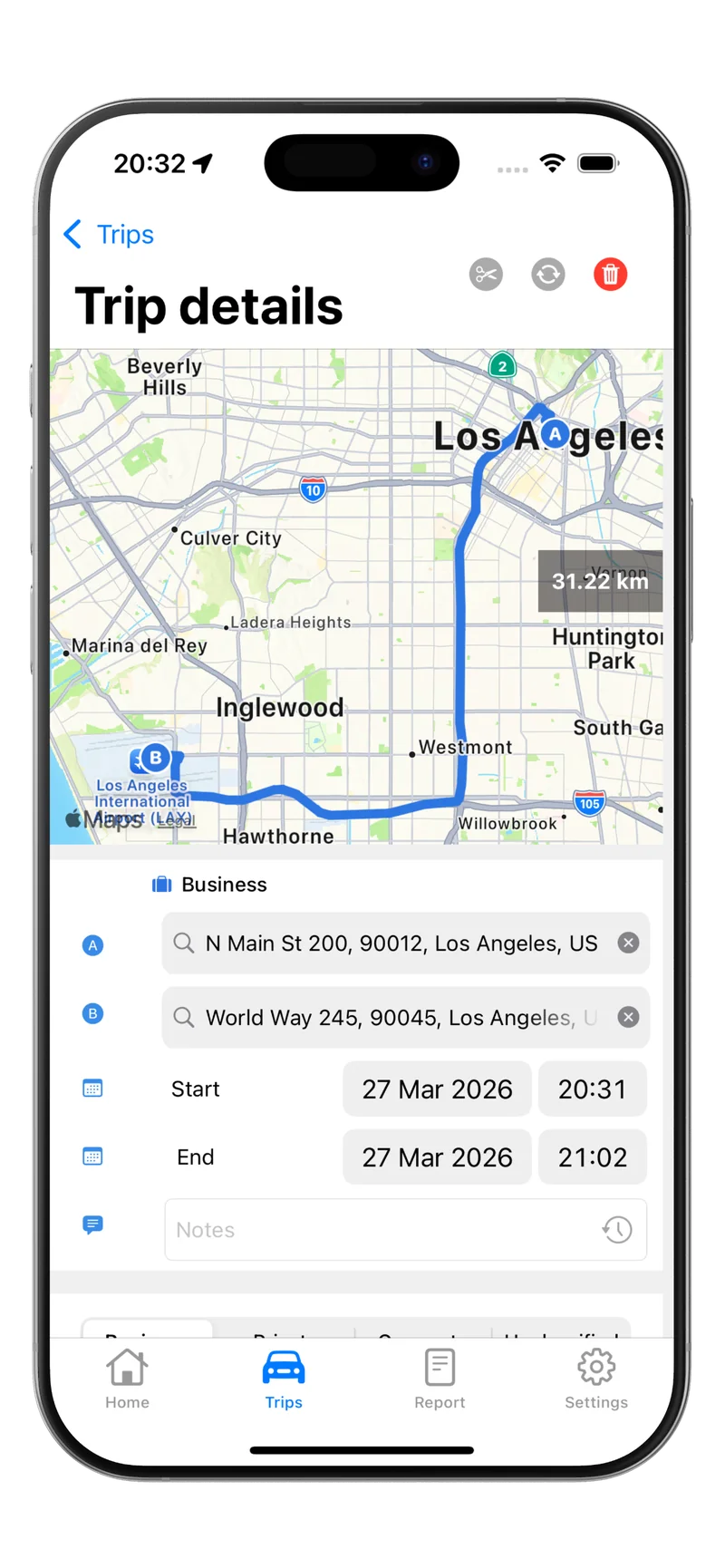
Paper logs and spreadsheets are technically acceptable, but they leave room for error and are difficult to maintain during a busy delivery day. A GPS-based mileage tracking app records trips automatically and captures all four required data points without any manual input.
The 72.5 Cents Per Mile Deduction
For tax year 2026, the IRS standard mileage rate is 72.5 cents per mile driven for business use. This rate covers fuel, insurance, depreciation, maintenance, and all other costs of operating your vehicle. You do not need to save individual gas receipts if you use this method.
The alternative is the actual expenses method, where you track every vehicle cost and multiply by your business-use percentage. Most courier drivers choose the standard rate because it is simpler and often produces a comparable or larger deduction. However, if you drive a newer or more expensive vehicle, the actual expenses method (which includes bonus depreciation) may yield a bigger write-off. Under the OBBBA, 100% bonus depreciation is now permanent for qualifying property acquired after January 19, 2025.
You must choose one method in the first year you use a vehicle for business. If you start with the standard mileage rate, you can switch to actual expenses in a later year. But if you start with actual expenses and claim depreciation, you cannot switch back.
How the Numbers Add Up
| Annual Business Miles | Deduction at 72.5 cents/mile | Estimated Tax Savings |
|---|---|---|
| 10,000 | $7,250 | ~$2,500 |
| 20,000 | $14,500 | ~$5,000 |
| 30,000 | $21,750 | ~$7,500 |
Tax savings assume a combined federal plus self-employment tax rate near 35%.
Other Deductions Courier Drivers Should Track
Mileage is your largest write-off, but it is not the only one. As a 1099 courier, you can also deduct on Schedule C:
- Parking and tolls paid during deliveries (deductible on top of the standard mileage rate)
- Phone and data plan — deduct the business-use percentage if you use the same phone for personal calls
- Delivery supplies like insulated bags, dollies, bungee cords, phone mounts, and dash cams
- Platform fees deducted from your earnings by the delivery app or load board
- Self-employment tax — you can deduct the employer-equivalent half (7.65%) on Form 1040
For a full breakdown, see the gig economy mileage tracking guide.
Quarterly Estimated Taxes
As a 1099 courier, no employer withholds taxes from your pay. The IRS expects you to make quarterly estimated payments using Form 1040-ES. The deadlines are April 15, June 15, September 15, and January 15 of the following year. Missing these deadlines triggers underpayment penalties even if you pay in full when you file.
Accurate mileage tracking throughout the year helps you estimate your quarterly tax liability correctly. If you wait until April to add up your miles, you will either overpay all year or face a surprise bill with penalties attached.
Start Tracking Today
Every untracked mile is money left on the table. A courier driver logging 25,000 business miles per year at 72.5 cents per mile is leaving over $18,000 in deductions unrecorded if they fail to keep a proper log. The IRS will not accept estimates, and reconstructed logs rarely survive an audit.
Mileage tracking for courier drivers does not have to be complicated. A GPS-based app runs in the background, records every trip, and categorizes business miles automatically. Download Tripbook to start logging your courier miles and keep your deductions audit-ready.