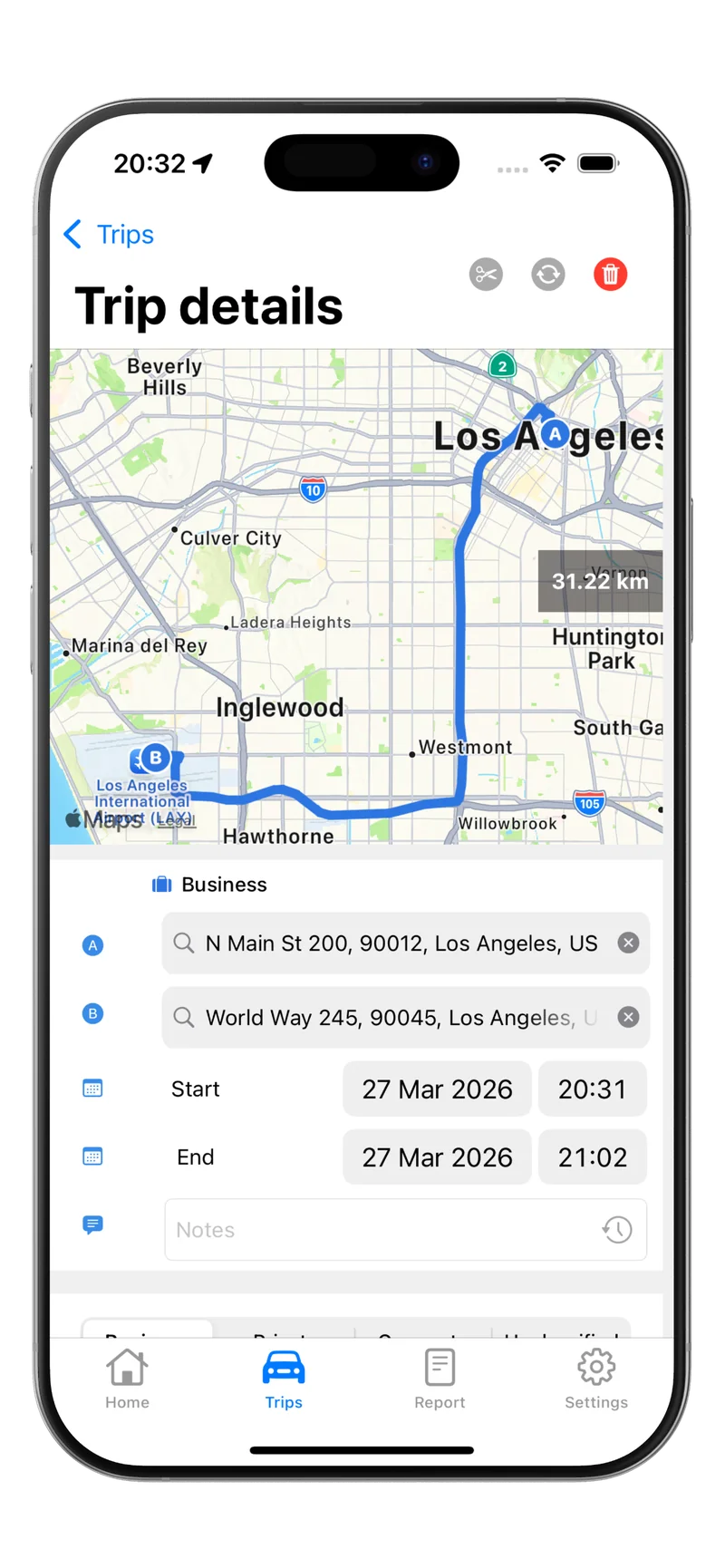

A personal vehicle business use deduction lets you write off the cost of driving your own car for work-related purposes. For the 2026 tax year, the IRS standard mileage rate sits at 72.5 cents per mile, and the potential savings are substantial. A freelance consultant who logs 12,000 business miles, for instance, could reduce taxable income by $8,700 with this single deduction.
Yet many self-employed taxpayers either skip the deduction entirely or claim far less than they should because they lack proper records. This guide covers every aspect of the personal vehicle business use deduction: who qualifies, which calculation method to use, what the IRS expects in your records, and how to report it all on your return.
Who can claim a personal vehicle business use deduction
The deduction is available to taxpayers who use a car, van, pickup, or panel truck they own or lease for legitimate business driving. Eligible filers include:
- Sole proprietors and self-employed individuals who visit clients, pick up supplies, travel between job sites, or make deliveries.
- Freelancers and independent contractors earning income through gig platforms, consulting, creative services, or any 1099-reported work.
- Partners, LLC members, and S-Corp shareholders who use a personal vehicle on behalf of the business and are not reimbursed through an accountable plan.
- Certain W-2 employees in narrow categories defined by the Tax Cuts and Jobs Act: active-duty military reservists, qualified performing artists, fee-basis state and local government officials, and eligible educators. Other employees lost the unreimbursed vehicle expense deduction when miscellaneous itemized deductions were eliminated, a provision that has since been made permanent.
If none of these apply, you cannot deduct personal vehicle business use on your federal return. But if any of them do, the IRS offers two calculation methods to choose from.
Two IRS-approved deduction methods
Standard mileage rate
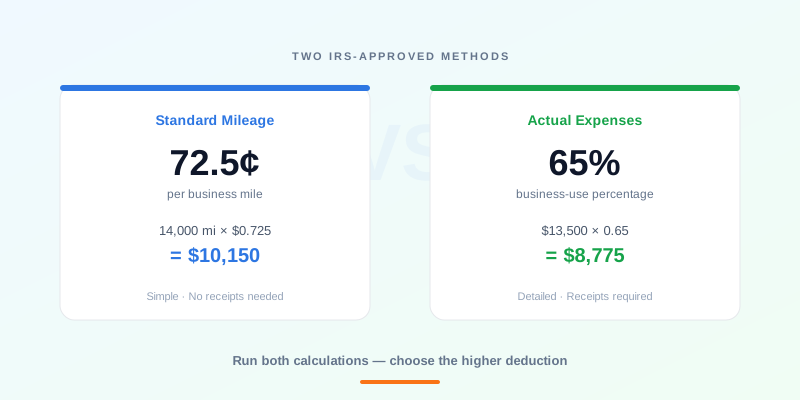
The standard mileage rate is the straightforward option. You multiply every qualifying business mile by the IRS rate for that tax year. In 2026, the rate is 72.5 cents per mile (up from 70 cents in 2025). That single figure is intended to cover fuel, oil, insurance, registration, depreciation, and normal wear-and-tear.
Calculation example
| Item | Amount |
|---|---|
| Business miles driven | 14,000 |
| IRS rate | $0.725 |
| Deduction | $10,150 |
Parking fees and tolls paid during business trips are deductible on top of the standard rate. They are always claimed separately.
Restrictions to know:
- You must elect the standard mileage rate in the first year the vehicle enters business service. In later years, you can switch.
- Vehicles on which you claimed Section 179, bonus depreciation, or MACRS depreciation cannot later use the standard mileage rate.
- Leased vehicles that start with the standard rate must stay on that method for the entire lease term.
- Fleet operators running five or more vehicles simultaneously are excluded.
For a full comparison of both approaches, read our guide on standard mileage rate vs actual expenses.
Actual expenses method
With actual expenses, you track every dollar spent on the vehicle during the year. Deductible costs include:
- Gasoline and oil
- Auto insurance premiums
- Repairs and maintenance
- Tires
- Registration and license fees
- Depreciation (if you own) or lease payments (if you lease)
- Loan interest for self-employed filers
- Garage rent or parking at your workplace
You then multiply the total by your business-use percentage to arrive at the deductible amount.
Calculation example
| Item | Amount |
|---|---|
| Total vehicle expenses | $13,500 |
| Business-use percentage | 65% |
| Deduction | $8,775 |
The actual expenses method often produces a larger deduction for newer, higher-cost vehicles or cars with above-average insurance and maintenance bills. The trade-off is more paperwork: you need receipts and documentation for every expense line item.
Figuring your business-use percentage
Your business-use percentage is the ratio of business miles to total miles driven during the tax year:
Business-use % = (Business miles / Total miles) x 100
If you drove 20,000 total miles and 13,000 were for business, your business-use percentage is 65%. That percentage directly determines your deduction under the actual expenses method.
Under the standard mileage rate, the calculation is simpler because you just multiply business miles by the rate. But you still need an accurate count of business versus personal miles. The IRS looks closely at inflated percentages, so guessing is not an option.
Business miles versus commuting and personal miles
Drawing the line between deductible and non-deductible miles is where many taxpayers make costly errors. The IRS is specific about what qualifies.
Deductible business miles:
- Driving between two work locations during the day
- Traveling to client meetings, vendor appointments, or job sites
- Trips to the bank, post office, or office supply store for business purposes
- Travel to a temporary work location expected to last less than one year
- Any trip originating from a qualifying home office to a business destination
Non-deductible (commuting or personal) miles:
- The drive from home to your regular, fixed workplace and back again. The IRS treats this as commuting, which is never deductible regardless of distance.
- Purely personal errands, even when they occur during the workday
- The personal leg of a mixed-purpose trip. Only the business portion counts.
The home-office rule deserves special attention. If you maintain a home office that meets IRS requirements, every trip from that office to a business destination is deductible starting from mile one. Without a qualifying home office, your first trip of the day to a regular workplace is a non-deductible commute.
For a deeper breakdown, see business miles vs commuting miles.
IRS record-keeping standards
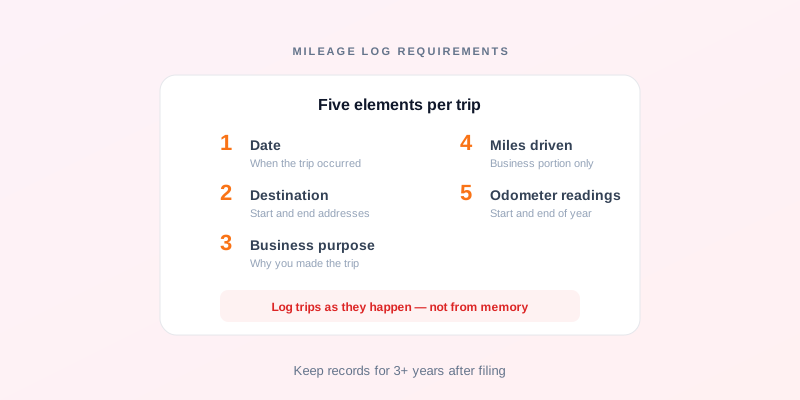
Documentation is the backbone of any vehicle deduction. The IRS requires contemporaneous records, meaning you log each trip at or near the time it occurs rather than reconstructing a log weeks or months later.
A compliant mileage log must capture five elements for every trip:
- Date of the trip
- Destination or starting and ending addresses
- Business purpose of the trip
- Miles driven for the business portion
- Odometer readings at the beginning and end of the tax year
If you use the actual expenses method, keep receipts for every vehicle-related cost: fuel, insurance, repair invoices, tire purchases, registration fees, and lease or loan statements.
Paper logbooks satisfy the IRS requirement on paper, but they are difficult to maintain consistently and easy to lose. A mileage tracking app creates a GPS-verified, timestamped log automatically and generates tax-ready reports that hold up under audit scrutiny.
Reporting the deduction on your tax return
Where you claim your personal vehicle business use deduction depends on your tax situation:
- Sole proprietors and single-member LLCs: Report on Schedule C (Profit or Loss from Business). Vehicle expenses go on line 9 (Car and truck expenses), and you fill out Part IV for vehicle information. Our Schedule C mileage deduction guide walks through every line.
- Partnerships and S-Corps: The deduction typically flows through the entity return or is handled via an accountable-plan reimbursement. Unreimbursed amounts may be deductible on the individual partner or shareholder return.
- Qualifying employees: File Form 2106 (Employee Business Expenses) and attach it to your individual return.
Whichever form you use, retain your mileage log and all supporting records for a minimum of three years after the filing date. The IRS audit window covers that period, and a disallowed deduction can result in additional taxes, penalties, and interest.
Strategies to increase your deduction
Run both calculations. Before filing, compute your deduction under both methods to see which is higher. The difference can be hundreds or even thousands of dollars.
Log every trip, no matter how short. A three-mile drive to the office supply store is still deductible. Over the course of a year, small trips compound into meaningful mileage.
Qualify your home office. A dedicated workspace that meets IRS guidelines converts your first trip of the day from a non-deductible commute into a deductible business mile. That single change can add significant mileage to your annual total.
Separate business and personal use clearly. If you own two vehicles and can designate one primarily for business, your business-use percentage rises and your deduction grows. The IRS favors clear, consistent patterns.
Track in real time. Reconstructing a log at year-end invites errors and raises audit red flags. An automated tool captures trips as they happen.
Start claiming your personal vehicle business use deduction
At 72.5 cents per mile in 2026, every unrecorded business trip is money you will not get back at tax time. A self-employed worker driving 15,000 business miles leaves $10,875 on the table without a proper log.
The simplest way to build and maintain an IRS-compliant mileage record is to automate the process. Tripbook tracks your business trips with GPS precision, categorizes them instantly, and exports tax-ready reports when you need them.
Download Tripbook and make sure every deductible mile counts.